All species › Lamiales › Bladderwort family › Pinguicula corsica
Pinguicula corsica
Corsica has one butterwort of its own, and it grows exactly where the island least resembles the Mediterranean: in the pozzines, the boggy alpine lawns around the mountain lakes, and along the headwaters of the mountain streams. Pinguicula corsica is small, yellow-green and flowers late — only when the heat in the valleys has become unbearable does it come into bloom up here.


Identification
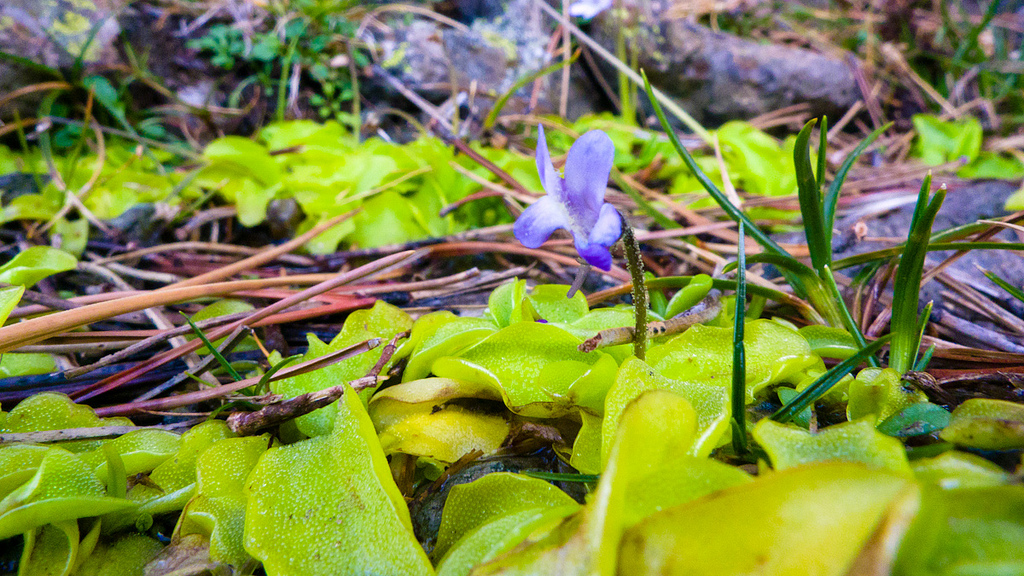
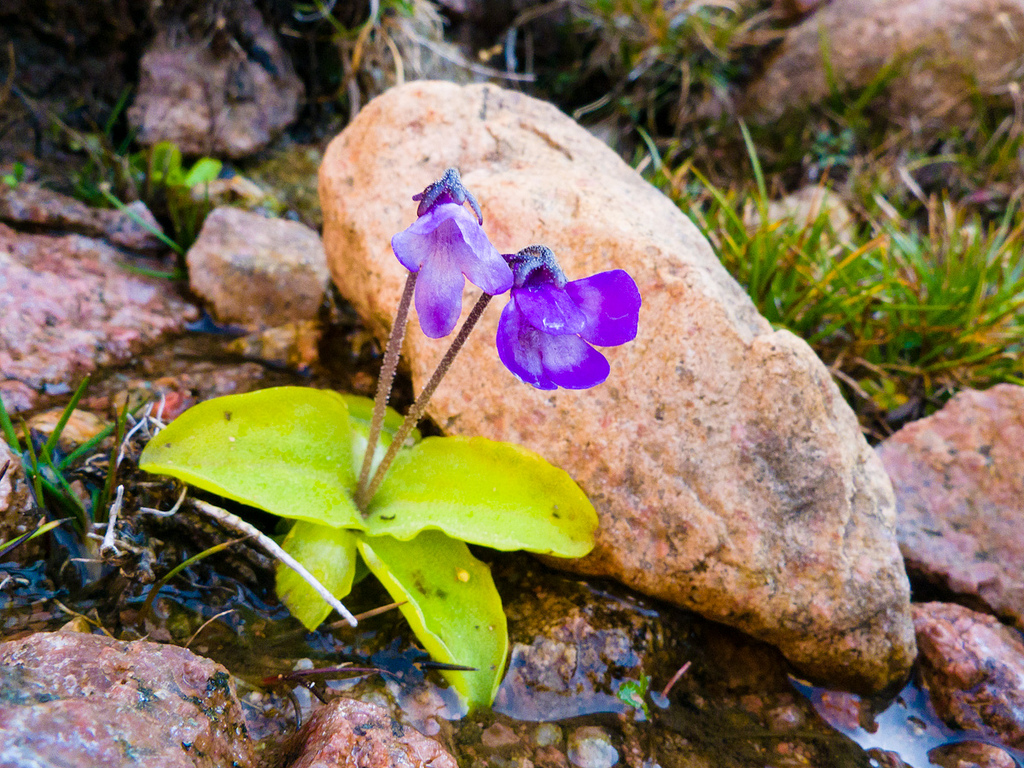
A flat rosette of ovate to oblong, entire leaves, light green to yellowish, with margins slightly curled upward. The leaf surface is densely glandular and feels greasy and sticky; the rosettes are not formed until late spring and persist into autumn. Slender glabrous scapes rise from the centre, each with one flower. The corolla is small, about ten to twelve millimetres, two-lipped, pale lilac to light violet and in some plants nearly white; the throat is paler. The spur is short, four to five millimetres, projecting straight back. Flowering is late, from June into September, and moves uphill with the summer.
Similar species
On Corsica itself there is nothing to confuse it with: this is the island's only Pinguicula. Compared with the mainland species it is smaller than P. vulgaris, and the flower is lighter and paler than in P. leptoceras, whose corolla is dark blue-violet and measures one and a half to three centimetres including the spur. The short four-to-five-millimetre spur rules out the long-spurred Mediterranean species of the P. hirtiflora type. Out of flower, small yellow-green rosettes in a boggy mountain lawn on Corsica are already enough.
The trap and how it works
Glue without hurry. The upper leaf surface carries thousands of stalked glands with a sticky droplet and, between them, sessile glands that deliver digestive enzymes only once something is lying on them. A midge or gnat that settles sticks fast; struggling spreads the mucilage and brings more glands into contact with the prey. Over the following days the leaf margin rolls slowly towards the catch, so the digestive fluid stands in a shallow bowl. In the pozzines, where the air over the wet turf is thick with midges at dawn, supply is generous, and by autumn an old leaf is littered with black insect remains.
Habitat and ecology
The boggy, short-cropped lawns around the Corsican mountain lakes and the edges of streams and springs, at roughly eleven hundred to two thousand metres. These are the pozzines: a dense, peaty sward over ground kept wet all season by meltwater and seepage, with low sedges, rushes and mosses. Unlike most butterworts in this guide this is not a lime plant — the rock of the Corsican high mountains is largely granite — and the water is soft and acid. The sites are sunny and open; the species tolerates neither shade nor rank growth.
Distribution and elevation
Corsica only, and there only the mountains. The species is a strict island endemic: its entire world range lies within the island's central massif, from the surroundings of the large mountain lakes to the high stream valleys. It does not occur on mainland France or in Italy, nor on Sardinia, whose own butterwort belongs to a different group. P. corsica is thus a good example of how island mountains hold species: since the last glaciation the Corsican high country has been a cool, wet island inside a warm, dry one.
- Recorded (one-degree cells)
Forms and variation
No wild varieties are recognised. What stands out is the flower's colour range: within one lawn, plants with a clearly lilac corolla stand beside plants that flower almost white, and older accounts even mention yellowish tints. That spread is most likely plain individual variation rather than grounds for named forms. Plant size also varies strongly with wetness: at the edge of a spring the rosettes grow generous, on a thin sward above a scree they stay small. Natural hybrids are impossible, since there is no second species on the island.
Where and when to see it
Go in July or August to the high plateaus around the mountain lakes, when the pozzines are green and the rest of the island is yellow. Walk along the edge of the wet lawn rather than across it — the sward is fragile and the plants sit precisely on the transition to running water. Kneel and look from the side: the pale flower stands only a few centimetres above the sedges and disappears completely from above. Early in the morning, with dew and raking light, the glandular coating of the rosettes betrays whole groups at once.
Conservation status
The species counts as of least concern. That owes much to the Corsican high country lying largely within the regional nature park and to the pozzines being impossible to reclaim or build on. Even so, an island endemic with a range this size is vulnerable by definition: all populations lie within one massif and depend on the same meltwater and seepage regime. The live concerns in the area are trampling by grazing stock and by walkers on the busy high routes and, in the longer term, the drying of the highest peaty lawns under warmer, less snowy winters. CITES does not apply.
Scientific name
Pinguicula corsica | Bernard & Grenier, 1853
Described by Célestin Bernard and Jean Charles Grenier in 1853. The species is endemic to the island of Corsica and has not been found growing wild anywhere else. The species name corsica refers directly to Corsica, the only island where this species grows.
World Checklist of Vascular Plants (WCVP), via Plants of the World Online (POWO), Royal Botanic Gardens, Kew.