All species › Lamiales › Bladderwort family › Pinguicula crystallina
Pinguicula crystallina
The butterwort of Cyprus is a plant of cool running water in a country that has little to spare. Pinguicula crystallina grows on wet rock beside springs, streams and small waterfalls in the Troodos and at a handful of sites in Anatolian Turkey, and it flowers — unlike almost any other European butterwort — through much of the year, as long as the water keeps running.
Identification
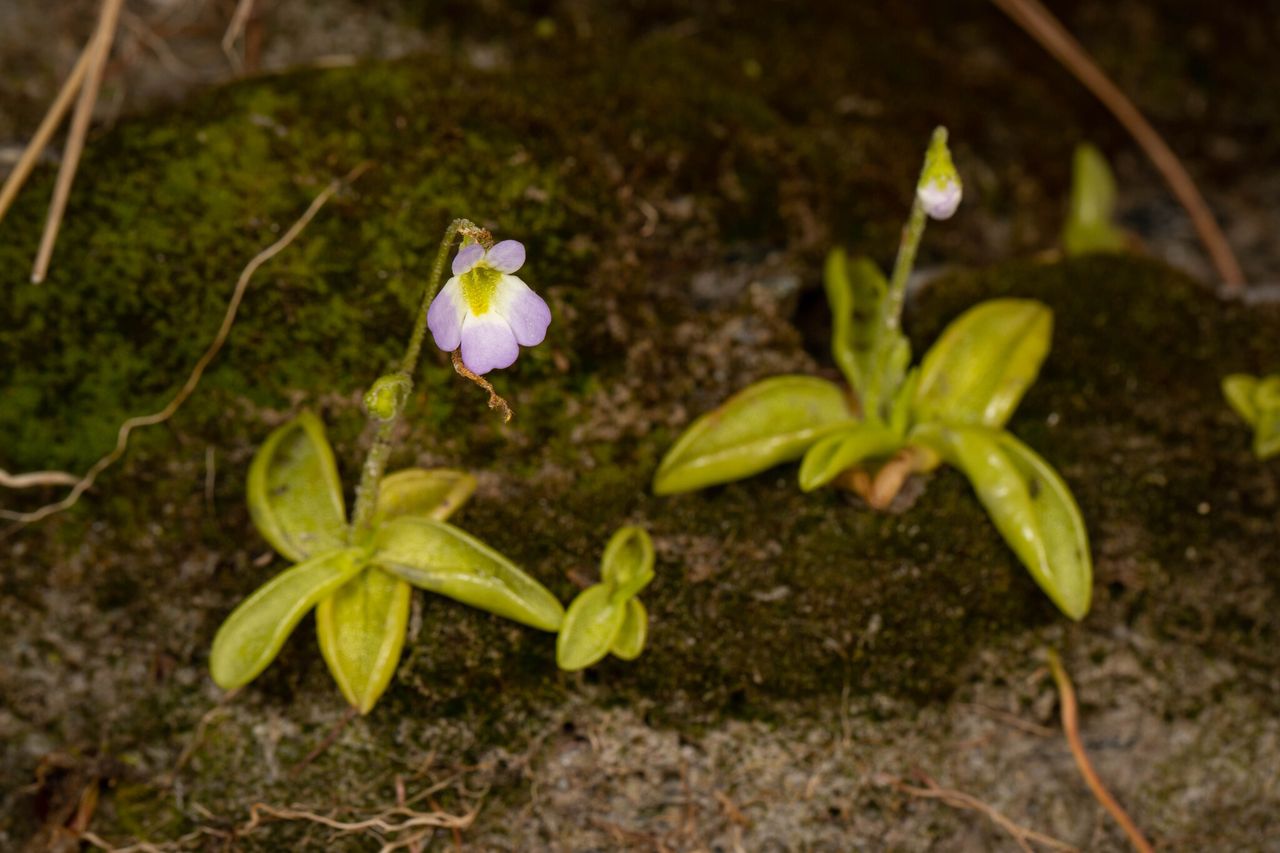
A small rosette of broadly elliptic to oblong leaves 15 to 25 mm long, occasionally 40, with distinctly upturned margins and a blunt or notched tip. The leaf is light green, glistens with glandular droplets and feels greasy. Scapes are 30 to 60 mm, in good conditions to 100. The flower is white with a violet-blue tip to each corolla lobe, as though brushed on; yellow hairs line the throat. The whole corolla is 8 to 15 mm long, exceptionally 21, and the spur is notably short: 4 to 6 mm, narrowly cylindrical, about a third of the corolla length. That proportion is what makes the species recognisable.
Similar species
The nearest relative is Pinguicula hirtiflora, very similar but larger in every part: leaves 30 to 60 mm, a corolla of 16 to 25 mm and above all a much longer spur of 7 to 13 mm. When in doubt, measure the spur against the rest of the flower: in P. crystallina it is about a third, in P. hirtiflora half or more. In south-west Anatolia Pinguicula megaspilaea may also come into play, but its strikingly long, linear summer leaves of 70 to 120 mm set it apart at a glance.
The trap and how it works
A classic flypaper trap. The leaf bears stalked glands with a clear mucilage droplet — the name crystallina refers to that glittering coat — and between them sessile glands that release digestive enzymes once prey is lying on them. Midges, gnats and other small flying insects from the permanently humid air around a spring stick fast. Over the following hours the leaf margin curls a little further inward so the digestive fluid does not run off the sloping rock. Because the plant sits on bare, flushed stone, this is very nearly its only source of nitrogen; the rock itself offers little.
Habitat and ecology
Permanently wet rock, preferably with water running over it: dripping cliffs at springs, the spray zone of small waterfalls, wet margins of mountain streams. The species is not fussy about rock type — both limestone and serpentine are occupied — but it is fussy about water: drying out is not tolerated. It grows lithophytically, rooted straight onto the rock in a thin skin of moss and weathered debris. On Cyprus the range runs from a couple of hundred metres to nearly two thousand, the highest sites lying in the Troodos massif.
Distribution and elevation
Cyprus and Turkey. On Cyprus the species is native but not endemic, scattered through the island's mountain country, most sites between 800 and 1,640 m and the odd one above 1,900. In Turkey it occurs in south-west and south-east Anatolia, where sites as low as 250 m have been recorded. It is thus an eastern Mediterranean species with a fragmented range: wherever it grows it grows at water, and between the water it is entirely absent.
- Recorded (one-degree cells)
Forms and variation
No wild varieties are recognised, but the taxon has a tangled history: P. hirtiflora was long treated as a subspecies of P. crystallina, and the two names have been used interchangeably in the literature. The recent revision separates them on spur length, leaf size and corolla size. What varies within the species is mainly stature: plants in the full spray of a waterfall grow larger than those on a barely damp wall, and the corolla may then reach 21 mm. The violet tips to the corolla lobes vary in size and can be almost absent in some plants.
Where and when to see it
The flowering season is exceptionally long, so the window is wide — but spring offers the best chance, when the mountain streams are still high and the walls are dripping everywhere. Follow a stream upward to where it emerges from the rock and search the wet, shaded face beside the fall. Look at eye level and above: the rosettes often sit above the path, wedged into a crack or on a moss cushion. The small white flower with its blue tips is obvious close up, but from five metres it vanishes entirely against wet stone.
Conservation status
The species has not been assessed for the global Red List, so there is no international category; CITES does not apply. On Cyprus it has been assessed nationally, and there it counts as Vulnerable, on the grounds of its few localities: the criterion used rests on a very restricted occupied area that a single event could hit. The threats typical of spring habitats are the same everywhere: capping and diverting spring water for drinking supply and agriculture, falling water tables in longer droughts, and trampling around popular waterfall and spring sites. Less is known about the Turkish populations.
Scientific name
Pinguicula crystallina | Smith, 1806
Described by James Edward Smith in 1806, around the time of his “Florae Graecae Prodromus”. The species occurs in the eastern Mediterranean: Cyprus, Turkey, Crete and the rest of Greece. The species name crystallina is Latin for "crystalline, glass-clear" and refers to the glistening, droplet-shaped mucilage on the leaves.
World Checklist of Vascular Plants (WCVP), via Plants of the World Online (POWO), Royal Botanic Gardens, Kew.