All species › Lamiales › Bladderwort family › Pinguicula hemiepiphytica
Pinguicula hemiepiphytica
The name says it: this is a butterwort that also grows in trees. Pinguicula hemiepiphytica sits in the moss cushions on trunks and branches in the cloud forest of the Sierra de Juárez in Oaxaca, and besides that on limestone rocks and mossy banks. The species was described in 1991 by Zamudio and Rzedowski, and is one of the few Mexican carnivorous plants you have to look up to find.
Identification
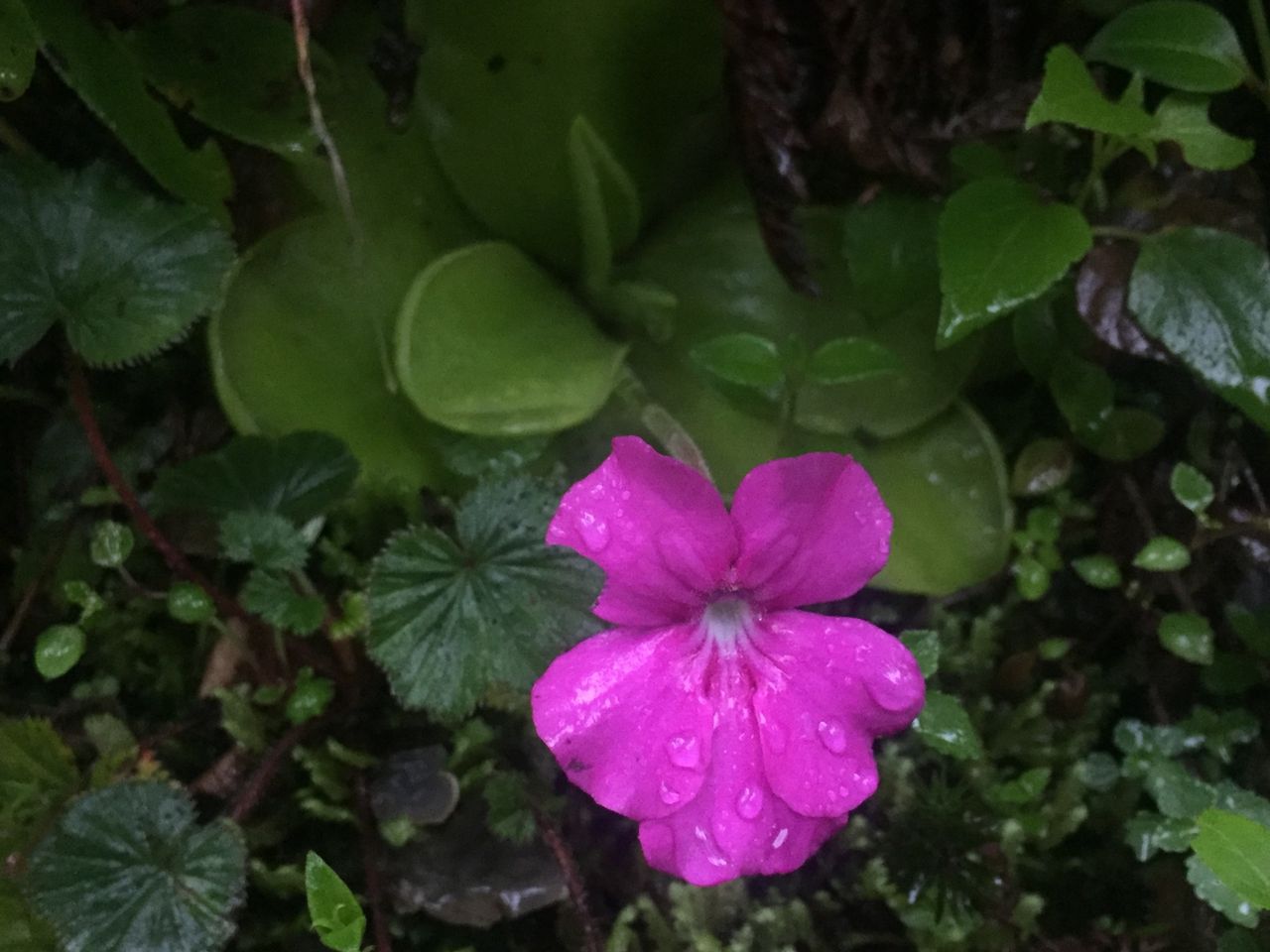
In the dry season there is a narrow winter rosette of leaflets 10 to 20 mm long and only 1 to 6 mm wide. The summer rosette is far more substantial: leaves 20 to 70 mm long and 12 to 55 mm wide, spread flat with a dense glandular coating. One to three scapes rise per plant. The flower is large and variable: 35 to 80 mm including the spur, violet-purple to crimson with a strikingly white throat; the upper lip measures 10 to 19 mm, the lower lip lobes 8 to 21 mm. The spur is cylindrical to subulate, 12 to 30 mm long, straight or curved. That wide spread in flower size is unusual in the genus and makes identification on measurements alone unreliable.
Similar species
The growing place is the strongest character: no other Mexican butterwort is found so regularly as an epiphyte on mossy trunks. On rock, confusion with Pinguicula moranensis is possible, which grows in the same mountains; that generally has a more evenly coloured flower without the sharply defined white throat, and a different leaf shape. P. laueana, also from Oaxaca, has a red flower too, but with a four-centimetre spur and no white throat. In doubt, the combination of white throat and short to medium spur decides.
The trap and how it works
A flypaper trap on a broad flat leaf. The stalked glands carry a clear droplet and hold the prey; the sessile glands between the stalks supply the digestive enzymes as soon as contact is made. The leaf margin then rolls over the prey, so the fluid stays in a shallow bowl. For a plant sitting on a trunk or branch that retention matters: there is no soil to make up the shortfall. In return, prey pressure in cloud forest is high — midges, gnats and small flies occur in clouds, and older leaves lie covered with them.
Habitat and ecology
Cloud forest on the northern slopes of the Sierra de Juárez, between about nineteen hundred and twenty-three hundred metres (B1). The plants grow on steep moss-covered banks, on limestone rocks and as epiphytes in the moss cushions on trunks and thick branches (R1, R2). It is a cool, almost permanently humid environment where mist hangs against the slope for most of the year; the moss cushions hold that moisture and form the only rooting medium the plant needs. Where the moss goes — after logging, fire or drying — the species goes with it.
Distribution and elevation
Endemic to Mexico and as far as known confined to the Sierra de Juárez in Oaxaca, with the classic sites along the road from Ixtlán to Valle Nacional. Our species list names Oaxaca, which is correct. The range is small and coincides with the cloud-forest belt on the northern flank of the range; below and above that belt the species is absent. That leaves it dependent on a narrow strip which is moreover sensitive to changes in the mist regime.
- Recorded (one-degree cells)
Forms and variation
The species is strikingly variable in flower size and colour — from violet-purple to crimson, and from three and a half to eight centimetres long — but that variation is gradual and no wild varieties are distinguished. Plants growing as epiphytes usually stay smaller than those on banks, which has more to do with limited rooting space than with heredity. Natural hybrids with P. moranensis have been reported from the same range; intermediates with a less sharply defined throat therefore deserve attention.
Where and when to see it
Go in spring, when most plants are in flower, and search along the road between Ixtlán and Valle Nacional where the cloud forest comes right to the verge. Look both down at the mossy banks and up at the trunks: the epiphytic specimens sit at eye level and above, often in the thickest moss on the north side of a trunk. Binoculars help. On misty mornings the glandular coating is heavy with condensation and lights up as soon as any sun breaks through.
Conservation status
Not assessed for the global IUCN Red List and not listed in CITES. What is known points to a species with a small range in a threatened vegetation type: the cloud forest of the Sierra de Juárez is under pressure from logging, road widening and conversion to farmland, and epiphytes are the first to go when old trees are lost. The species is also attractive to collectors because of its large, colourful flower. Published population figures are lacking, so no trend can be supported; here, an empty file emphatically does not mean that nothing is wrong.
Scientific name
Pinguicula hemiepiphytica | Zamudio & Rzedowski, 1991
Described by Sergio Zamudio and Jerzy Rzedowski in 1991, in Acta Botanica Mexicana 14: 23–32. The type area lies in the Sierra de Juárez, in the cloud forests of the Mexican state of Oaxaca. The species name hemiepiphytica combines the Greek hemi- ("half") and "epiphytic" and refers to this species' growth habit, one of the few Pinguicula species that grows partly as an epiphyte on trees.
World Checklist of Vascular Plants (WCVP), via Plants of the World Online (POWO), Royal Botanic Gardens, Kew.