All species › Lamiales › Bladderwort family › Pinguicula filifolia
Pinguicula filifolia
Almost nobody seeing Pinguicula filifolia for the first time thinks of a butterwort. Instead of a flat rosette of fleshy leaves there is a tuft of narrow, almost thread-like leaves standing upright out of white sand — a shape found nowhere else in the genus. The plant belongs to the white-sand savannas of western Cuba and the Isla de la Juventud, it is short-lived, and outside the rains it vanishes so completely that months later the same spot shows nothing at all.
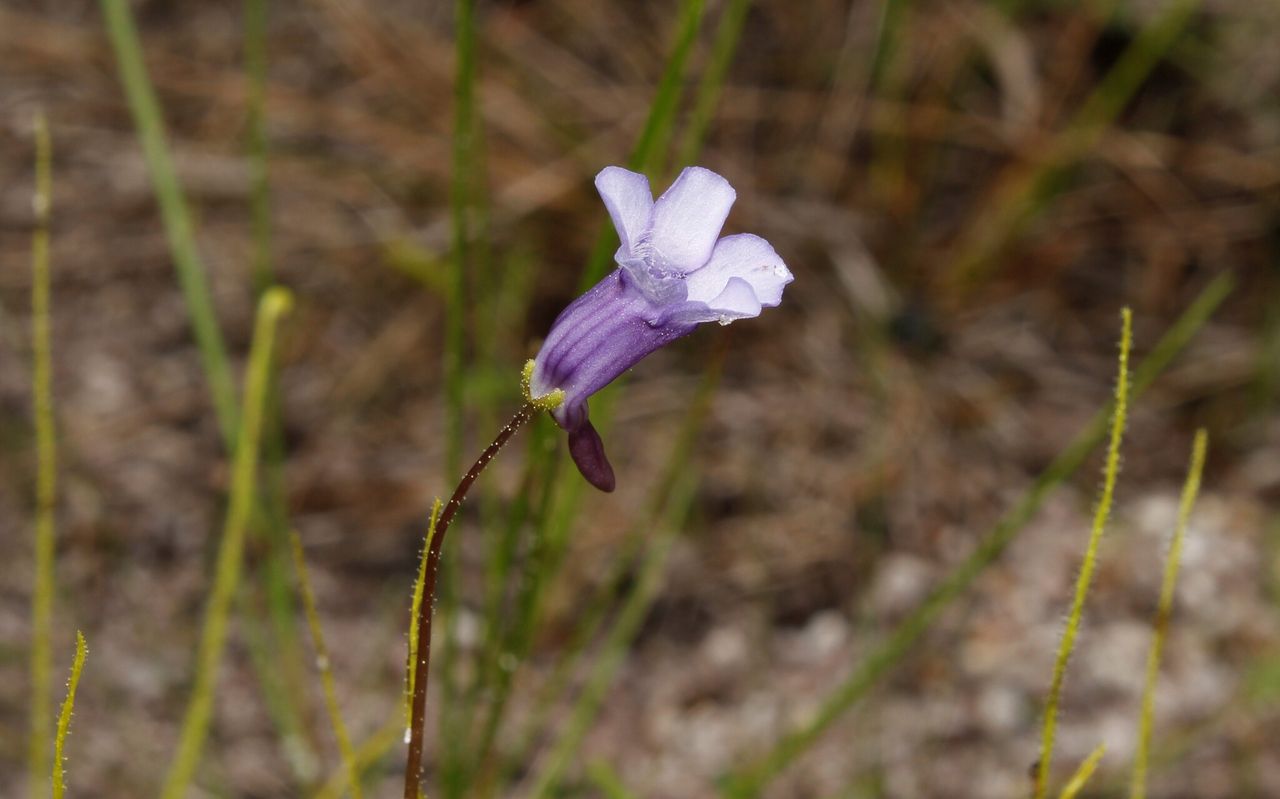
Identification
The leaves are linear to filiform, erect, often a few centimetres long, pale green and set along their whole length with stalked glands that glitter in the sun. They stand in a loose rosette that reads more like a tuft of grass than a butterwort. The scapes are slender and glandular-hairy and each carries a single flower. In the typical subspecies that flower is violet to purple; in subsp. alba, known only from the far west of Pinar del Río, it is white. The fruits are small capsules full of dust-fine seed. Because the plant is short-lived you usually meet all stages at once: seedlings, plants in flower, and the dried scapes of last season.
Similar species
Confusion with another carnivorous plant is barely possible in the field: no other butterwort has thread-like leaves. The real risk is the opposite — failing to see it at all and writing it off as a grass or a young sedge. So use the light: the glandular droplets along the leaves give the plant away at once. The same white-sand savannas hold sundews (Drosera) and bladderworts (Utricularia), which have clearly stalked traps with long tentacles, or no glands above ground at all. Within the genus the only real question is which subspecies you are looking at, and flower colour answers it.
The trap and how it works
The trapping principle is the standard butterwort one, only the surface is distributed differently. In an ordinary rosette the glandular coat lies like a carpet on the ground; here it stands upright, spread over a bundle of slender leaves, so the plant mostly catches insects flying through the vegetation rather than landing on it. Stalked glands supply the sticky droplet, sessile glands the digestive enzymes. A trapped midge is not enveloped by an inrolling margin as in broad-leaved species — the leaf is far too narrow for that — but stays where it stuck, and the digestive fluid drains away along the surface. The catch is correspondingly small: midges, aphids, small flies.
Habitat and ecology
The species grows in seasonally wet savanna on white quartz sand, the soil Cuba calls arenas blancas: extremely nutrient-poor, strongly acid, waterlogged in the rains and bone-dry afterwards. Type material of subsp. alba comes from open pine woodland on that white sand close to the coast, only a few metres above sea level. This is a habitat where almost all nutrients sit in the living biomass rather than in the soil, and where carnivory therefore pays. The plant depends completely on open ground; as soon as shrubs close the savanna it disappears. The savanna also works to a rhythm the plant has adopted completely: germinate, grow and flower in the wet months, then set seed and vanish. A site is therefore less a place where the plant stands than a place where it returns each year from the seed bank.
Distribution and elevation
Endemic to Cuba and restricted there to the west: Pinar del Río province and the Isla de la Juventud. Collections come from, among others, the Los Indios ecological reserve on the Isla de la Juventud and the coastal savannas of Los Pretiles in Pinar del Río. Elevation is effectively nil — labelled finds sit at four to five metres above sea level. The range is thus small and fragmented across a handful of savanna remnants, each with its own history of drainage, planting and fire.
- Recorded (one-degree cells)
Forms and variation
Two subspecies are recognised. The typical one has violet to purple flowers and is known from the Isla de la Juventud and parts of Pinar del Río. Subsp. alba, described in 2014, has white flowers and an extremely restricted distribution in the far west of Pinar del Río. Beyond that, the main variation is in the length and number of the thread-like leaves, which track the weather closely: in a wet month the tufts are larger than in a dry one. Cultivated selections fall outside this guide.
Where and when to see it
Go in the rainy season, when the savanna stands in shallow water; outside it there is literally nothing to see. Search the lowest ground of the open savanna, the edges of temporary pools and bare sand between the tussocks, and get down on your knees — the plant is thin and low and vanishes into the grass. Early raking light is the best ally: it lights up the droplets along the thread-leaves. Bear in mind that many sites lie inside protected reserves for which permission is required. Take the trouble to come back: because the plant is short-lived, a good year may produce dozens of individuals where nothing stood the year before. So record not only what you find but also where you find nothing.
Conservation status
The species has not been assessed for the global IUCN Red List and is not listed in CITES. What is certain is that this is a Cuban endemic with a small number of known sites in a habitat — white-sand savanna — that has declined sharply on Cuba itself through drainage, conversion to pine plantation and altered fire regimes. Subsp. alba was explicitly characterised as extremely restricted in distribution when described in 2014. The absence of a global assessment therefore says nothing about vulnerability, only that the file has not yet been opened.
Scientific name
Pinguicula filifolia | Wright ex Grisebach, 1866
Described by Charles Wright, published by August Grisebach in 1866. The type area lies in western Cuba, from Pinar del Río province to Isla de la Juventud. The species name filifolia combines the Latin filum ("thread") and folium ("leaf") and refers to this species' thin, thread-like leaves.
World Checklist of Vascular Plants (WCVP), via Plants of the World Online (POWO), Royal Botanic Gardens, Kew.