All species › Lamiales › Bladderwort family › Pinguicula jarmilae
Pinguicula jarmilae
A butterwort that only received a name in 2007 and was then described twice over: first as Pinguicula jarmilae, a year later again as P. chuquisacensis, before anyone realised the two were the same plant. It grows on a single sandstone wall in the Bolivian highlands, at some two thousand four hundred metres, where cloud drifts against the rock every afternoon and the stone never dries out completely.
Identification
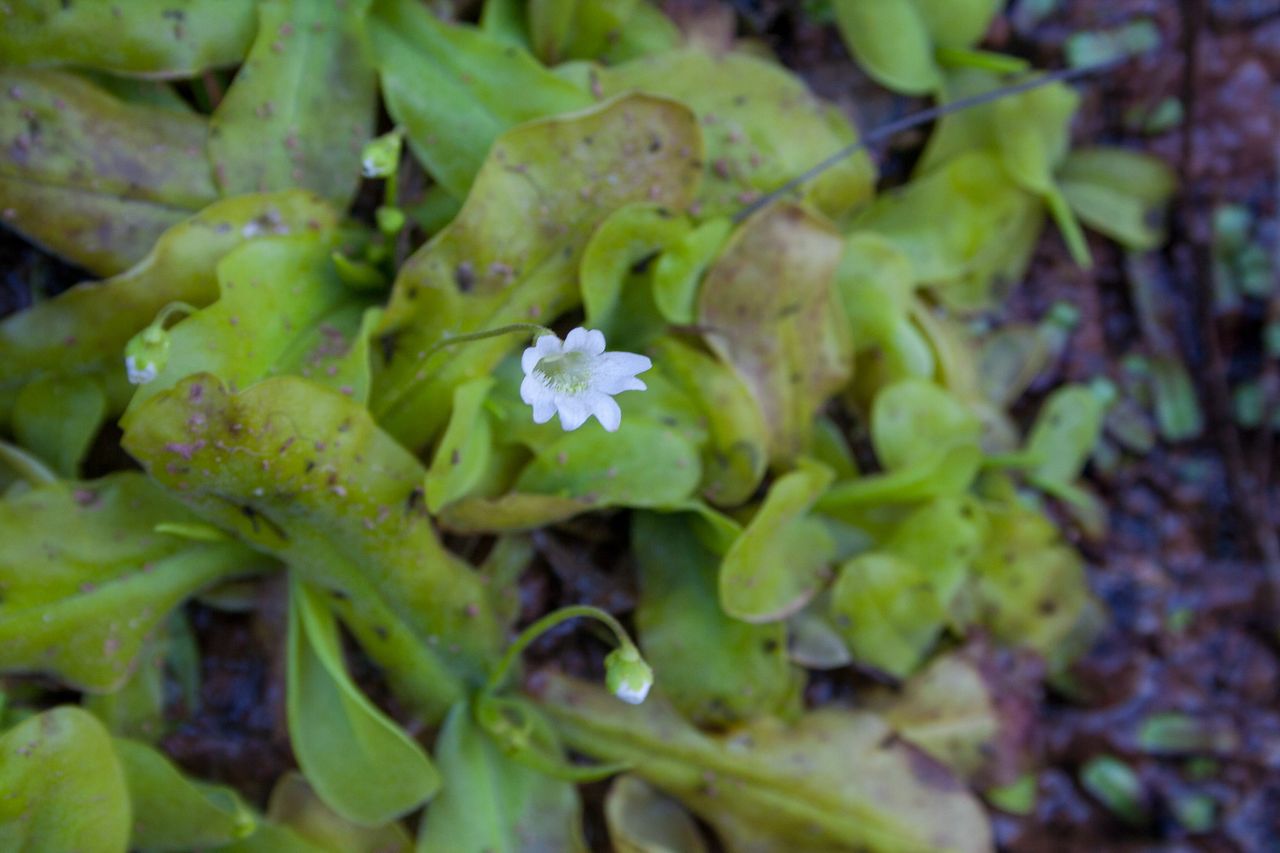
A small, somewhat ascending rosette of four to six oblong to ovate-oblong leaves lying flat against moss or wet stone. The upper surface carries the usual two kinds of gland and glistens with moisture; the leaf margin is slightly inrolled. The species forms no winter bud — it stays in leaf year round, which fits a site without real frost but with a pronounced wet and dry season. Slender one-flowered scapes rise from the centre. The flower is small: thirteen to fifteen millimetres long including the spur, two-lipped, with a short blunt spur of two to three millimetres. Flowering is in July; in November fruit is still on the plant while flowers are also open, so the effective flowering period runs longer than that single month.
Similar species
Within Bolivia the main risk of confusion is with Pinguicula involuta, which also grows on mossy rock in the same country but sits higher, between two thousand seven hundred and three thousand four hundred metres, and has still smaller flowers of ten to twelve millimetres with a markedly curved spur. Molecular work places this species close to P. involuta and to P. calyptrata from the northern Andes; together the three form the South American core of the genus. For now the most reliable distinction is geographical: a butterwort on sandstone in the Chuquisaca highlands is almost certainly this species, because P. involuta has not been found there.
The trap and how it works
A flypaper trap of the ordinary butterwort kind, but running without a closed season. The leaf carries stalked glands holding a clear, tenacious droplet, and sessile glands that release digestive enzymes only once something is lying on them. Small insects landing on the glossy surface stick fast; their struggling brings them into contact with more glands, and the leaf margin then rolls slowly towards the prey so that the digestive fluid stands in a shallow dish instead of running away down the steep rock. On a vertical face that is not a detail but the difference between digesting and losing a meal. Because the plant forms no winter bud it catches all year; in the misty months the supply of small flies on the rock wall is at its highest.
Habitat and ecology
A wet, half-shaded sandstone wall in the cloud belt of the Bolivian highlands (R1) at about two thousand four hundred metres, where the rock is acid and the plant depends on seeping water and fog rather than on soil. The wall lies in the transition between cloud forest and open montane vegetation (B1), with bare, open patches free of competition. Nutrients are barely present in such a place: the water runs across the surface and takes whatever is loose with it. That is precisely what makes catching insects pay here.
Distribution and elevation
The species is known from a single valley in the department of Chuquisaca in southern Bolivia and is therefore endemic to that country. All known plants stand together on one rock formation; strictly speaking there is no distribution to speak of. At roughly two thousand four hundred metres the elevation is low for an Andean butterwort — most South American species sit higher, in páramo or puna. Whether further populations exist elsewhere in the Bolivian highlands is an open question; the region is poorly surveyed botanically and comparable sandstone walls are not rare there.
- Recorded (one-degree cells)
Forms and variation
No wild varieties or subspecies are recognised, which is hardly surprising for a species known from a single population. The main variation in the file is one of names rather than of plants: the 2008 description of P. chuquisacensis rests on material that proved indistinguishable from P. jarmilae, and that name is now treated as a synonym. Anyone consulting older literature or old herbarium labels will therefore meet the species under two names. No natural hybrids are reported; there is no second butterwort in the area to cross with.
Where and when to see it
This is not a species you meet by walking about. Searching in the Bolivian highlands means concentrating on damp sandstone faces on north-facing slopes in the cloud belt, where mosses and ferns form a closed layer and water runs down the stone all day. Look low, just above the base of the wall and under overhangs that break the rain. July is the flowering month, but the rosettes are present year round. Backlight helps: the glandular droplets then light up against the dark, wet rock.
Conservation status
The species has not been assessed for the global IUCN Red List, so it carries no international category, and it is not listed in CITES. What is known is worrying: the authors who described P. chuquisacensis — now regarded as the same plant — proposed treating it as Critically Endangered, on the grounds of a single known site, a very small number of mature individuals and a habitat that hangs on one rock wall. A single fire, a road cut or a shift in rainfall could affect the entire world population. The absence of a formal assessment here mainly means that nobody has yet done the official arithmetic, not that there is no problem.
Scientific name
Pinguicula jarmilae | Halda & Malina, 2007
Described by Josef Jaroslav Halda and Marcel Malina in 2007, in Acta Musei Richnovensis, Sectio Naturalis 14(4): 110. The type material had been collected illegally in the wild; once this became known, other authors (Beck, Fleischmann, Huaylla, Müller & Borsch) published a second name, Pinguicula chuquisacensis, in 2008 in Willdenowia 38: 201–212, based on legally collected material — but since P. jarmilae was validly published first, that name has priority. The species occurs in the Andes of Bolivia, at altitudes of roughly 2100 to 2500 metres. The species name honours a woman named Jarmila; her precise identity could not be established with certainty.
World Checklist of Vascular Plants (WCVP), via Plants of the World Online (POWO), Royal Botanic Gardens, Kew.