All species › Lamiales › Bladderwort family › Pinguicula hirtiflora
Pinguicula hirtiflora
Of all Mediterranean butterworts this is the most widespread: Pinguicula hirtiflora runs from southern Italy through Albania and Greece into Turkey, everywhere in the same way — clinging to a dripping limestone wall, along a stream, or even in living sphagnum. From sea level to seventeen hundred metres, as long as the water keeps running.


Identification
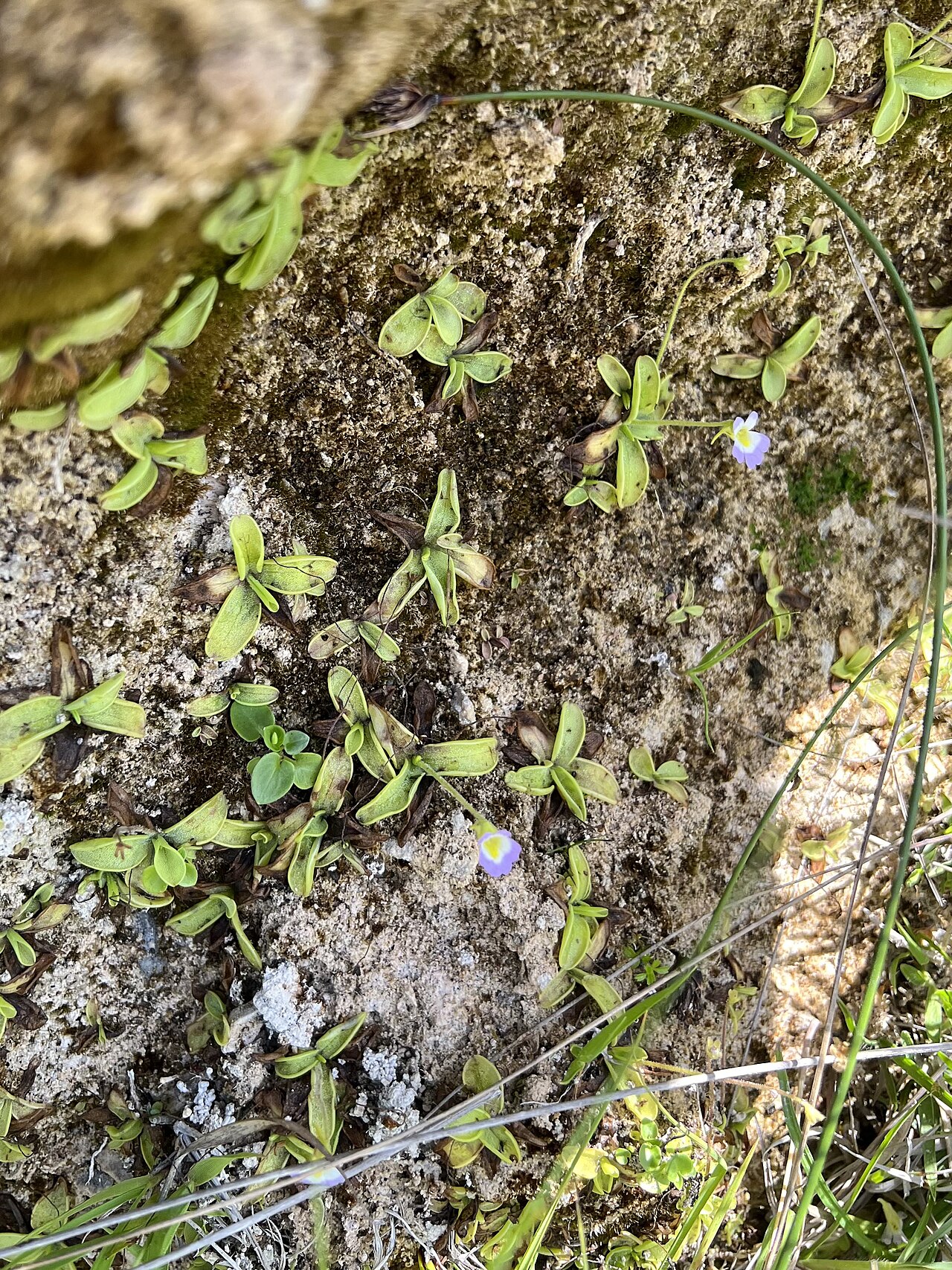
A rosette of broadly elliptic to obovate leaves 30 to 60 mm long and 15 to 25 mm wide, with inrolled margins and a blunt or notched tip; large specimens reach 40 mm across. The leaf is yellow-green, glistens with glandular droplets and feels greasy. The flower is white, with a violet-blue tip to each corolla lobe and yellow hairs in the throat — the epithet refers to that hairiness. The corolla with spur is 16 to 25 mm, exceptionally 32, and the spur itself is 7 to 13 mm, so roughly half the flower length or more.
Similar species
The closest relative is Pinguicula crystallina of Cyprus and Turkey, smaller in every part: leaves 15 to 25 mm, a corolla of 8 to 15 mm and above all a much shorter spur of 4 to 6 mm, about a third of the corolla length. The two were long treated as one species with two subspecies. There is also a long-spurred variety in the Balkans whose spur can equal the rest of the flower, and in Greece and south-west Turkey P. megaspilaea occurs, with strikingly long, linear summer leaves.
The trap and how it works
A flypaper trap that in this climate can work year-round. The leaf bears stalked glands with an adhesive droplet and sessile glands releasing digestive enzymes once prey is lying on them. The catch is varied — midges, gnats, small beetles, springtails — because the species occupies such different habitats, from the spray zone of a waterfall to a sphagnum cushion. After a catch the leaf margin rolls over the prey so the digestive fluid stands in a shallow dish. On flushed limestone walls in particular, where no nutrient stays put, that is the only way to obtain nitrogen.
Habitat and ecology
Permanently wet ground in the widest sense: dripping limestone cliffs, calcareous seepages, stream margins, wet serpentine rock and even bog-like places with living sphagnum. The species is thus far less fussy about substrate than most butterworts in this guide — limestone, serpentine and acid peat are all occupied — but utterly dependent on a constant water supply. Elevation runs from sea level to seventeen hundred metres, the lowest sites at the coast and the highest in the Greek and Albanian mountains.
Distribution and elevation
Southern Europe: southern Italy (Campania and Calabria), Albania, North Macedonia, Greece and adjacent Turkey, with naturalised populations besides in France, Switzerland and the Czech Republic. It is thus the only species in this group to have established itself outside its native range, most likely from botanic gardens. Our own species list names Italy, Albania, Greece, the north-western Balkans and Turkey; the naturalised central European occurrences are not included there and are added here.
- Recorded (quarter-degree cells)
Forms and variation
Unlike most species in this guide, wild varieties are recognised here. Besides the ordinary form there is a variety with much smaller leaves, barely inrolled margins, entirely rounded corolla lobes and an exceptionally long spur of 13 to 20 mm that can equal or exceed the rest of the flower; those plants grow on damp calcareous meadows and seeping slopes in Albania and on Mount Olympus in Greece. White-flowered variants have also been reported from southern Italy. The species has 28 chromosomes.
Where and when to see it
In this climate spring is the best time, but in the mountains flowering runs on into summer. Always search at water: follow a stream upward to its source, watch for dark wet bands on a limestone face and check the spray zone of small waterfalls. The rosettes often sit above eye level. The small white flower with its blue tips is obvious close up but vanishes against wet stone from a few metres, so come close or use binoculars. Do not walk on sphagnum cushions the species grows in.
Conservation status
The species counts as of least concern, which is plausible for a range reaching from Italy to Turkey and sites from sea level to seventeen hundred metres. Nationally the picture differs: in Italy the species is under pressure because the spring habitats of Campania and Calabria are small and scattered and their water is captured. The same pattern applies everywhere: tapping of springs for drinking water and irrigation, falling water tables in drier summers, and trampling around popular waterfall and spring sites. CITES does not apply.
Scientific name
Pinguicula hirtiflora | Tenore, 1815
Described by Michele Tenore in 1815. The species occurs around the Mediterranean, including Italy and the Balkans, and is often confused with the closely related P. balcanica. The species name hirtiflora combines the Latin hirtus ("roughly hairy") and flos ("flower") and refers to the hairiness of the flower stalk and calyx.
World Checklist of Vascular Plants (WCVP), via Plants of the World Online (POWO), Royal Botanic Gardens, Kew.