All species › Lamiales › Bladderwort family › Pinguicula ibarrae
Pinguicula ibarrae
A substantial white-flowered butterwort of the low cloud forests around Tlanchinol in Hidalgo, where the Sierra Madre Oriental drops steeply towards the Gulf and mist hangs against the slope almost daily. Pinguicula ibarrae grows there on banks of Tertiary shale, and with summer leaves up to nearly ten centimetres it is one of the larger species of the district. It was described in 2005 alongside P. martinezii, in one paper covering two new butterworts of this range.

Identification
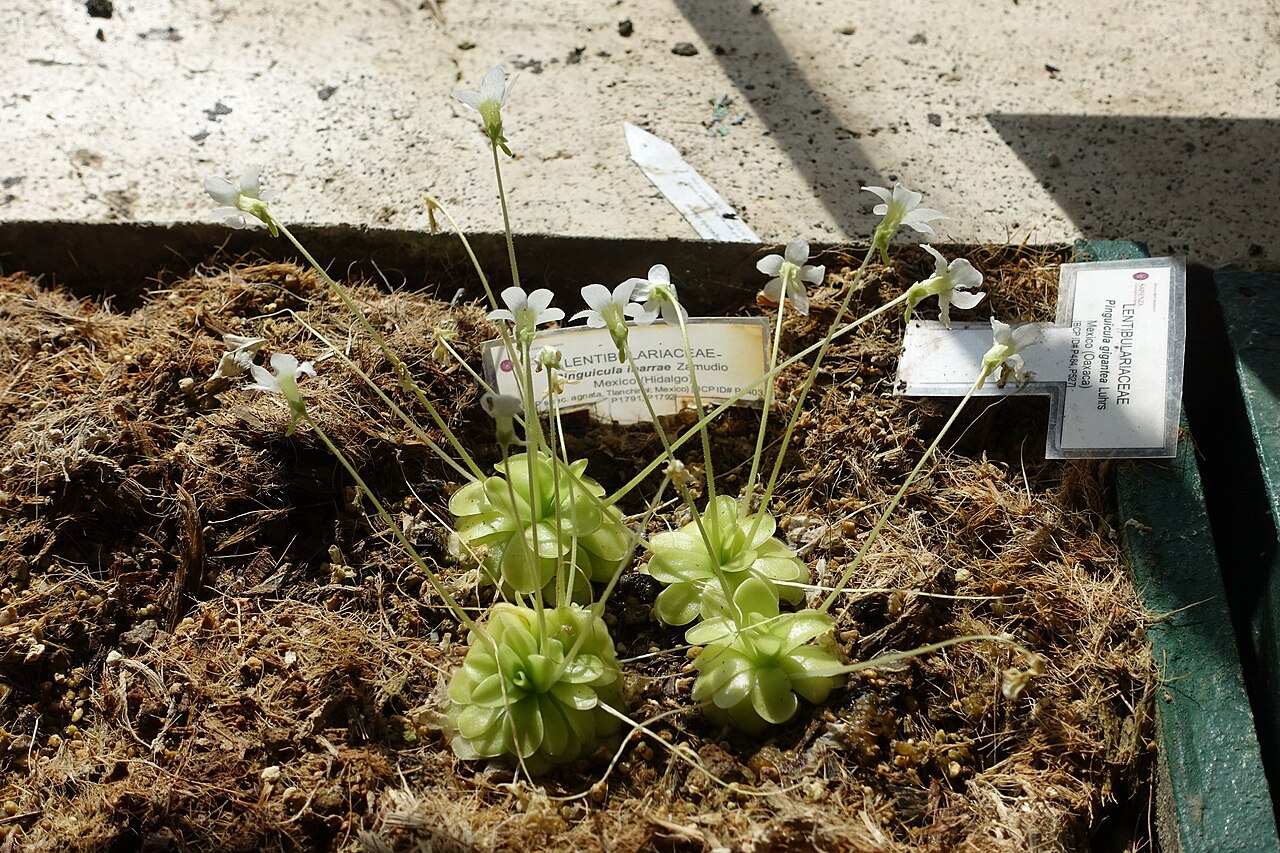
Two leaf types, as in most Mexican butterworts. The summer rosette counts (8)10 to 20 thin, obovate-spathulate leaves 35 to 95 mm long and 15 to 45 mm wide, lying flat and glistening with glandular droplets. The winter rosette consists of 11 to 20 fleshy, spathulate to elliptic leaves 12 to 25 mm long and 7 to 12.5 mm wide. Scapes reach 60 to 150 mm. The flower is white, sometimes with a lilac margin, and measures 24 to 35 mm including the spur; that spur is straight, 4.5 to 8 mm long, and meets the corolla tube at an angle of roughly 130 to 160 degrees. Flowering runs from September to March and thus falls in the coolest, mistiest months.
Similar species
The species it is compared with in the protologue is Pinguicula pilosa from Tamaulipas. P. ibarrae is larger in every part: summer leaves 35 to 95 mm against 25 to 40 mm, longer scapes and larger flowers. Decisive is the set of the spur: in P. ibarrae it is straight and stands at a shallow angle of 130 to 160 degrees to the tube, in P. pilosa it is curved and set at roughly a right angle. The two also occur in different states. Large purple-flowered species of the P. moranensis complex, which in Hidalgo grow higher on the mountain, are told by their colour and much longer spur.
The trap and how it works
The broad summer leaves offer a generous catching surface. Stalked glands carry a clear sticky droplet; the sessile glands between them release digestive enzymes as soon as prey makes contact, after which the leaf margin bends a few millimetres over the catch during the course of a day. In the humid, warm low cloud forest of Tlanchinol the insect supply is large and varied — midges, fruit flies, psyllids, small beetles — and because the plant is above ground precisely during the cooler months, it exploits a period when many other carnivorous plants are at rest. The winter rosette, which bridges the warmer, drier months, does not feed.
Habitat and ecology
Slopes and banks of Tertiary shale in the bosque mesófilo de montaña and in its transition to tropical rainforest, at 900 to 1100 m. That is strikingly low for a Mexican cloud-forest butterwort: most relatives sit above two thousand metres. The explanation lies in the position on the eastern flank of the Sierra Madre Oriental, where humid Gulf air rises against the slope and pushes the mist zone far below its usual level. The plants grow on the damp, loose shale (R1), in half shade under the canopy (B1), where water runs down the face after rain without standing.
Distribution and elevation
Endemic to the Mexican state of Hidalgo, described from the surroundings of Tlanchinol on the eastern flank of the Sierra Madre Oriental. Our species list gives Hidalgo and Veracruz; the original description names Hidalgo, and while the Tlanchinol cloud-forest belt does run on towards the Veracruz border, we found no confirmation of sites in that state. The known range is therefore small: a strip of cloud forest along one mountain flank. As that belt extends over tens of kilometres and is botanically under-explored, more populations are likely.
- Recorded (one-degree cells)
Forms and variation
No wild varieties have been described. There is variation within the known populations in the flower: from pure white to white with a clearly lilac-edged lobe, and flower size runs from 24 to 35 mm. Summer leaves also vary strongly in size, from 35 to 95 mm, which tracks mainly the moisture and light of the site: plants in a wet shaded crevice grow considerably larger than those on a lighter, drier bank. Such variation is within the species and has not been given a name of its own. No natural hybrids are reported.
Where and when to see it
December to February is best: flowering is then at its peak and the Tlanchinol cloud forest is cool and damp. Search the banks and cuttings of the mountain roads between nine hundred and eleven hundred metres, where the loose grey-brown shale comes to the surface and carries a coat of moss. The white flowers on ten- to fifteen-centimetre scapes show well against the dark face; the rosette itself lies flat and is harder. Do not step onto the banks — shale crumbles easily and takes whole groups of plants with it.
Conservation status
The species has not been assessed for the global IUCN Red List and is not listed in CITES. What is known: a species with a small range in one cloud-forest belt, described only in 2005, tied to damp shale banks. That habitat is ambiguous — road cuttings actually provide the species with suitable ground, but they are also cleared, widened or faced with concrete from time to time, and each of those wipes out a population. The low cloud forest of Tlanchinol is further under pressure from coffee growing, cattle and logging. Without a formal assessment there is no category, but the combination of a small range and a vulnerable habitat is exactly the profile where an assessment would be worthwhile.
Scientific name
Pinguicula ibarrae | Zamudio, 2004
Described by Sergio Zamudio in 2004, in Acta Botanica Mexicana 70: 69–83. The type area lies in the Sierra Madre Oriental, near Tlanchinol, in the Mexican state of Hidalgo. The species name ibarrae honours Adolfo Ibarra Vázquez, a Mexican grower of carnivorous plants who discovered the species and brought it into cultivation.
World Checklist of Vascular Plants (WCVP), via Plants of the World Online (POWO), Royal Botanic Gardens, Kew.