All species › Lamiales › Bladderwort family › Pinguicula laxifolia
Pinguicula laxifolia
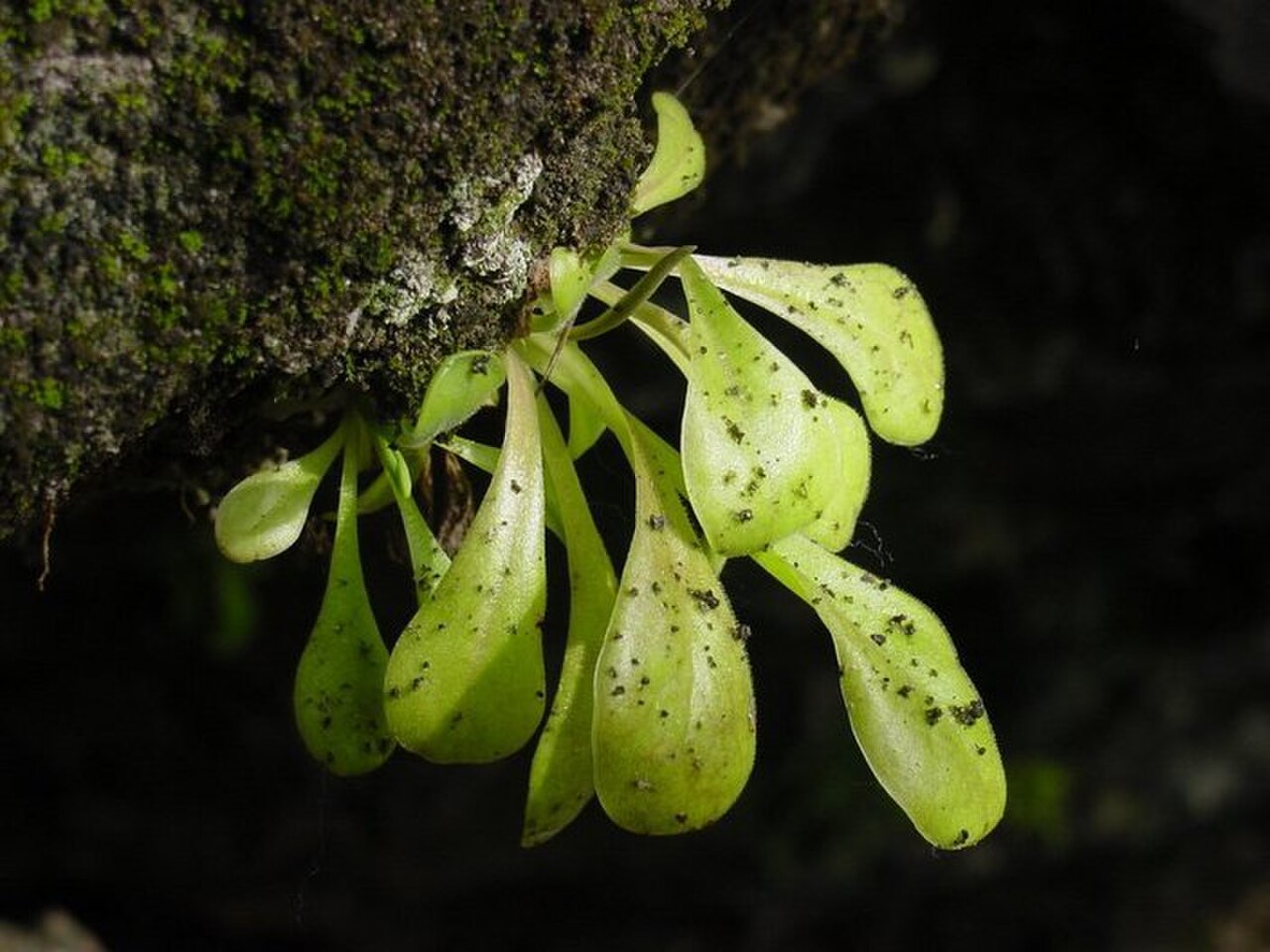
A butterwort that does not lie but hangs. Where almost all its relatives press a flat rosette against the substrate, Pinguicula laxifolia lets its long, limp leaves dangle from a vertical rock face — hence the name, 'with loose leaves'. The species is known only from the El Cielo cloud-forest reserve in Tamaulipas, where it grows on shaded wet walls.
Identification
The rosette consists of pendulous to semi-erect leaves, elliptic to oblanceolate and 40 to 68 mm long, with the glistening glandular droplets characteristic of the genus on the upper surface. Because the plants sit on a vertical face, those leaves hang downwards rather than spreading flat, which gives the species an untidy, almost slack look that sets it apart from any other Mexican species. The flowers are pink to pale violet with a white throat and darker violet markings; flowering falls in February and March, at the end of the dry season. Where exactly the winter rosette fits into the annual rhythm is less well documented in this species than in its relatives.
Similar species
The pendulous leaf posture makes field confusion unlikely. Other butterworts in the same El Cielo cloud forest carry the usual flat rosette, pressed against the face or the ground, with shorter and firmer leaves. On flower characters alone it is harder: pink to pale violet flowers with a white throat occur in several species of the Sierra Madre Oriental. So look first at the set of the leaves and only then at the flower. In case of doubt the range decides, because this species is known from no other district.
The trap and how it works
The hanging leaves work as a flypaper trap mounted vertically — an unusual arrangement for a butterwort. The upper surface carries stalked glands with a clear sticky droplet and, between them, sessile glands that release digestive enzymes as soon as prey lies on the leaf; the margin then rolls up slightly to hold the fluid. The hanging posture has a practical consequence: rain and seepage run straight off instead of washing the catch away, which is an advantage on a permanently wet face. The catch consists of the small flying insects of the cloud forest, supplemented by whatever falls from the face above.
Habitat and ecology
Shaded vertical rock faces in cloud forest, between about 1920 and 2070 m. It is a habitat without soil: the plants root in a thin layer of moss and weathered material on the rock, over which water seeps (R1), beneath a closed canopy that keeps humidity high all year (B1). The vertical position is not incidental for this species but central to its way of life: hanging leaves are only possible on a face, and on level ground the plant would smother itself. That makes it wholly dependent on the presence of suitable walls within the reserve.
Distribution and elevation
Endemic to the Mexican state of Tamaulipas, in the El Cielo biosphere reserve — the northernmost cloud forest of the Americas and a botanical island of real significance. This agrees with the entry in our species list. The known range is very restricted: the species is described as extremely local and has not been reported from any other district. Since El Cielo is itself a large and partly inaccessible reserve, further faces with populations cannot be ruled out, but outside the reserve suitable habitat appears to be absent.
- Recorded (one-degree cells)
Forms and variation
No wild varieties have been described. The species is known from a small number of faces within one reserve and within an altitudinal band of barely a hundred and fifty metres, which offers no meaningful environmental contrast for forms to attach to. The observed variation concerns leaf length, between roughly four and seven centimetres, and the shade of the flower, running from pink to pale violet. Both probably track the light and moisture of the particular face. No natural hybrids are reported.
Where and when to see it
Go in February or March, when the species flowers and the El Cielo trails are passable. Search along wet, shaded faces and overhangs in the cloud forest around two thousand metres, and look up: this species hangs on the wall, often above eye level, and anyone watching the ground walks underneath it. The pendulous leaves read from a distance as strands of green against dark wet rock; the flower confirms the identification. Keep to the paths, leave the faces alone and take nothing — in a reserve with so small a known range every plant counts.
Conservation status
The species has not been assessed for the global IUCN Red List and is not listed in CITES. What is known sketches an extremely narrow profile: a species with a very restricted range within one reserve, tied to wet rock faces in an altitudinal band of less than two hundred metres. That it lies within the El Cielo biosphere reserve is favourable — the forest there is managed and the pressure of logging and conversion is lower than outside. Against it are the tourism drawn to exactly the rock faces and waterfalls, the collecting of plants from the wild, and in the longer term the drying of the mist zone under climate change, to which a northern cloud-forest island such as El Cielo is especially sensitive.
Scientific name
Pinguicula laxifolia | Luhrs, 1996
Described by Holger Lührs in 1995, in Phytologia 79(2): 114–122. The species is known only from its remote type locality in the "El Cielo" cloudforest reserve in the Mexican state of Tamaulipas, on well-shaded, vertical rock walls at 1900 to 2070 metres altitude. The name "laxifolia" is Latin for "loose-leaved" (laxus, loose + folium, leaf) and refers to this species' unusually pendulous leaves — notable within a genus that mostly has stiff or succulent leaves.
World Checklist of Vascular Plants (WCVP), via Plants of the World Online (POWO), Royal Botanic Gardens, Kew.