All species › Lamiales › Bladderwort family › Pinguicula mariae
Pinguicula mariae
The second butterwort of the Apuan Alps grows on the same wet marble and limestone faces as the first, but is genetically a very different plant. Pinguicula mariae was described in the same 1981 paper as P. apuana, and only modern chromosome counts revealed how far apart the two are.
Identification
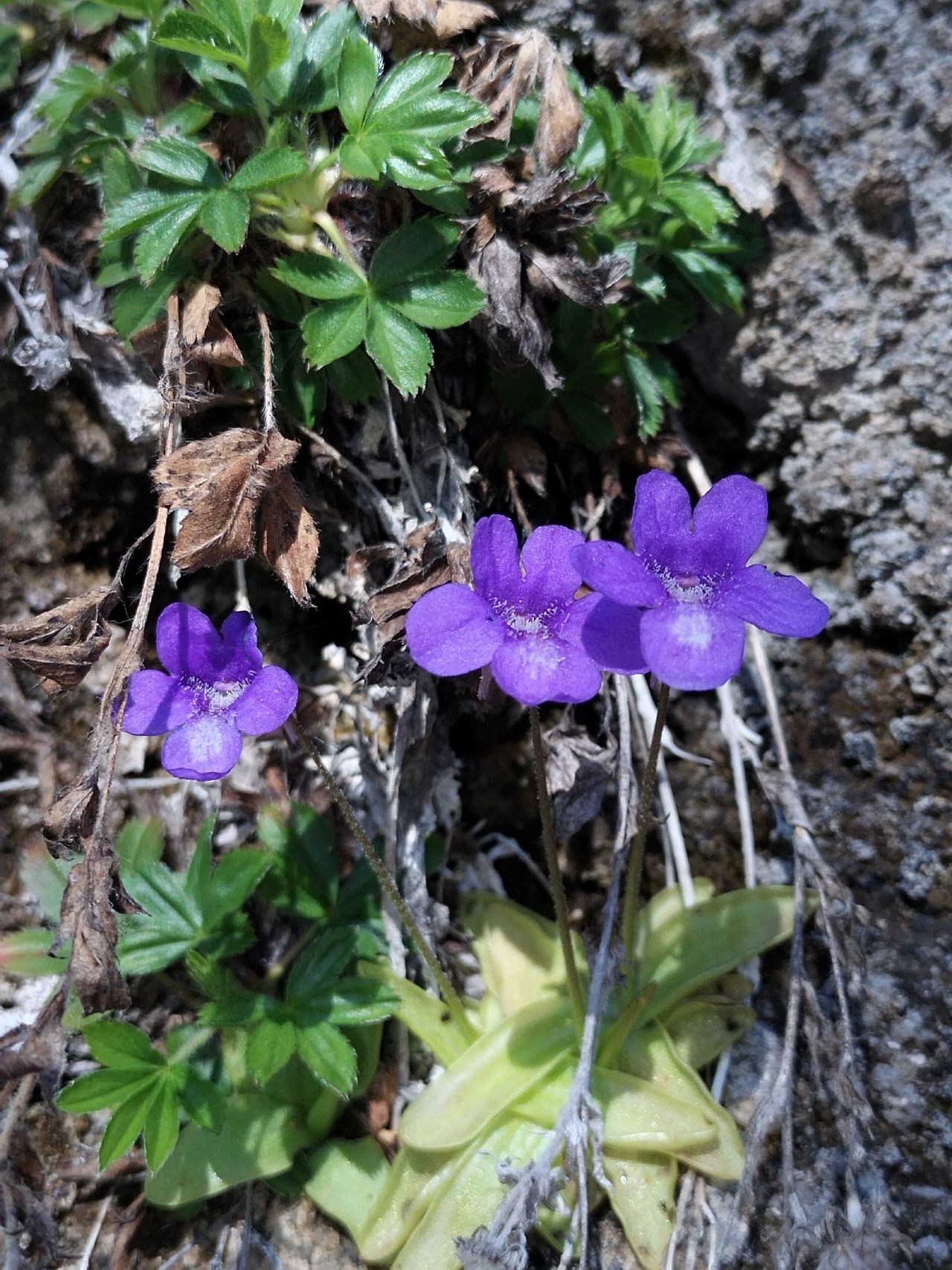
A flat rosette of entire, oblong-ovate leaves, yellow-green, greasy to the touch and with margins curled upward. Slender glabrous scapes rise from the centre, each with one two-lipped flower, with a two-lobed upper lip, a three-lobed lower lip with throat markings and a spur behind. Reliable measurements for plant, corolla and spur could not be traced to a checkable source for this guide and are therefore not given. The chromosome number is 32, half that of P. apuana; in practice that means a slightly slighter plant.
Similar species
The only serious confusion is with Pinguicula apuana from the same range, which is sturdier and has twice the chromosome number. To the eye the distinction is subtle and rests on size and flower proportions; in the literature the two are accordingly always treated together. Anyone finding a butterwort in the Apuan Alps therefore has one of these two, and certainty comes from measurements rather than first impressions. Further north, on the Apennine crest, stands P. christinae, geographically separate.
The trap and how it works
A flypaper trap permanently in business on a dripping wall. The leaf bears stalked glands with a sticky, glistening droplet and, between them, sessile glands that release digestive enzymes only once something is lying on them. The catch is small and plentiful: mosquitoes, midges, gnats and springtails from the humid air along the water. In response to prey the leaf margin rolls slowly over it, so the digestive fluid does not run off. On flushed limestone and marble that is the plant's only source of nitrogen, since the rock supplies none and the water washes away what does arrive.
Habitat and ecology
Wet limestone and marble rock in the Apuan Alps: dripping faces, seepage patches where water leaves a crack, and damp, short-cropped ground on higher slopes. The plant roots in crevices and in moss cushions directly on the rock. The range is strongly karstic, so almost all precipitation disappears underground and surface water is confined to the points where it emerges again; there, and only there, the plant grows. Shading and drying are the two threats that make a site unsuitable at once.
Distribution and elevation
Only the Apuan Alps in Tuscany, Italy. It is an endemic of a single short, steep range, with a limited number of sites separated by dry ridges and valleys. Although the species is listed here as of least concern, that should not be read as a large range: the whole world population sits within a few tens of kilometres. That two butterwort species persist side by side in so small a range has to do with the age of the massif and with its many isolated wet faces.
- Recorded (one-degree cells)
Forms and variation
No wild varieties are recognised. The interesting variation is at species level: P. mariae and P. apuana have different chromosome numbers and, according to recent molecular work, are not each other's closest relatives despite their shared range and outward similarity. That makes the pair a textbook case of two species arising in one massif by different routes. Within the species, variation in size and flowering follows simply the wetness of the site.
Where and when to see it
May and June. Look for the dark wet bands on the pale faces and follow them; the rosettes often sit above eye level in a crevice or on a moss cushion. Kneel at seepage patches along the path and look into the light, which makes the glandular coating of the rosettes glow. This is working quarry country with loose stone: keep to the waymarked routes, do not climb the faces and keep clear of the quarries. Photograph flower, leaf and fruit and record the site — identifying this pair takes more than one glance.
Conservation status
The species counts as of least concern. That sounds more reassuring than it is: the entire range covers one mountain group of limited size, and every site depends on the water-bearing layers in the karst. The real risks in the Apuan Alps are marble quarrying, which removes mountain flanks and can sever underground water paths, and drier summers that let the seepage patches fail. In addition, rank growth of short-cropped slopes after grazing ends can render sites unsuitable. CITES does not apply.
Scientific name
Pinguicula mariae | Casper & Stimper ex Casper, 2009
Described by Siegfried Jost Casper in 2009, in Wulfenia 16: 1–31, in the same article that also described Pinguicula apuana (Casper & Ansaldi). The species occurs in the Apuan Alps, in Tuscany, Italy. The species epithet honours Maria Ansaldi (born 1959 in Massa), a botanist and director of the Botanical Garden of the Apuan Alps "P. Pellegrini", who collaborated with Casper on this research. Casper described the two species named in the same article as "a tribute to the Apuan land [apuana] and to Maria Ansaldi [mariae]".
World Checklist of Vascular Plants (WCVP), via Plants of the World Online (POWO), Royal Botanic Gardens, Kew.