All species › Lamiales › Bladderwort family › Pinguicula nahuelbutensis
Pinguicula nahuelbutensis
A butterwort that occurs on one ridge only: the Cordillera de Nahuelbuta, the coastal range of southern Chile lying like an island between the Pacific and the Andes. At eleven hundred to twelve hundred and fifty metres, in saturated seepages under old southern beech, grows Pinguicula nahuelbutensis — a species whose scape is so short that the flower all but lies on the rosette.
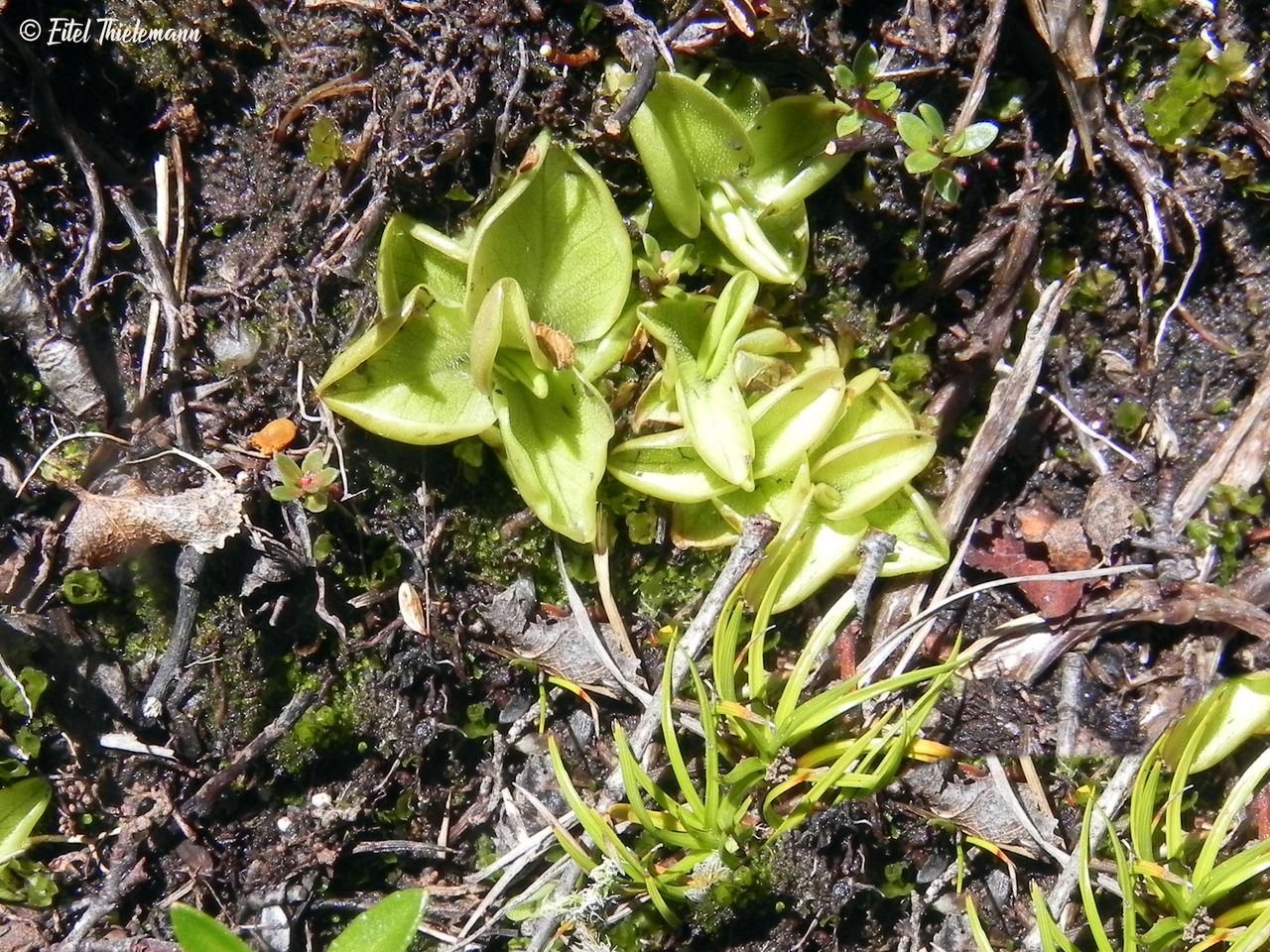
Identification
A rosette of five to eight leaves fourteen to twenty-two millimetres long, green to yellowish green with a conspicuous dark midrib. The character that identifies the species is the scape: at half a centimetre to one, exceptionally one and a half, it is far shorter than in any other southern species, and it is densely set with glandular hairs. The flower therefore sits almost on the rosette. It is white to light violet with pale or darker violet veins, two-lipped, with a spur of one to two and a half millimetres that may be rounded or pointed. Flowering runs from mid-December to early February — earlier in the season than the Andean species, which fits the lower elevation.
Similar species
Pinguicula antarctica also occurs in the coastal range, and there the distinction has been difficult enough to warrant a paper of its own. The scape decides: two and a half to twelve centimetres and sparsely hairy in P. antarctica, at most one and a half centimetres and densely hairy in P. nahuelbutensis. P. antarctica also has a saccate spur, while here it is rounded to pointed. The Andean species P. chilensis and P. australandina stand further east and higher and do not occur in this range. Out of flower, locality remains the best character.
The trap and how it works
A flypaper trap in a shaded, permanently wet forest setting. The stalked glands hold a droplet that does not dry in the near-constant humidity, and the sessile glands beneath release digestive enzymes as soon as prey is on the leaf; the margin then rolls slowly over the catch. Under old southern beech the supply of insects differs from that of open alpine pasture: fewer midges, more springtails, mites and small flies from the litter layer. The very short scape is probably no accident here — just above the ground there is shelter from wind and from the water running across the seepage.
Habitat and ecology
Wet seepages within forest of Nothofagus dombeyi and Nothofagus pumilio between eleven hundred and twelve hundred and fifty metres (B5), where spring water trickles across a slope and keeps the ground continuously wet (R1). These are open patches in the wood, often along a gully or a small scarp, where the canopy does not close. The site is acid and nutrient-poor, with a thick layer of moss and litter. The climate is cool and markedly wet; the Cordillera de Nahuelbuta catches the moist westerlies off the Pacific.
Distribution and elevation
Endemic to the Cordillera de Nahuelbuta in Malleco province, in the Chilean region of Araucanía. Its range is thus among the smallest in the whole genus: one coastal range, and within it only the narrow band around twelve hundred metres where the right seepages lie. Part of the area is protected as a national park, which probably makes the difference for the species. There is no distribution map in the usual sense: it is a handful of sites close together.
- Recorded (one-degree cells)
Forms and variation
No wild varieties are recognised. Variation within the species concerns mainly flower colour, running from almost pure white to light violet, and how sharply the spur is pointed. No natural hybrids have been described, although P. antarctica occurs in the same range and the two have long been confused in the literature; whether they really stand side by side anywhere is a question only targeted fieldwork can answer. Anyone reading older records from Nahuelbuta should allow for plants filed under P. antarctica that belong here.
Where and when to see it
In the old southern beech forest of Nahuelbuta, look for the places where water comes out of the slope: a dark, glistening patch under the trees, heavy with moss and without a closed field layer. The rosettes lie flat on the moss and the flower barely rises above them, so this is work on hands and knees. December and January are the best months. The forest is old and the ground fragile; stay on the paths and keep off the seepages, because that is exactly where everything is.
Conservation status
The species has not been assessed for the global IUCN Red List and is not in CITES, so there is no international category. What is known deserves attention: an endemic of a single coastal range, with an altitudinal band of barely a hundred metres and a few known sites. The Cordillera de Nahuelbuta is moreover an island range, surrounded by farmland and by extensive plantations of exotic pine and eucalyptus, which affect the water regime of the slopes. The protected part offers some security, but the species has nowhere to go if the climate dries. A formal assessment should come sooner rather than later here.
Scientific name
Pinguicula nahuelbutensis | Gluch, 2017
Described by Oliver Gluch in 2017, in "Revision of Pinguicula (Lentibulariaceae) in Chile and Argentina", Carnivorous Plant Newsletter 46(4): 121–131, based on material collected on 7 January 1968 by Ricardi, Marticorena and Matthei. The type locality lies in Malleco Province, Nahuelbuta National Park, at 1250 metres altitude, Chile. The name refers to the Cordillera de Nahuelbuta, the mountain range in the Chilean Bíobío region to which the species is endemic.
World Checklist of Vascular Plants (WCVP), via Plants of the World Online (POWO), Royal Botanic Gardens, Kew.