All species › Lamiales › Bladderwort family › Pinguicula parvifolia
Pinguicula parvifolia
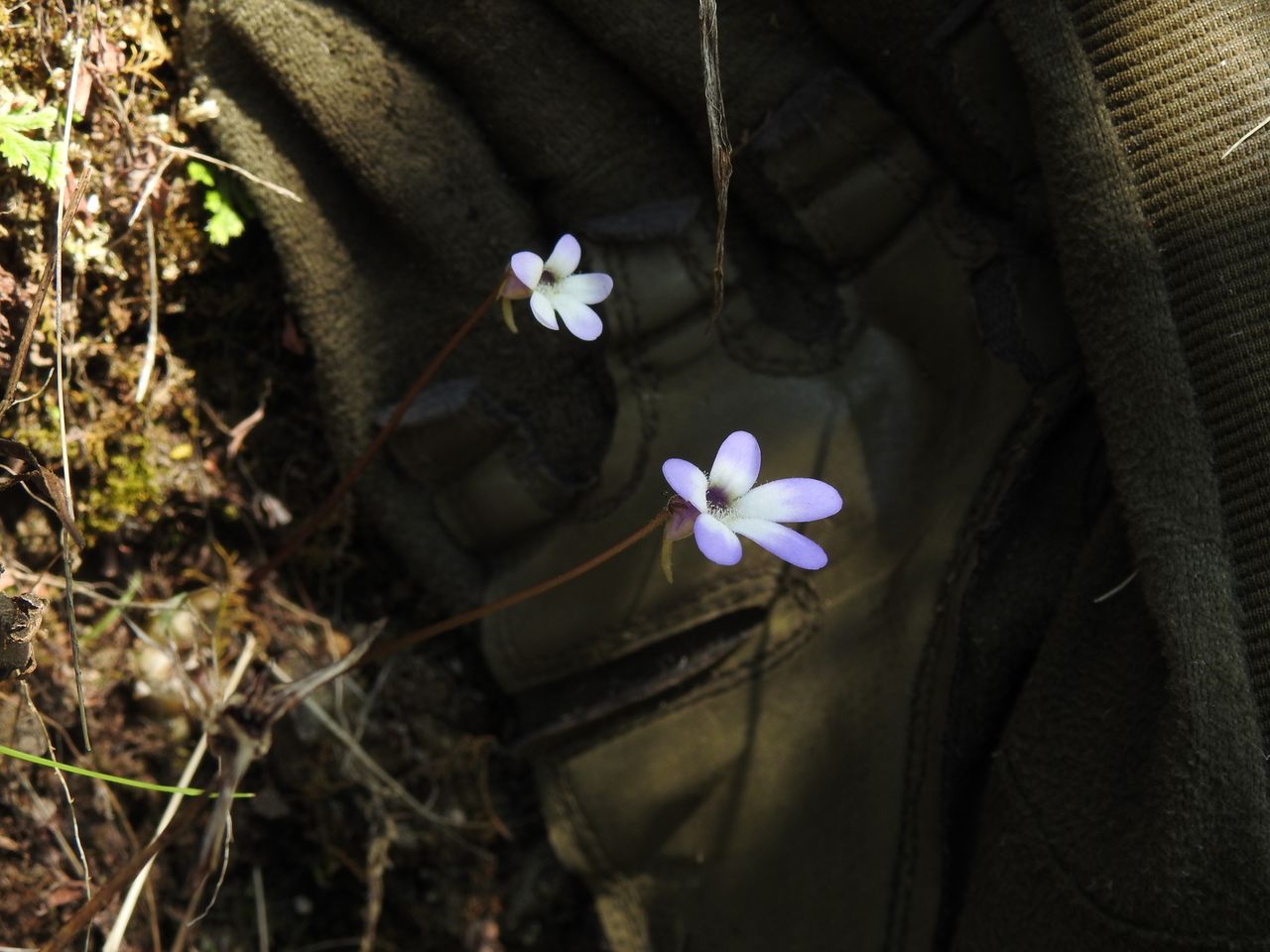
As the name says: a butterwort with small leaves. Pinguicula parvifolia was described in 1894 from material in the Sierra de San Esteban near Guadalajara and has rarely been reported since. It is one of the least known Mexican species in this guide, and in the field a plant of barely two centimetres with a small pale flower.
Identification
A small rosette with leaves of two clearly different sizes: the outer are narrow, 15 to 22 mm long and only 2 to 3 mm wide, the inner shorter but broader, 8 to 18 mm long and 3 to 6 mm wide; in the other season the leaves stay smaller still, 5 to 9 mm long and 1.5 to 2.5 mm wide. One to three slender scapes 3 to 10 cm tall rise per plant. The flower is small, 12 to 17 mm including the spur, and purple-blue to whitish; the spur is nearly cylindrical, blunt or shortly pointed. The whole plant is so small and so colourless that out of flower it is scarcely noticeable.
Similar species
The original description of Pinguicula rotundiflora from 1985 names this very species as its closest relative; P. rotundiflora, however, has broader rounded corolla lobes and comes from north-eastern Mexico, while P. parvifolia grows in the west. Among western species, P. macrophylla and P. oblongiloba are excluded on size alone. A small butterwort with a pale flower of at most one and a half centimetres in the highlands near Guadalajara is therefore a good candidate for this species — but check that it is not a juvenile plant of something larger. A further problem is that juvenile plants of larger species are in their first years exactly as small as an adult P. parvifolia; only a flowering plant settles the matter. Anyone searching outside the flowering season must therefore be content with 'small butterwort, undetermined'.
The trap and how it works
A flypaper trap on a very small leaf. The stalked glands carry a sticky droplet and hold the prey; the sessile glands between them release digestive enzymes on contact, with the margin bending inward almost invisibly. With leaves a few millimetres wide the catch is exclusively small: springtails, mites, the smallest midges and flies. For a plant growing on a mossy, impoverished bank, where the soil supplies almost no nitrogen, even that slight catch matters. With so small a catching surface the number of leaves matters more than their size: the plant compensates with a rosette of fairly many leaflets, each contributing a few square millimetres of sticky surface. The total stays modest, but on an impoverished mossy substrate even that yields a measurable nutritional gain.
Habitat and ecology
Mossy, gravelly bluffs and banks in mountain country, where the soil is thin and water drains quickly but the moss cover holds moisture (R1, R2, B5). The surrounding vegetation is open pine and oak woodland or scrub. Because published records are scarce, the habitat description in the literature is thin; what there is points to shaded or half-shaded spots with permanent or periodic moisture and very little competition. Elevation is that of the highlands around Guadalajara.
Distribution and elevation
Endemic to Mexico, with the type locality in the Sierra de San Esteban near Guadalajara in Jalisco. Our species list says only 'Mexico'; the literature places the species in western Mexico, in Jalisco and adjoining highlands. The number of known sites is very small, and little targeted searching has been done since the 1894 description. Whether the range really is that limited or the species is simply overlooked cannot be settled with present data.
- Recorded (quarter-degree cells)
Forms and variation
No wild varieties are distinguished. The most conspicuous variation within the species is flower colour, running from purple-blue to nearly white, and the difference between the leaf sizes of the two seasons — the latter not a matter of forms but ordinary seasonal dimorphism. About variation between populations almost nothing is known, simply because too few populations have been studied. No natural hybrids have been published.
Where and when to see it
Search in spring and summer, when the flowers stand above the rosette; out of flower the plant is practically unfindable. Work along mossy banks and gravelly edges in open pine and oak woodland, looking for the thin scapes with a small pale flower. Sit down and cover small areas; from standing height the rosette looks like a tuft of moss. Anyone finding this species would do well to record the locality and date precisely: for a plant reported so rarely, every well-documented observation counts.
Conservation status
Not assessed for the global IUCN Red List and not listed in CITES. Less is known of this species than of almost any other in this group: few published sites, no population figures and hardly any recent fieldwork. The highlands near Guadalajara are an area where urban expansion, road building and fire form a real pressure on small isolated sites. The absence of an assessment here mainly reflects the lack of data, and the first step would be to establish whether the species still occurs at its historical sites.
Scientific name
Pinguicula parvifolia | Robinson, 1894
Described by Benjamin Lincoln Robinson in 1894, in Proceedings of the American Academy of Arts and Sciences 29: 320–321. The type locality lies in the Sierra de San Esteban, near Guadalajara, in the Mexican state of Jalisco. The name "parvifolia" is Latin for "small-leaved" and refers to this species' small leaves (5–9 mm in the summer rosette, 8–22 mm in the winter leaves).
World Checklist of Vascular Plants (WCVP), via Plants of the World Online (POWO), Royal Botanic Gardens, Kew.