All species › Lamiales › Bladderwort family › Pinguicula sharpii
Pinguicula sharpii
The smallest-flowered carnivorous plant in Mexico, and one of the least conspicuous in this whole guide: the flower of Pinguicula sharpii measures under a centimetre and the spur is sometimes barely half a millimetre long. The species was described in 1977 from plants on a moist roadside bank in Chiapas and has since been reported from virtually nowhere else.
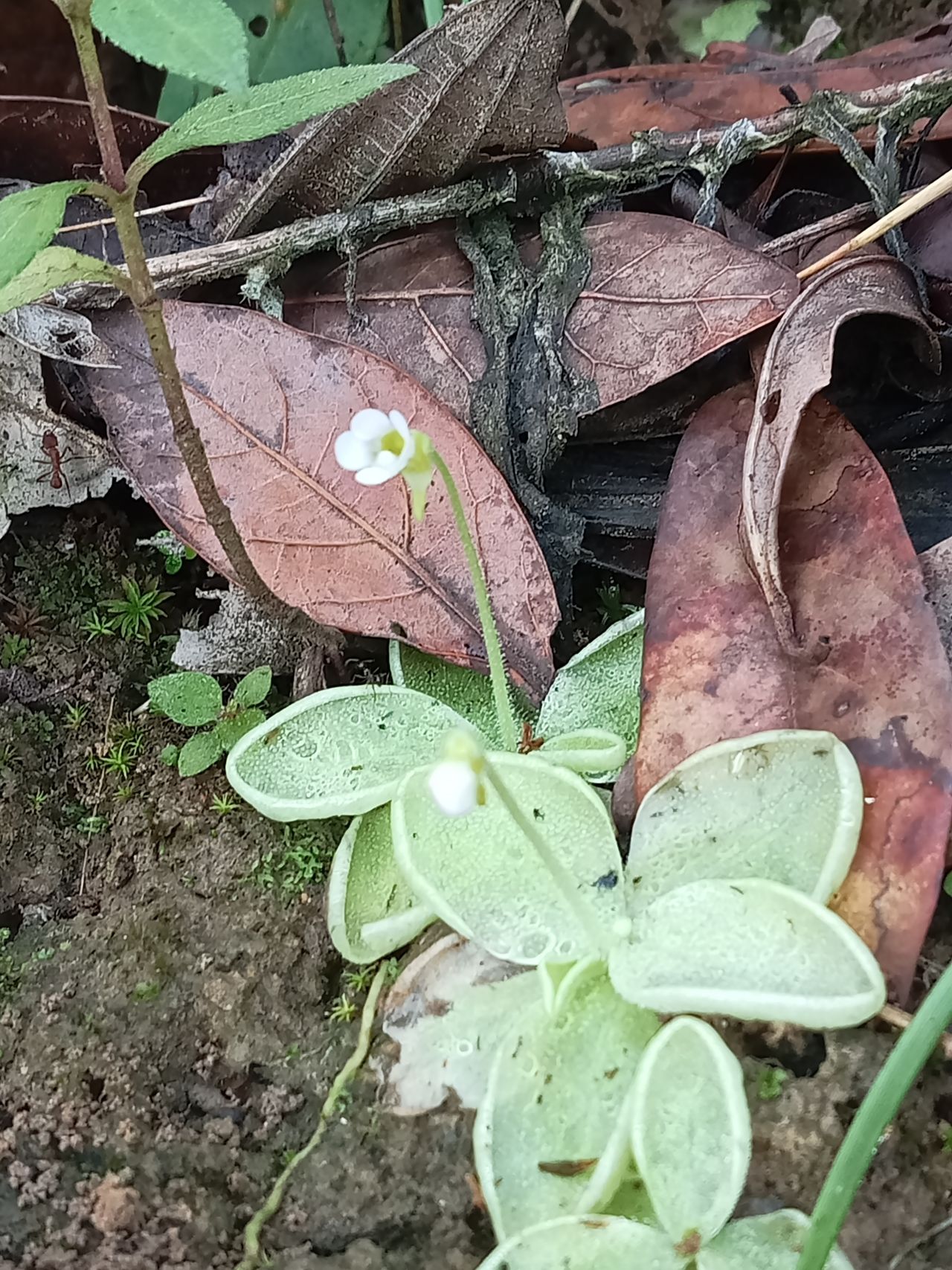
Identification
A small flat rosette of fairly broad leaves, 14 to 18.5 mm long and 11 to 17 mm wide, so nearly as broad as long — a somewhat squat shape for the genus. One to five very short scapes 13.4 to 39.5 mm tall rise per plant. The flower is extremely small, 3 to 9 mm in total, with white lobes and a tawny throat; the spur is cylindrical and only 0.5 to 2.6 mm long, so that at a glance it seems to be absent. The plant is annual: it flowers at the end of its growing season, sets seed and dies. The seed germinates in four to five weeks. Fruit set is correspondingly productive for an annual: a plant with five scapes yields as many capsules, which split open on the bare ground after the rosette dies back. The population stands or falls with that, since nothing of the plant itself remains.
Similar species
The extremely small flower with a spur of at most two and a half millimetres separates the species from all other Mexican butterworts. The only real candidate for confusion is Pinguicula lilacina, also annual and small-flowered, but its flowers are considerably larger at eight to seventeen millimetres, lilac, and with a yellow throat mark. P. takakii, also annual, grows on gypsum and likewise has larger flowers. With an annual butterwort in Chiapas bearing a flower under a centimetre, identification is therefore all but settled.
The trap and how it works
A flypaper trap that need work for only one season, on a small but relatively broad leaf. The stalked glands hold the prey and the sessile glands between the stalks supply digestive enzymes on contact. Because the plant must germinate, grow, flower and set seed within a few months, the nutritional gain from insects goes straight into seed production. Prey consists of springtails, midges and the smallest flies from the humid air of a shaded bank.
Habitat and ecology
Moist shaded banks and verges in the highlands of Chiapas, in the humid montane forest zone (B1, R1). The type locality lies at Yerba Buena, close to Pueblo Nuevo, on a shady slope beside a road. The site is thin, wet and sparsely vegetated: exactly the sort of place where a small annual can hold on as long as dense vegetation does not arrive. Because the plant depends on a seed bank rather than on perennial rosettes, it can be numerous one year and almost absent the next. That the only known site is a roadside bank need not mean the species is a verge plant: more likely, banks are the only places in this densely vegetated highland where so small an annual finds light and open ground — and at the same time the only places where a botanist notices it.
Distribution and elevation
Endemic to Mexico and, as far as published, known from one area in Chiapas. Our species list names Oaxaca and Chiapas; the literature knows only Chiapas, and the type locality lies in that area. We follow Chiapas here. That it stays at one known site probably says as much about how findable the species is as about its real rarity: an annual plant a few centimetres across with a flower of half a centimetre is not found without a deliberate search.
- Recorded (one-degree cells)
Forms and variation
No wild varieties have been described, which is hardly to be expected in a species known from one area. The variation reported in the description concerns flower size and the number of scapes per plant, and in an annual both relate strongly to how good the season has been: a plant that has caught well makes more and larger flowers. Since the species has no vegetative propagation, the clonal cushions conspicuous in many relatives are absent.
Where and when to see it
Go towards the end of the growing season, because only then are the flowers out. Search moist shaded verges and banks in the highlands, in spots with sparse vegetation and a wet thin soil layer. Sit down: the flower is smaller than a grain of rice and the rosette disappears entirely among moss. A place where the species stood last year may be empty this year, since everything rests on the seed bank; better to return over several seasons than to search one spot for long.
Conservation status
Not assessed for the global IUCN Red List and not listed in CITES. What is known is worryingly little: one published site, an annual habit making plant numbers vary greatly from year to year, and not a single count. The habitat — a bank beside a road in the highlands — is moreover the kind that can disappear in one season through road maintenance, widening or the stabilising of a cutting. An assessment here would require multi-year fieldwork to establish whether the species is still present and where else it occurs.
Scientific name
Pinguicula sharpii | Casper & Kondo, 1977
Described by Siegfried Jost Casper and Katsuhiko Kondo in 1977, in Brittonia, based on material collected in the winter of 1972 by A.J. Sharp. The type locality lies on a moist, shaded bank along a road at Yerba Buena, near Pueblo Nuevo, in the Mexican state of Chiapas, at approximately 1599 metres altitude. The species name honours Dr. A.J. Sharp, of the University of Tennessee in Knoxville, who collected the original material.
World Checklist of Vascular Plants (WCVP), via Plants of the World Online (POWO), Royal Botanic Gardens, Kew.