All species › Lamiales › Bladderwort family › Pinguicula vallisneriifolia
Pinguicula vallisneriifolia
Europe's largest butterwort, and the only one that from a distance looks like an aquatic plant stranded on a rock face. The strap-shaped summer leaves of Pinguicula vallisneriifolia reach twenty centimetres and more, hanging in dense curtains from overhanging limestone walls in the sierras of Cazorla and Segura in Andalusia. The epithet refers to the water plant Vallisneria, whose leaves look exactly like them.
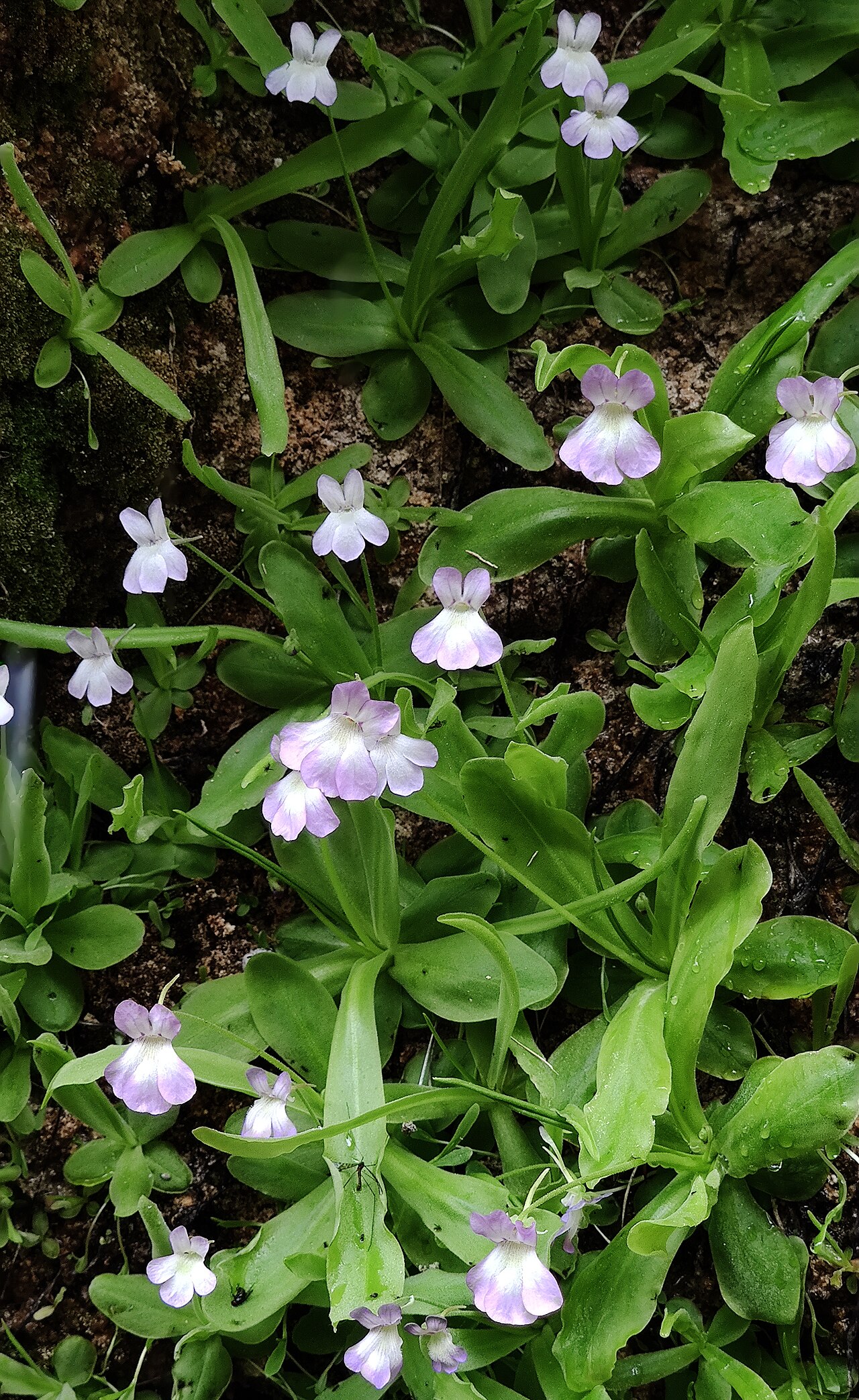

Identification
A plant with two quite different guises. In winter it is a compact rosette of leaves twenty-five to forty millimetres long; in the growing season long, narrow, strap-shaped leaves emerge from it, forty to two hundred millimetres and exceptionally two hundred and sixty, hanging slack from the wall. In flower the plant stands seven to fifteen centimetres tall. The flower is the largest of any European member of the genus: twenty-five to thirty-five millimetres, exceptionally forty, with a spur of ten to fourteen millimetres and sometimes up to twenty. Colour varies by district — clear violet in the Sierra de Cazorla, nearly white with less overlapping corolla lobes in the Sierra de Segura. The plant runs on stolons and thereby forms large clones.
Similar species
Pinguicula longifolia from the Pyrenees has summer leaves up to seventeen centimetres and a smaller flower of eighteen to twenty-seven millimetres; the ranges lie almost a thousand kilometres apart. P. mundi, from the Albacete–Jaén border and thus much nearer, has summer leaves of six to eleven centimetres and a flower of at most twenty-three millimetres with a darker upper lip. In practice leaf length decides: no other European butterwort hangs twenty-centimetre ribbons from the rock. On a leafless wall — early in spring — the substantial winter rosette helps.
The trap and how it works
A flypaper trap with an area unmatched in Europe. A full-grown plant carries dozens of long sticky ribbons hanging free of the wall; together they form a vertical catching screen that small insects moving along the rock have to pass. The stalked glands carry the droplet, the sessile glands beneath release enzymes as soon as prey is lying there, and the margin rolls over the catch so that the digestive fluid does not run down the leaf — with a hanging ribbon leaf a critical detail. The catch consists of gnats and small flies from the damp, shaded gorge. On bare limestone where the water carries everything away, that is the main source of nutrition.
Habitat and ecology
Vertical, overhanging limestone rock and dripping travertine walls, always shaded and with water seeping permanently across them, between six hundred and seventeen hundred metres (R1, R2). The plants often hang under overhangs, out of direct sun, where the wall stays wet all year. There is no soil: the roots sit in moss and in crevices of the tufa. In the dry Andalusian climate such walls are cool damp islands — the plant exploits a microclimate that a hundred metres away no longer exists.
Distribution and elevation
Endemic to southern Spain. The core of the range lies in the sierras of Pozo, Cazorla, Segura and Las Villas in Jaén province, with extensions to the Sierra de Castril in Granada, one site in Albacete province and an isolated population in the Sierra de Cázulas. Dozens of populations are known in the core area, which for an endemic rock plant is a good many. Our own species list names Andalusia, which captures the centre well but leaves out the Albacete site. Elevation spans more than a thousand metres.
- Recorded (quarter-degree cells)
Forms and variation
No wild varieties are recognised, but there is a clear geographical pattern in flower colour: plants in the Sierra de Cazorla flower clear violet, while those in the Sierra de Segura are nearly white with narrower, less overlapping corolla lobes. There is also the seasonal shift from winter rosette to long summer leaves, which all plants go through. Because the species spreads by stolons, a wall often consists of one or a few clones, which limits genetic variation within a population. No natural hybrids have been described.
Where and when to see it
Go in May or June to the gorges of the Sierra de Cazorla and follow the valley road; the walls where water comes out are visible from the road. Look up at overhanging limestone on the shaded side — the long curtains of leaves are unmistakable and recognisable from tens of metres, long before the flowers. Binoculars are the key instrument here. Do not climb to the plants: the walls are brittle, the moss cushions come away, and it is unnecessary, because almost everything can be seen well from below.
Conservation status
The species is assessed as Least Concern on the global IUCN Red List and is not in CITES. That rests on a relatively large number of known populations within a small range, mostly inside a protected natural park. Even so, this is a southern Spanish endemic with particular vulnerabilities. The plants hang on walls fed by karst springs, and the water table in these limestone mountains is under pressure from water use in the surrounding valleys and from longer, hotter droughts. On top of that, many populations consist in effect of a handful of clones, which limits their capacity to adapt. The favourable category here says mainly that things are still going well, not that nothing can change.
Scientific name
Pinguicula vallisneriifolia | Webb, 1853
Described by Philip Barker Webb in 1853. The species is endemic to Spain, where it occurs on limestone cliffs, particularly in the Cazorla and Segura mountain ranges, in Jaén province. The name refers to the resemblance of the long, ribbon-like summer leaves to those of the aquatic plant genus Vallisneria.
World Checklist of Vascular Plants (WCVP), via Plants of the World Online (POWO), Royal Botanic Gardens, Kew.