All species › Ericales › New World pitcher plant family › Sarracenia flava
Sarracenia flava | Yellow pitcher plant
Gele trompetbekerplant | Planta carnívora amarilla
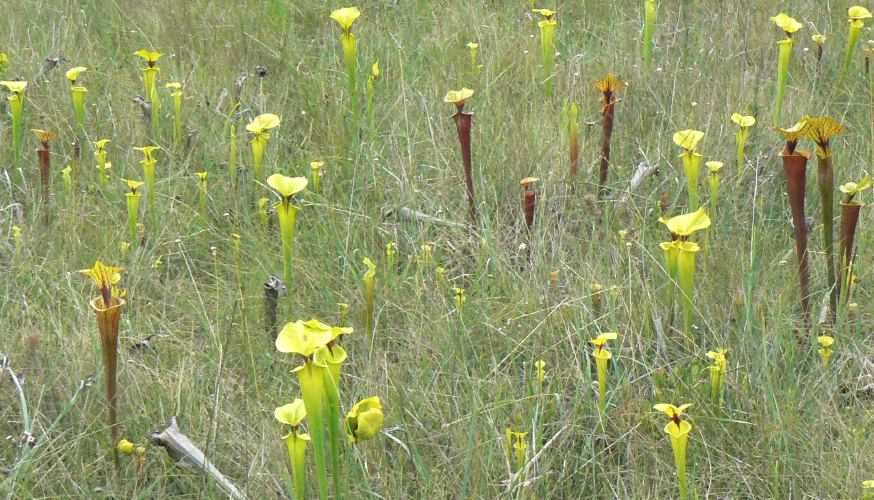
The tallest and the yellowest plant of the coastal plain: a sheaf of upright yellow trumpets forty to seventy centimetres high, in flower in March before the grass gets going. No other species has so many wild varieties — seven — and at some sites several stand within one field of view.

Varieties, colour forms and hybrids

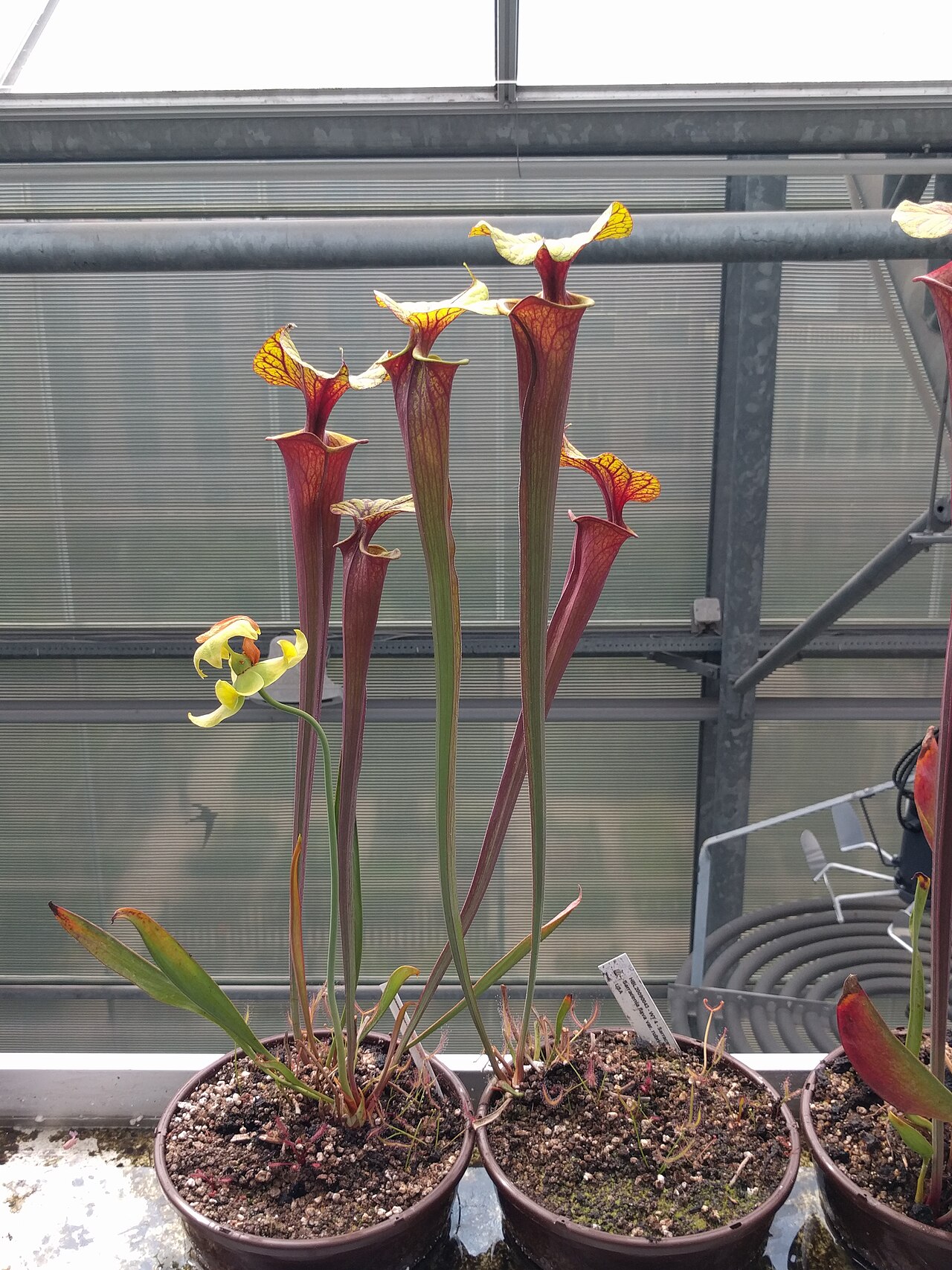
Identification
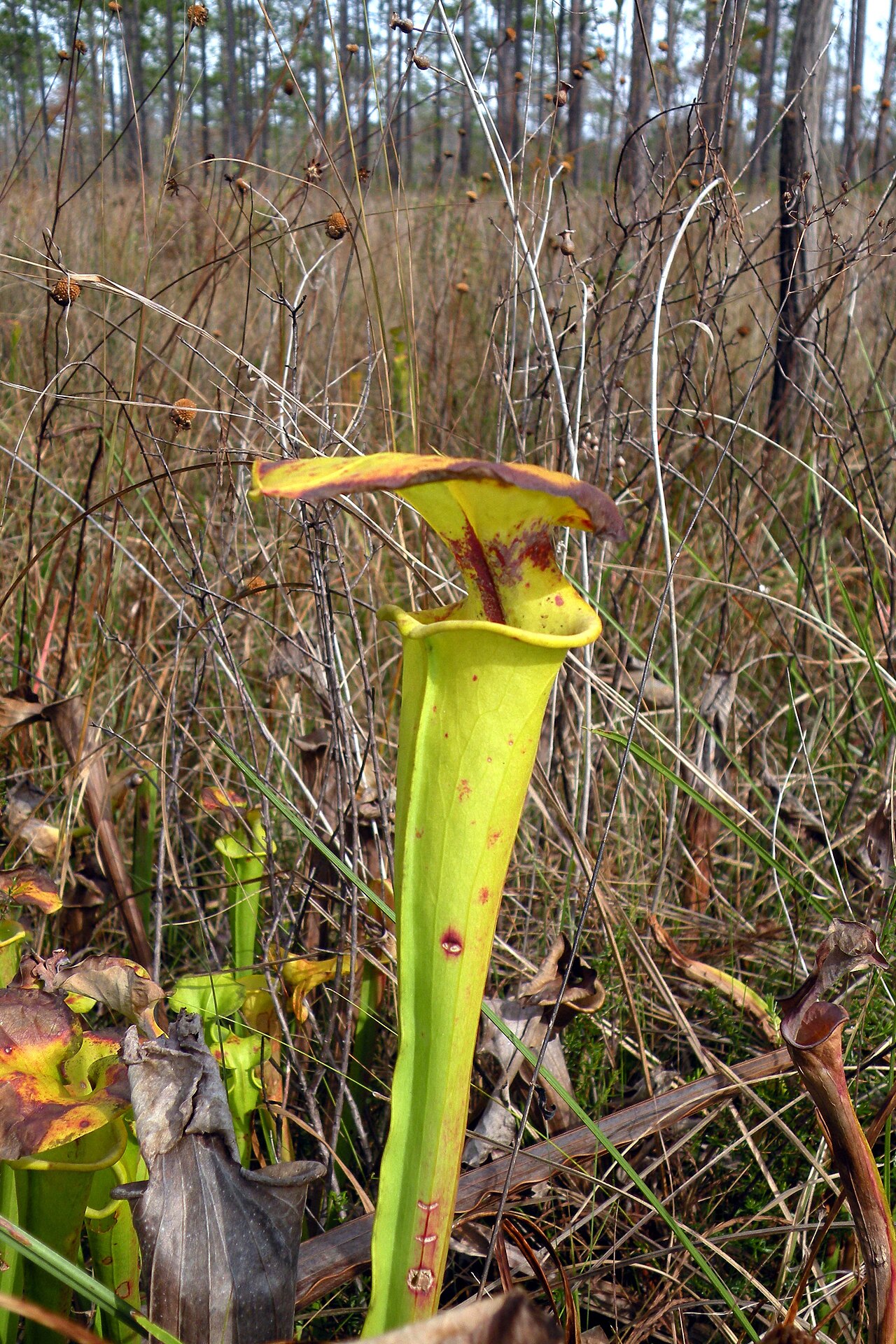
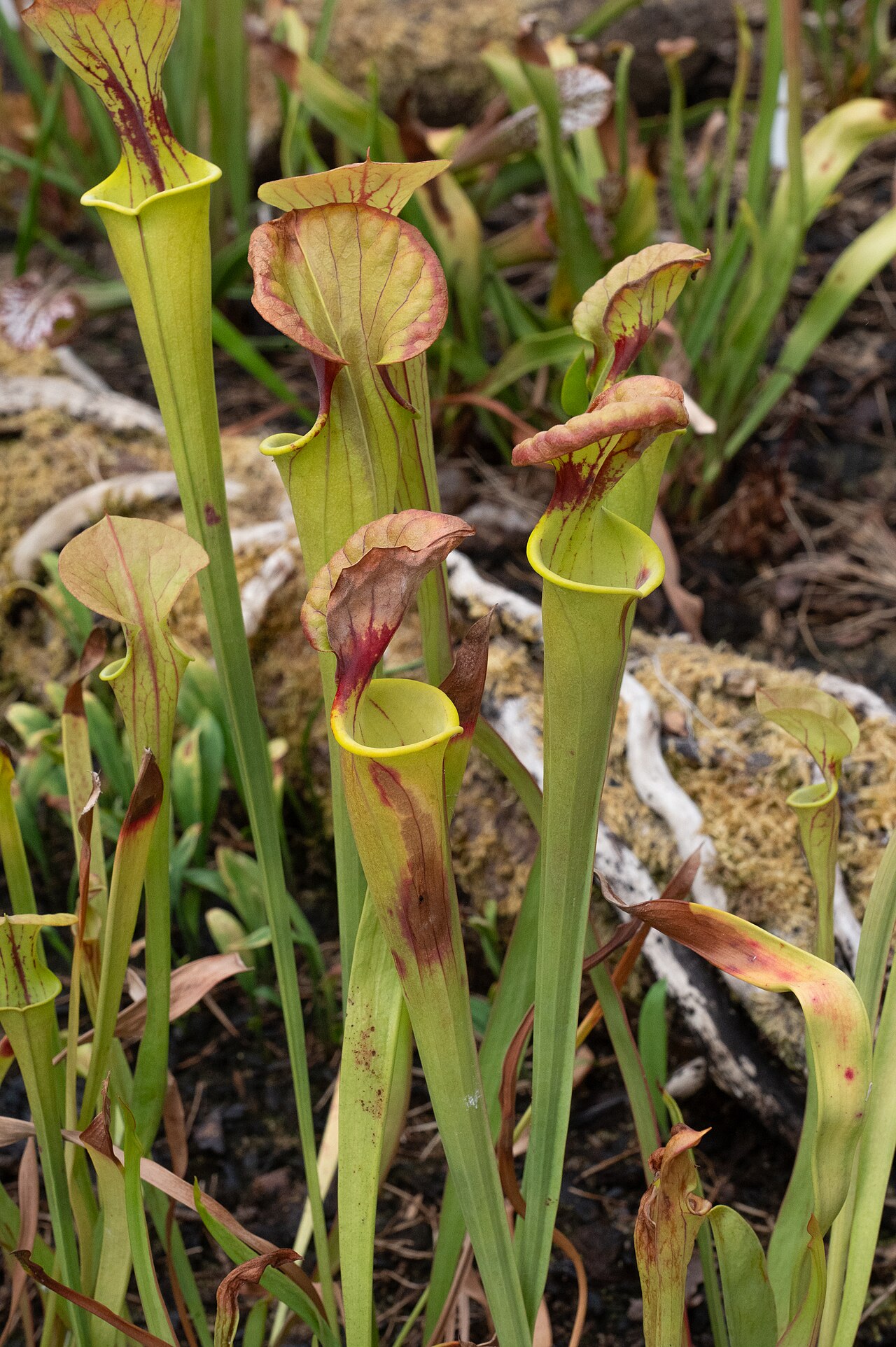
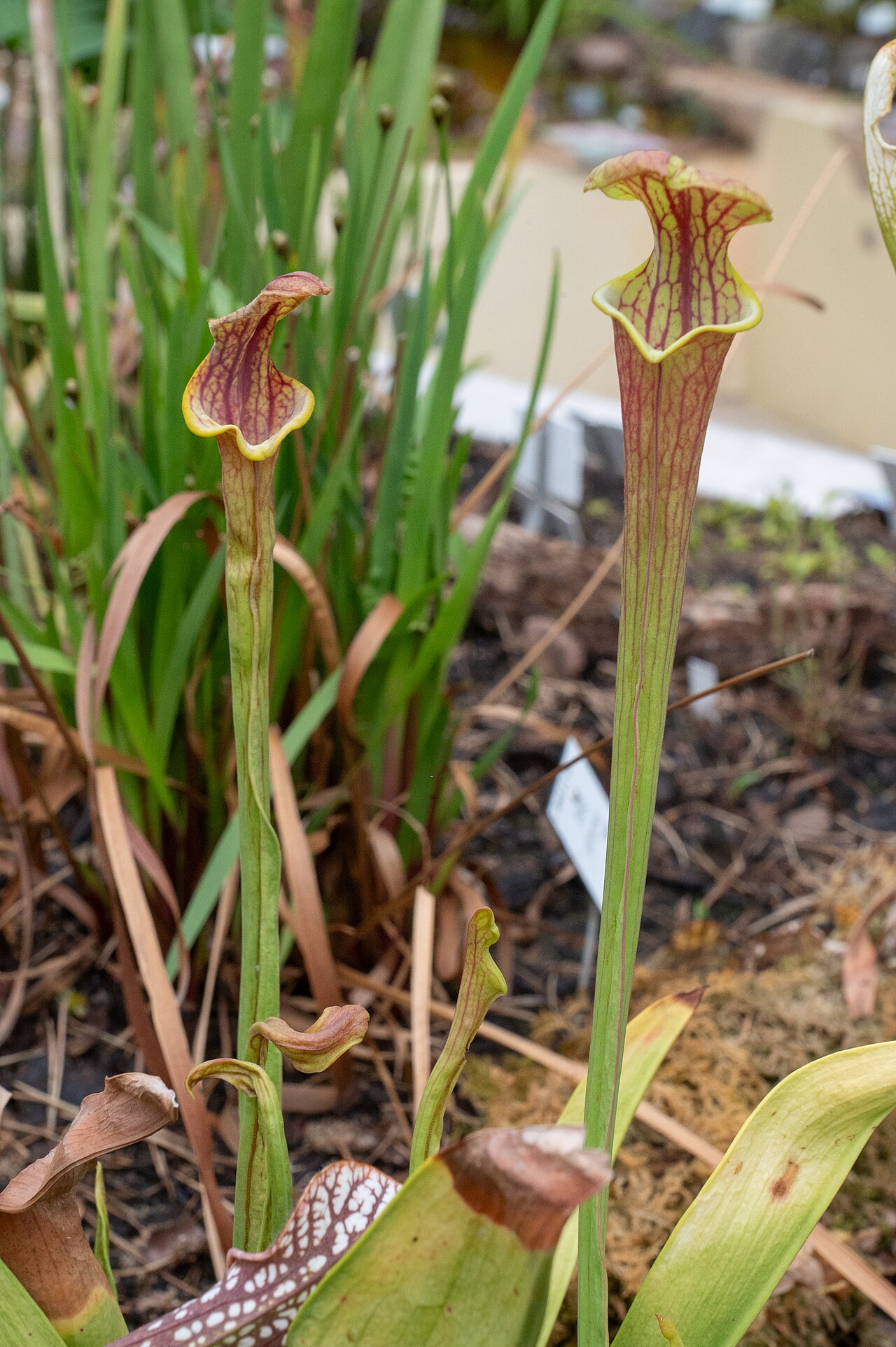
Erect, funnel-shaped pitchers 25 to 90 cm tall, narrow at the base and widening upward, with a narrow wing down the front. Just below the mouth the pitcher is often slightly pinched — the 'neck' — and above it stands a round, wavy lid, broader than the mouth and held well above it, so little rain gets in. The ground colour is yellow to yellow-green; most plants carry a dark red blotch inside the throat, and in some varieties red veining runs over the whole exterior. The flower comes before the pitchers: bright yellow, nodding on a bare scape, its long limp petals hanging over the umbrella-shaped style disc. It smells sharp — many people call it a cat smell.
Similar species
S. alata is the closest match, but it grows west of the Mississippi and does not overlap with this species; it is paler, has a smaller lid held less far forward and lacks the red throat blotch. S. oreophila, of the mountains of Alabama and Georgia, has shorter pitchers that die back in summer and then produces flat, sickle-shaped phyllodia that S. flava does not make in that form. S. leucophylla is as tall but has a white fenestrated upper part and flowers deep red. S. rubra is far smaller with red-brown flowers. And watch the hybrids: S. × moorei (with leucophylla) is tall and yellow with a white-shot head — a plant that looks halfway usually is halfway.
The trap and how it works
A passive pitfall with a chemical trick. The rim secretes nectar that in this species contains the alkaloid coniine — the poison of hemlock — and insects that drink it become slow and unsteady. The rim is also slippery and curved inward. Whatever falls lands in a tube whose wall is first waxy and lower down densely set with stiff downward-pointing hairs; climbing out does not work. At the bottom stands a layer of digestive fluid with the plant's own enzymes. The catch is large and varied: flies, wasps, bees, beetles and many ants, and a well-filled pitcher in June is half full of a black mass of indigestible husks. The lid keeps the rain out so the fluid is not diluted.
Habitat and ecology
Wet longleaf pine savanna, wet flatwoods and seepage slopes on sand, and strikingly often wet ditches and verges along sand roads, where mowing does the work of fire. Acid, wet, nutrient-poor ground in full sun. The species depends on fire for its survival: where the savanna no longer burns the shrub layer closes and it is gone within ten to fifteen years. A winter burn is followed by a lavish spring flowering.
Distribution and elevation
Endemic to the coastal plain of the south-eastern United States: from south-eastern Virginia through the Carolinas and Georgia to the Florida Panhandle and southern Alabama. Its strongholds are the wet savannas of the Carolinas and the western Panhandle. Inland it is absent. Beyond that range it has held on in a few places where it was planted, among them Maryland and Washington state, and in Europe in Great Britain, France and Austria.
- Recorded (quarter-degree cells)
Forms and variation
Seven wild varieties are recognised, and this is the one species in the genus where the forms are a genuine field character. Var. flava is the common form: a yellow pitcher with a red blotch inside the throat and fine red veining in the neck. Var. rugelii is the largest and the cleanest: almost wholly yellow or yellow-green, without red veining outside, but with one sharply bounded dark red splash low in the throat; it belongs to the Gulf coast. Var. maxima lacks the red altogether — no throat blotch, no red veins, only yellow-green with green venation. Var. ornata is the opposite: heavy dark red veining over the whole outside of the tube, like a net, plus the throat blotch. Var. rubricorpora has a deep red tube with a yellow to yellow-green lid — from a distance a red plant in a yellow hat; it grows almost only in the Florida Panhandle. Var. cuprea is its mirror image: a copper to bronze lid on a green-yellow tube. Var. atropurpurea is dark red to almost purple over the whole plant, tube and lid alike. The varieties grow mixed together and the transitions are gradual; names in quotation marks belong to cultivation and are not in this guide. The species also crosses with nearly every neighbour: S. × catesbaei with S. purpurea, S. × moorei with S. leucophylla, S. × harperi with S. minor, S. × popei with S. rubra. At mixed sites those crosses are sometimes in the majority: a plant with intermediate characters is more likely a hybrid than a new variety.
Where and when to see it
Late March and early April, when the yellow flowers are out and the new pitchers are just opening — and the savanna is still short. Look along wet ditches and on burnt savanna in the Carolinas, southern Georgia and the Panhandle; several state forests and preserves have trails through it. Later in the year the old pitchers stand brown and toppled and it is much less conspicuous. Look into the pitchers without tearing them open: held to the light, the black mass of prey shows through the wall.
Conservation status
Least Concern on the Red List — of the coastal-plain pitcher plants this is the one with the largest range and the most populations. That does not mean the habitat is safe: only a fraction of the original wet longleaf pine savanna survives, and without management by fire the remaining sites decline too. Several states therefore carry it on a state list. Collecting for the trade and picking the flowers matter locally. As a Sarracenia it falls under CITES Appendix II.
Scientific name
Sarracenia flava | Linnaeus, 1753
Linnaeus described the species in 1753 in Species Plantarum. No precise type locality was given; the species occurs naturally in the coastal plain of the south-eastern United States, from Virginia to Alabama. The species epithet flava is Latin for 'yellow', referring to the colour of the flowers and pitchers.
World Checklist of Vascular Plants (WCVP), via Plants of the World Online (POWO), Royal Botanic Gardens, Kew.
Natural hybrids of this genus
These ten species can cross with one another. See the nineteen named natural hybrids of Sarracenia, with photographs where available.