All species › Ericales › New World pitcher plant family › Sarracenia minor
Sarracenia minor | Hooded pitcher plant
Kleine trompetbekerplant | Planta carnívora encapuchada
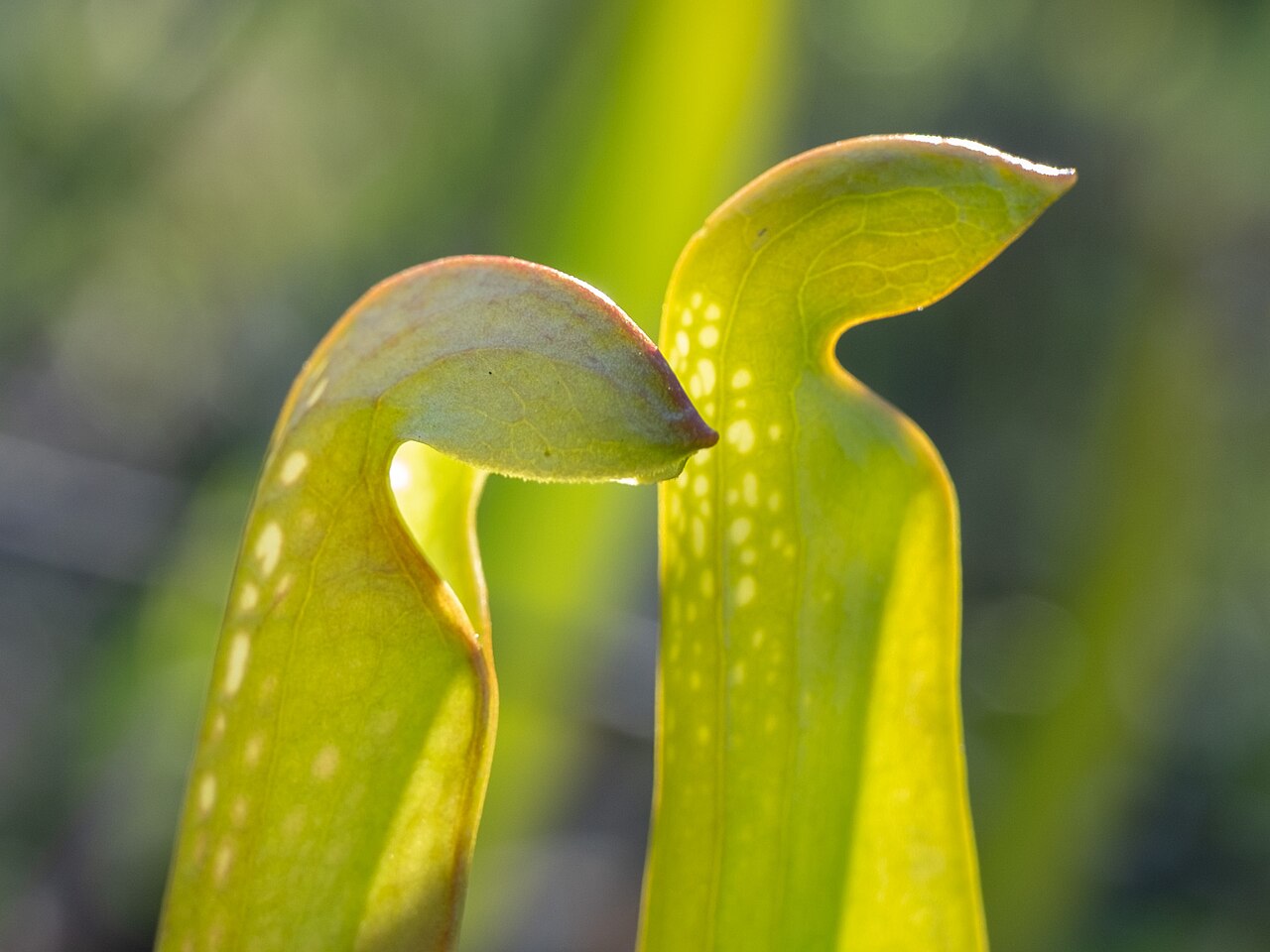
The pitcher plant that roofs over its own mouth. In this species the lid arches forward across the opening, so that no rain gets in — and on the back of that hood stand dozens of white translucent windows that promise an insect inside a way out which is not there.
Identification
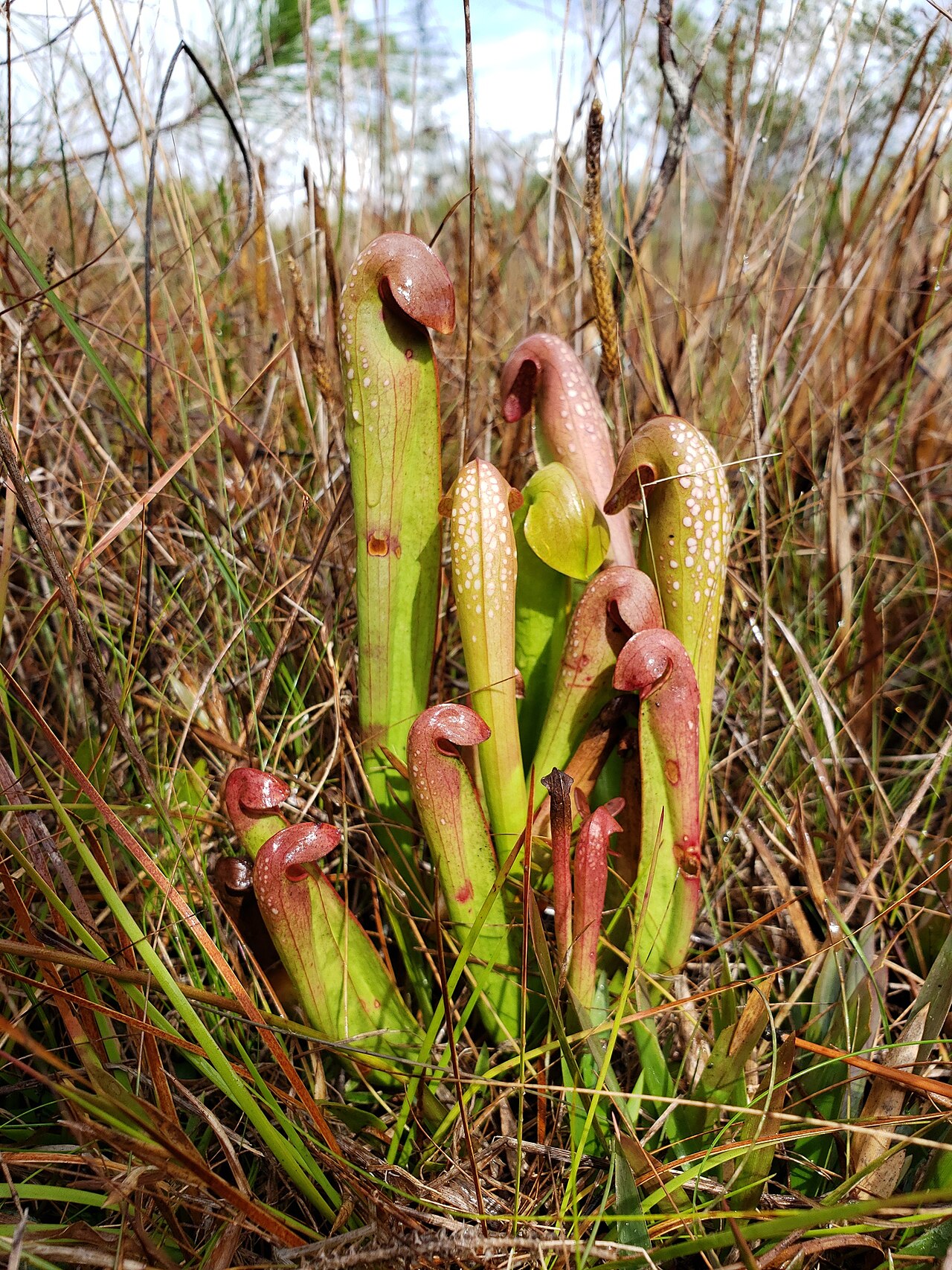
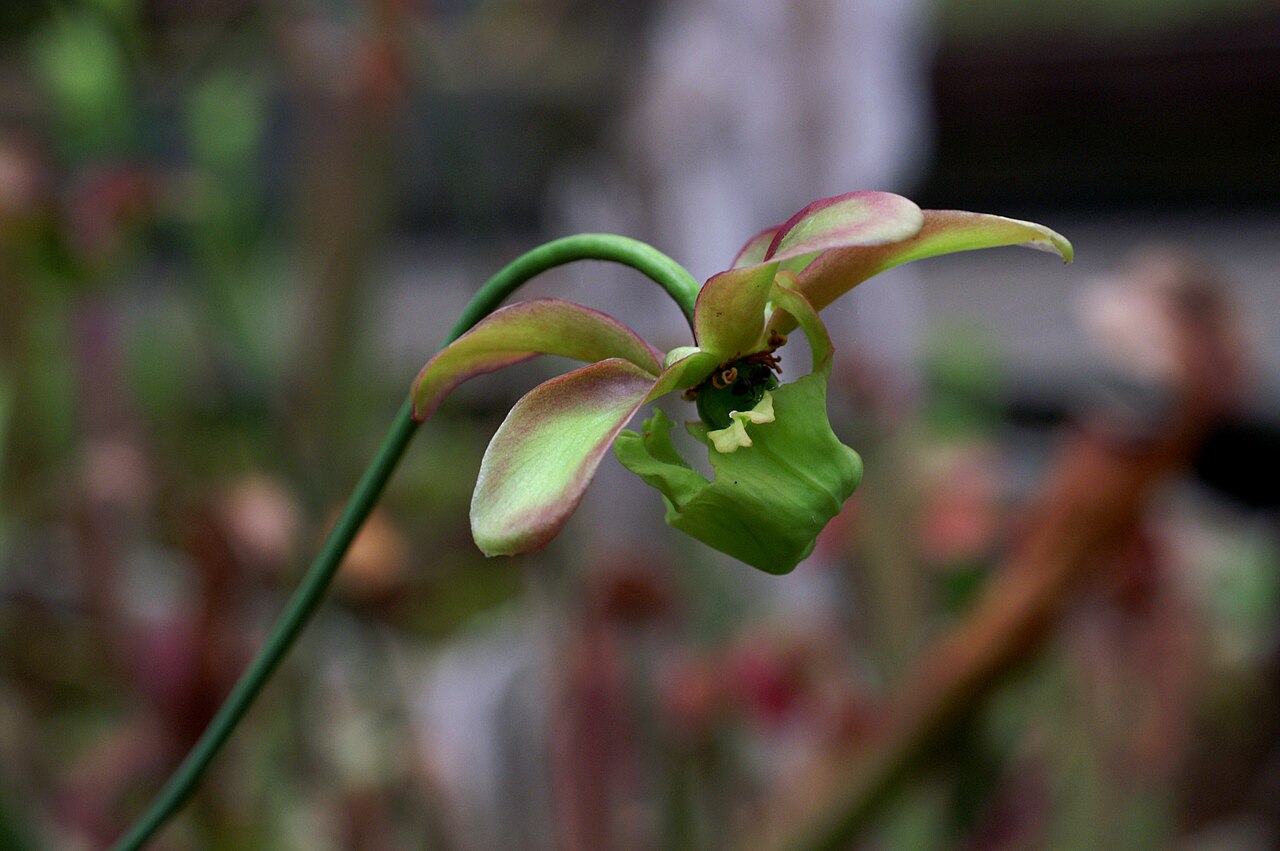
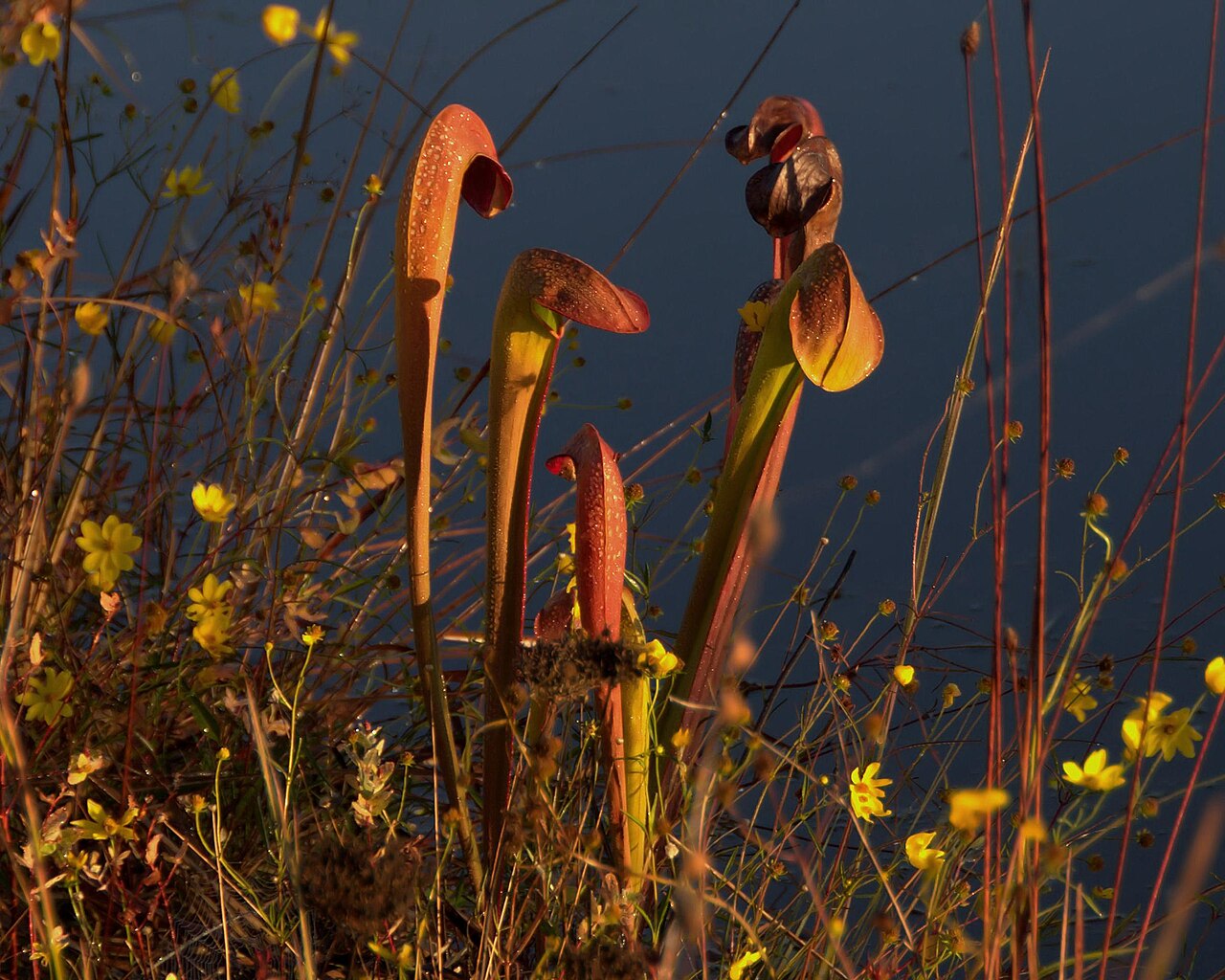
Erect pitchers 12 to 45 cm tall, slender, with a narrow wing down the front. The upper part bends forward and ends in a hood vaulting over the mouth like a helmet; look down on the plant and you cannot see the opening. Across the back and sides of that upper part stand irregular white translucent patches — the areoles, or windows — which glow against the light. The tube is green, the upper part often flushed red-brown with red veining. In April and May a bare scape 12 to 55 cm tall, usually a little shorter than the tallest pitchers, carries a single nodding flower with five hanging pale yellow petals 3 to 5 cm long and an umbrella-shaped style disc. The flower has no scent.
Similar species
The roofed mouth is the character: no other upright Sarracenia has a lid that leans forward over the opening. S. psittacina also has white windows, but lies flat on the ground with a closed globular hood and a hole in the side. S. leucophylla is far taller, with a large white field over the whole upper third and an upright lid, and flowers red. S. rubra is small but has an open mouth and red-brown flowers. Beware the hybrids: S. × excellens (with S. leucophylla) is larger and whiter with a half-hanging lid, S. × formosa (with S. psittacina) is half decumbent, and S. × harperi (with S. flava) has a hood that does not curve far enough forward.
The trap and how it works
A light trap. Prey — and in this species that means ants above all — climbs a nectar trail up the wing to the rim and enters the roofed opening. Inside it goes dark, except in one place: daylight falls through the white windows in the back wall. The animal walks toward that light, meets the wall, and drops into the smooth, waxy tube. Lower down stand downward-pointing hairs that allow one direction only, and at the bottom the digestive fluid. Because the hood covers the opening, little rain enters and the fluid stays concentrated — unlike S. purpurea, which lives off rainwater. Field studies show a strikingly high proportion of ants in the catch; the windows work chiefly on what is already inside, not as a lure from a distance.
Habitat and ecology
Wet savanna and wet to mesic longleaf pine flatwoods, seepage slopes on sand, sphagnum seeps at swamp margins and, very often, the wet ditches along sand roads. Acid, wet, nutrient-poor ground in sun or light shade. Of the coastal-plain pitcher plants this one tolerates most shade and most disturbance, which is why it persists longest along verges and on neglected ground. Here too fire is the management that keeps the savanna open.
Distribution and elevation
Endemic to the coastal plain of the south-eastern United States: from southern North Carolina through South Carolina and Georgia into peninsular Florida, where it runs further south than any other pitcher plant. It is absent inland and from the Gulf coast west of Georgia. Beyond that range it persists at a few planted sites in Great Britain.
- Recorded (quarter-degree cells)
Forms and variation
The most striking wild form is var. okefenokeensis, the giant of the Okefenokee Swamp in southern Georgia and adjacent Florida: the same plant, but with pitchers reaching about 120 cm, broader windows and a more heavily built hood. In ordinary var. minor the variation is limited to how far the upper part flushes red-brown. Beyond that the species crosses in the field with nearly every neighbour: S. × excellens with S. leucophylla, S. × formosa with S. psittacina, S. × harperi with S. flava, S. × swaniana with S. purpurea. At mixed sites those crosses are sometimes commoner than the pure plants. The rule of thumb holds here too: if the hood does not fully cover the mouth, you are not looking at an unusual S. minor but at a hybrid.
Where and when to see it
April and May, when the pale yellow flowers hang above the grass; outside that season the plant gives itself away chiefly by the odd forward-leaning silhouettes among the sedges. Look in wet savanna and along ditches in southern Georgia and northern Florida, and in the savanna preserves of the Carolinas. Go after a winter burn, when the grass is short. Keep your head low: the charm of this species only appears when you look at it from the side and from below with the sun behind the hood — then the windows light up like a row of panes.
Conservation status
The species has not been evaluated for the Red List, so a global assessment is lacking. What is known: within its range it is still widespread and common in many places, and of the coastal-plain pitcher plants it holds on best in verges and along ditches. Against that, its habitat — wet longleaf pine savanna — has been reduced to a fraction in a century, and the giant form of the Okefenokee is tied to a single swamp complex. Collecting and the digging of wild plants affect the whole genus. As a Sarracenia it falls under CITES Appendix II.
Scientific name
Sarracenia minor | Walter, 1788
Thomas Walter described the species in 1788 in Flora Caroliniana. No precise type locality was given; the species occurs naturally in the coastal plain of North and South Carolina, Georgia and Florida. The species epithet minor is Latin for 'smaller', referring to the relatively modest size of the pitchers compared with other upright Sarracenia species.
World Checklist of Vascular Plants (WCVP), via Plants of the World Online (POWO), Royal Botanic Gardens, Kew.
Natural hybrids of this genus
These ten species can cross with one another. See the nineteen named natural hybrids of Sarracenia, with photographs where available.