All species › Ericales › New World pitcher plant family › Sarracenia rubra
Sarracenia rubra | Sweet pitcher plant
Rode trompetbekerplant
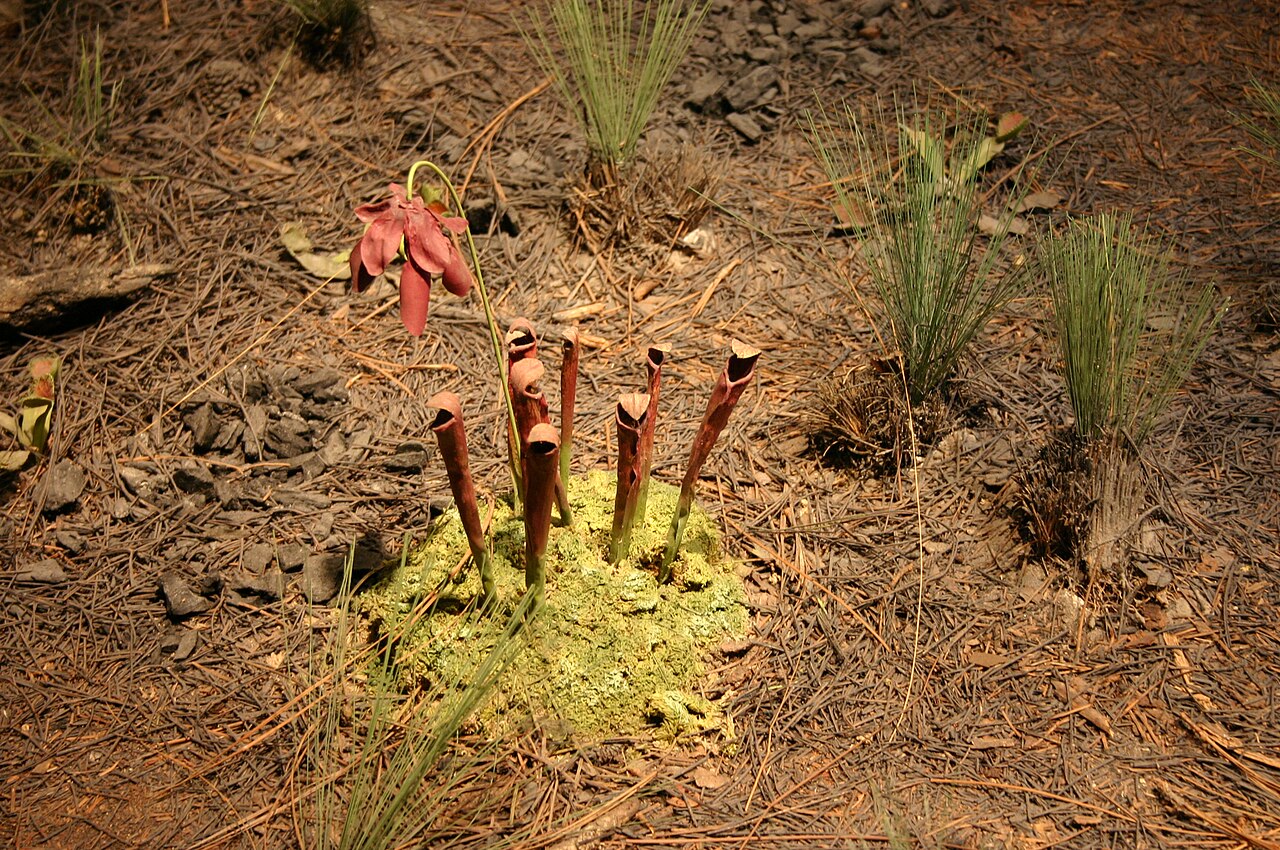
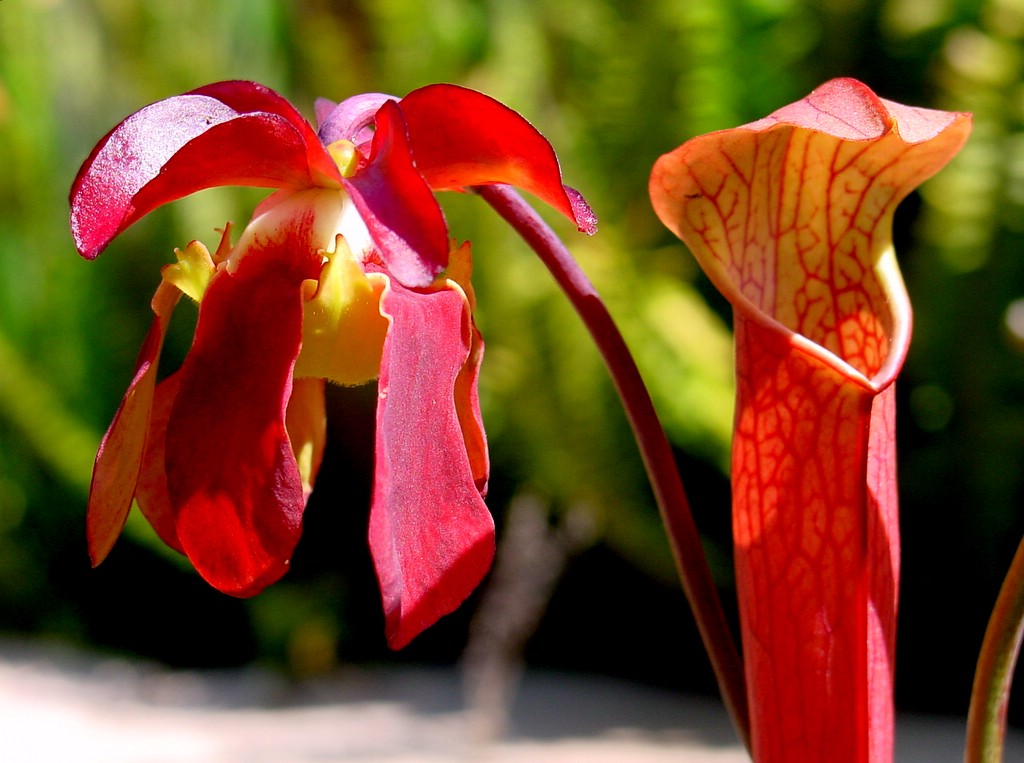
The most modest of the upright trumpet pitchers: slender pitchers that rarely reach half a metre, topped by small dark red flowers you can smell from several metres away on a still day. It is also the most awkward species of the genus, because what stands here under one name is, in the field, a series of regional forms scattered from the coastal plain to the southern Appalachians.
Varieties
Identification
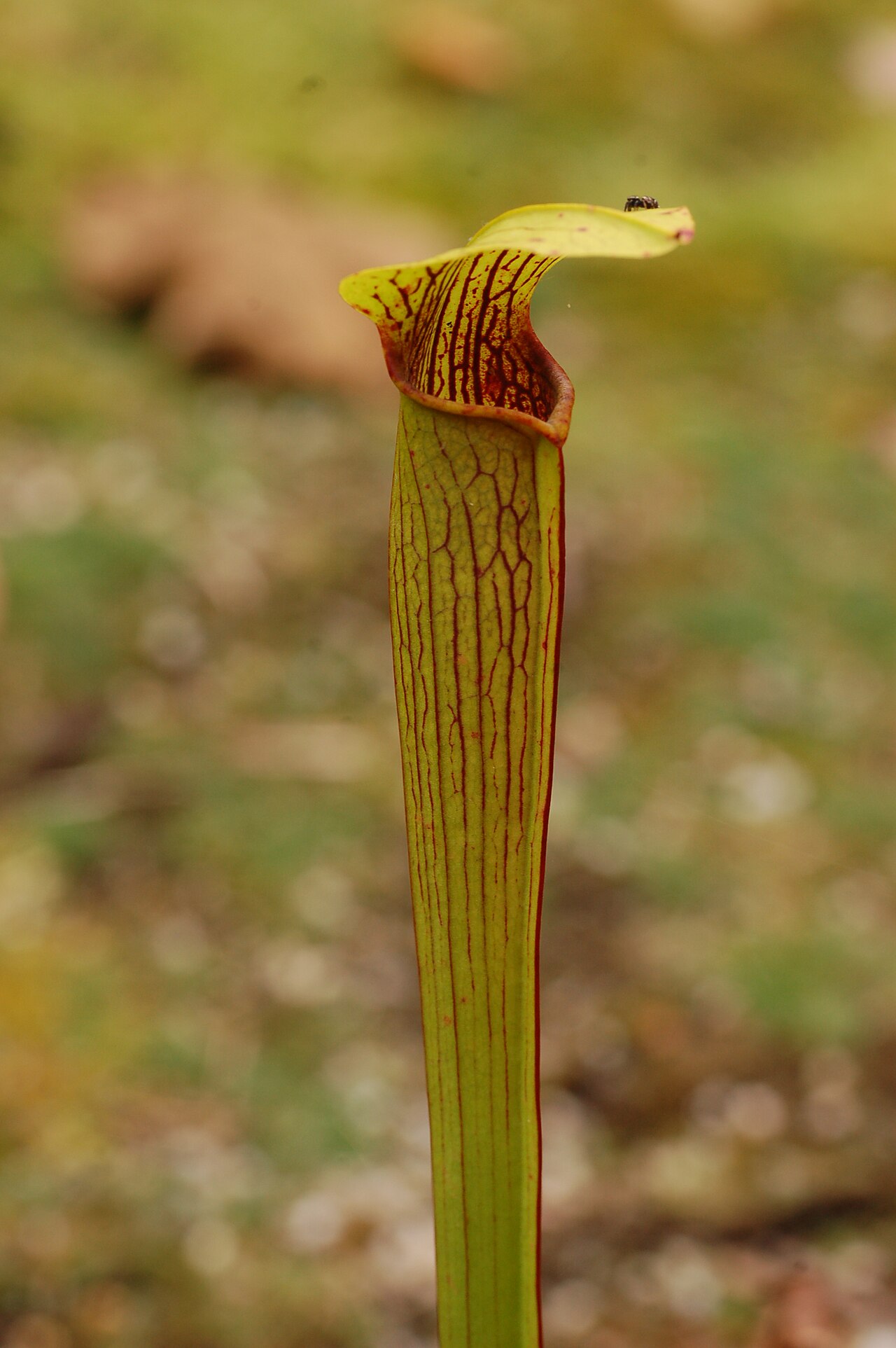
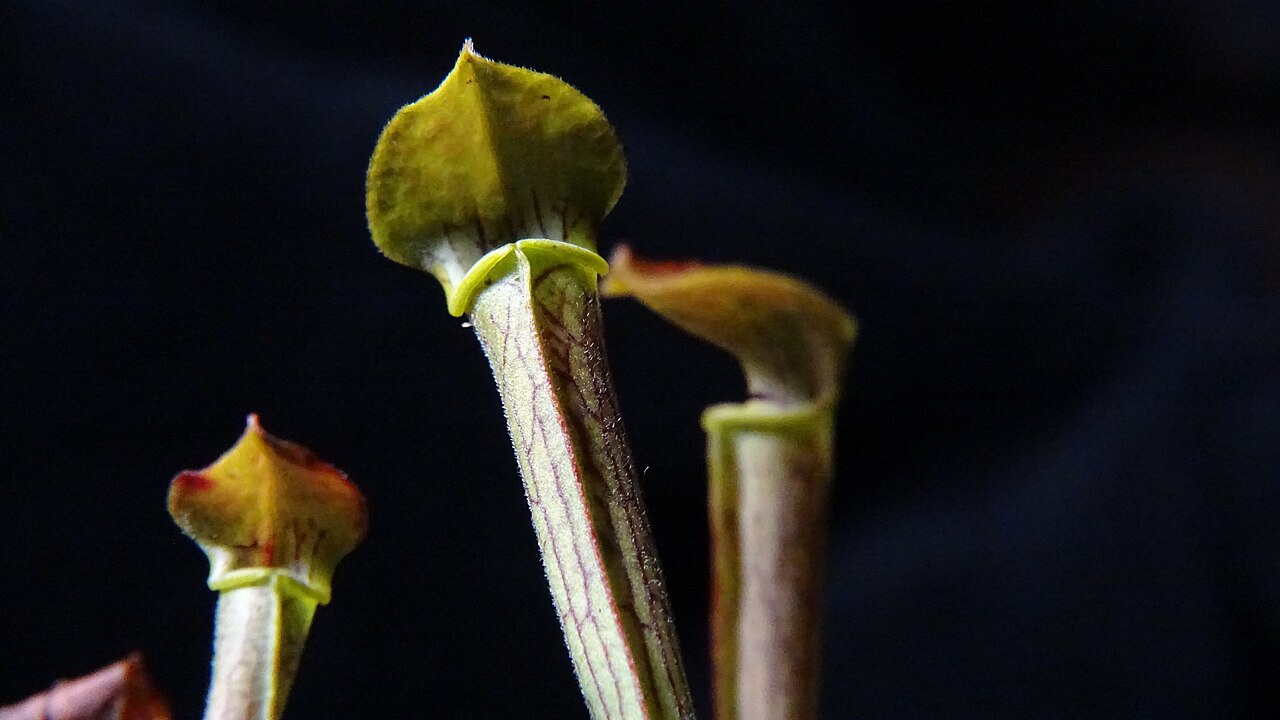
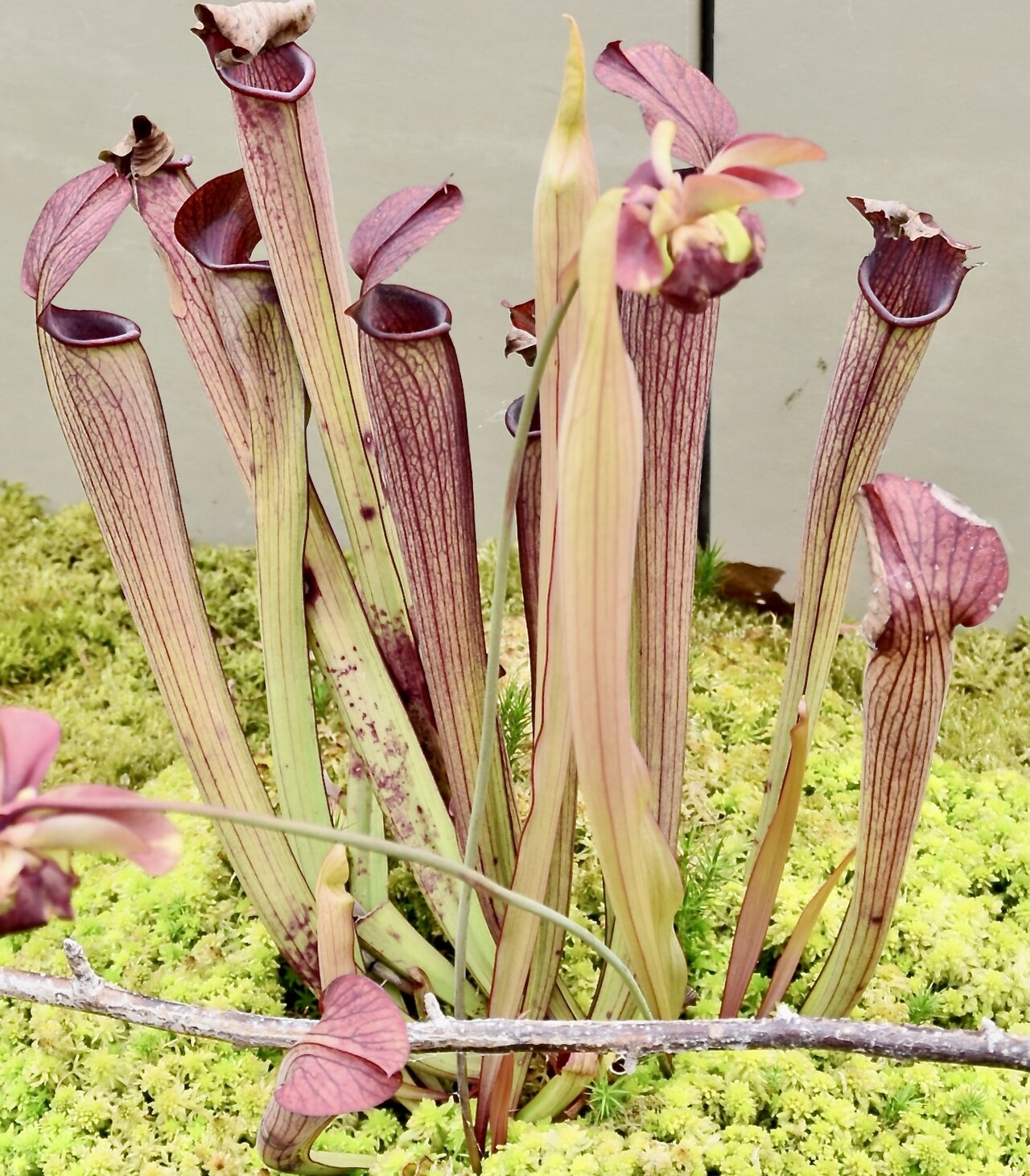
Erect, slender pitchers (6–)10 to 52, exceptionally 57 cm tall, green to flushed red or wholly maroon, with a narrow wing 0.5 to 2 cm wide down the front. The orifice is oval and small, 0.5 to 3.5 cm across, with a tightly revolute green to red rim. The hood is held almost horizontally and close over that orifice, ovate and flat to slightly undulate, 0.7 to 4.5 by 0.7 to 4 cm; translucent white areolae are entirely absent. From a rhizome 0.5 to 1.5 cm thick rise one or two scapes 12 to 75 cm tall bearing a nodding flower: maroon sepals 1.5 to 2.7 cm and obovate petals 2.5 to 4 by 1.3 to 2.5 cm. The scent is strong and sweet, and it is the most reliable character the species has.
Similar species
The same savannas hold larger species with a far wider mouth. Sarracenia flava and S. leucophylla are two to three times as tall and have yellow flowers; S. leucophylla also carries a net of white windows over the upper pitcher, which S. rubra never has. S. minor has those windows too and holds its hood like a helmet far over the opening. S. purpurea and S. rosea lie half on the ground instead of standing up. What is left is a slender upright pitcher with a small mouth, a low horizontal hood without windows, and a dark red flower that smells.
The trap and how it works
A classic pitfall with no moving parts. The wing on the front runs like a ladder from base to rim and carries nectar glands; that trail of sugar ends on the revolute rim, where the nectar is richest and the surface slick. Anything that walks on falls into the tube. Inside, three zones can be told apart: a waxy belt where no foot finds purchase, below it a belt of downward-pointing hairs, and at the bottom the fluid. The hairs stand like barbs and make the way back impassable. Unlike the pitcher of Heliamphora, this one has no drainage slit: it catches rainwater, and the level in the tube rises and falls with the weather. A small mouth means a small menu — mostly ants, small flies and spiders — and the plant digests the catch with enzymes of its own as well as with the bacteria living in the fluid.
Habitat and ecology
Wet longleaf pine savanna, seepage bogs on sand along the edges of sand ridges, and the damp fringe of pocosin scrub. In the mountains it grows in small bogs and in the wet margin beside waterfalls and streams. Everywhere the soil is acid, sandy to peaty and wet the year round. Like the other trumpet pitchers it needs open ground: where fire stays away the scrub closes and within a few years the plant disappears beneath the branches.
Distribution and elevation
The coastal plain of North and South Carolina, Georgia, the extreme north of Florida and Alabama, together with a group of isolated mountain populations in the southern Appalachians of North and South Carolina. The range is thus broken in two, and the two halves carry different subspecies. Outside this area the species does not occur in the wild.
- Recorded (quarter-degree cells)
Forms and variation
This is not a species but a complex. Subsp. rubra of the Carolinas, subsp. gulfensis of the Gulf coast, subsp. wherryi and subsp. alabamensis of Alabama, and subsp. viatorum and subsp. jonesii of the mountains are distinguished; they differ in pitcher height, hood width and hairiness. Several American floras raise jonesii and alabamensis to species; this guide follows POWO and keeps them as subspecies within S. rubra. The difference is not merely on paper: those two are listed separately in CITES Appendix I. Natural crosses with other trumpet pitchers occur where the species meet.
Where and when to see it
Look low, and look with your nose. The pitchers vanish among sedges and grass, but the flower is dark red and scented so strongly that you smell it before you see it. Go to open, fire-managed savanna or to the edge of a seepage slope where the water runs visibly over the sand; the plant usually stands in small groups. The best field character is the hood: small, flat and horizontal over a narrow mouth, without a trace of white windows. Look into a pitcher, but do not cut one open; a pitcher has to last a whole season.
Conservation status
The species as a whole has not been assessed by the IUCN — the Red List gives it no category, and it stands here as not evaluated. What is settled: the whole genus is in CITES Appendix II, and two subspecies are listed separately in Appendix I and have been federally endangered in the United States since 1988 and 1989. Of the mountain populations of subsp. jonesii fifteen sites remain, holding an estimated seven hundred to twelve hundred plants between them. The causes are the same everywhere: drainage, the absence of fire that lets scrub close over, conversion of savanna, and the digging of wild plants for the trade.
Scientific name
Sarracenia rubra | Walter, 1788
Thomas Walter described the species in 1788 in Flora Caroliniana. No precise type locality was given; the species occurs naturally in the coastal plain and southern Appalachians of the Carolinas, Georgia, Florida and Alabama. The species epithet rubra is Latin for 'red', referring to the dark red flowers.
World Checklist of Vascular Plants (WCVP), via Plants of the World Online (POWO), Royal Botanic Gardens, Kew.