All species › Ericales › New World pitcher plant family › Sarracenia alata
Sarracenia alata | Pale pitcher plant
Gevleugelde trompetbekerplant
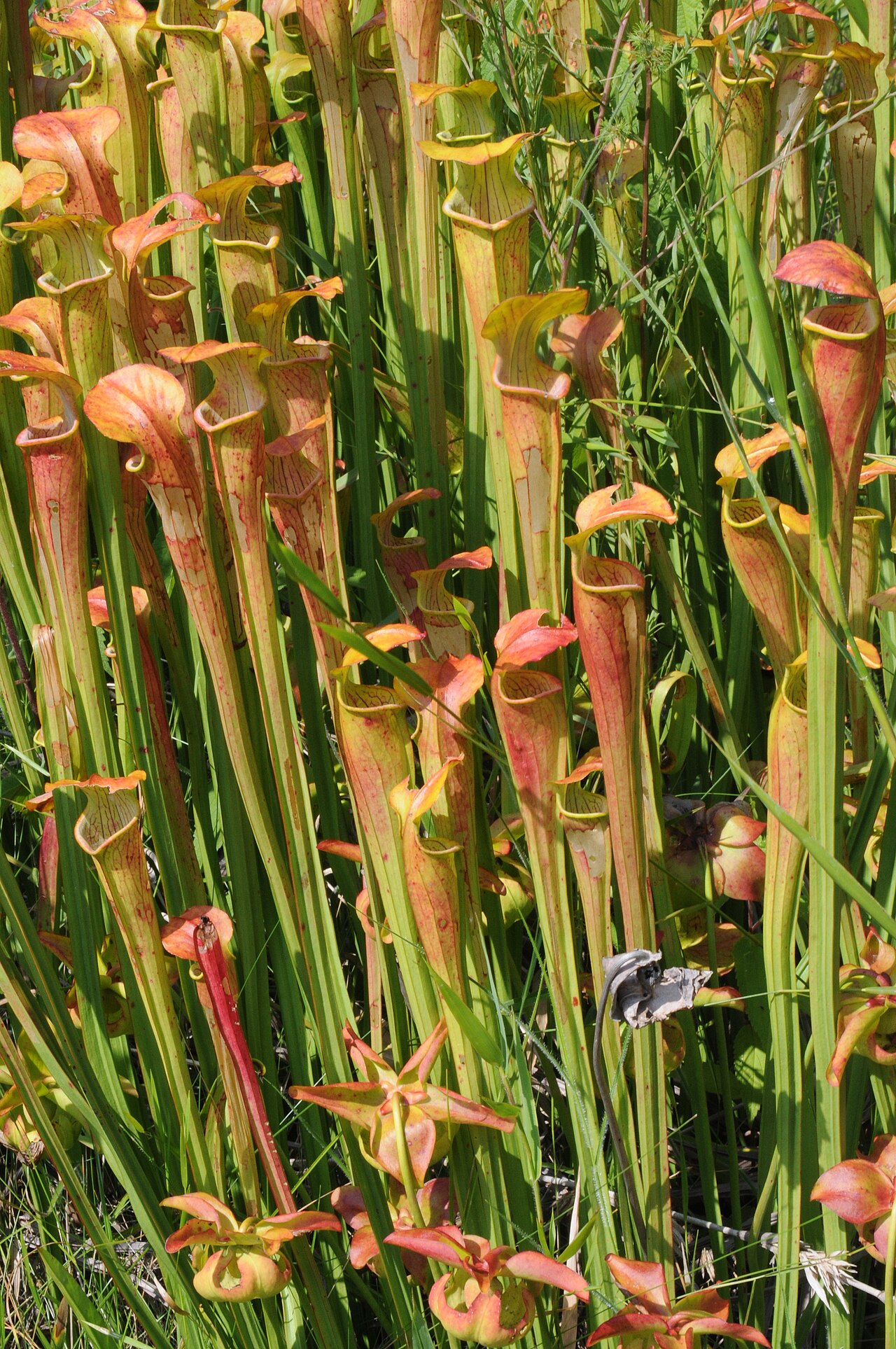
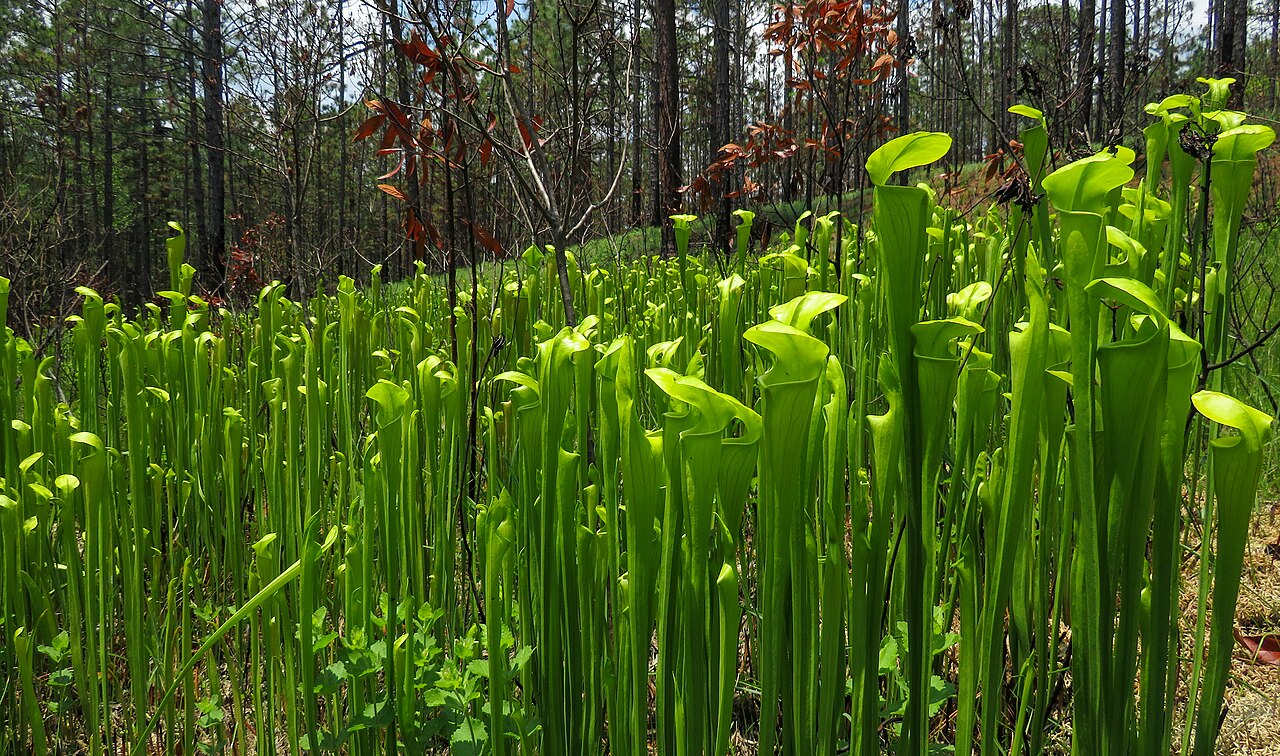
The trumpet pitcher of the west: where the savanna beyond Mobile Bay turns into the coastal plain of Mississippi, Louisiana and Texas, this is usually the only upright species standing in it. It grows in dense stands of hundreds of pitchers at a time, pale yellow-green, with a hood that hangs like an awning over the mouth.

Natural hybrids
Identification
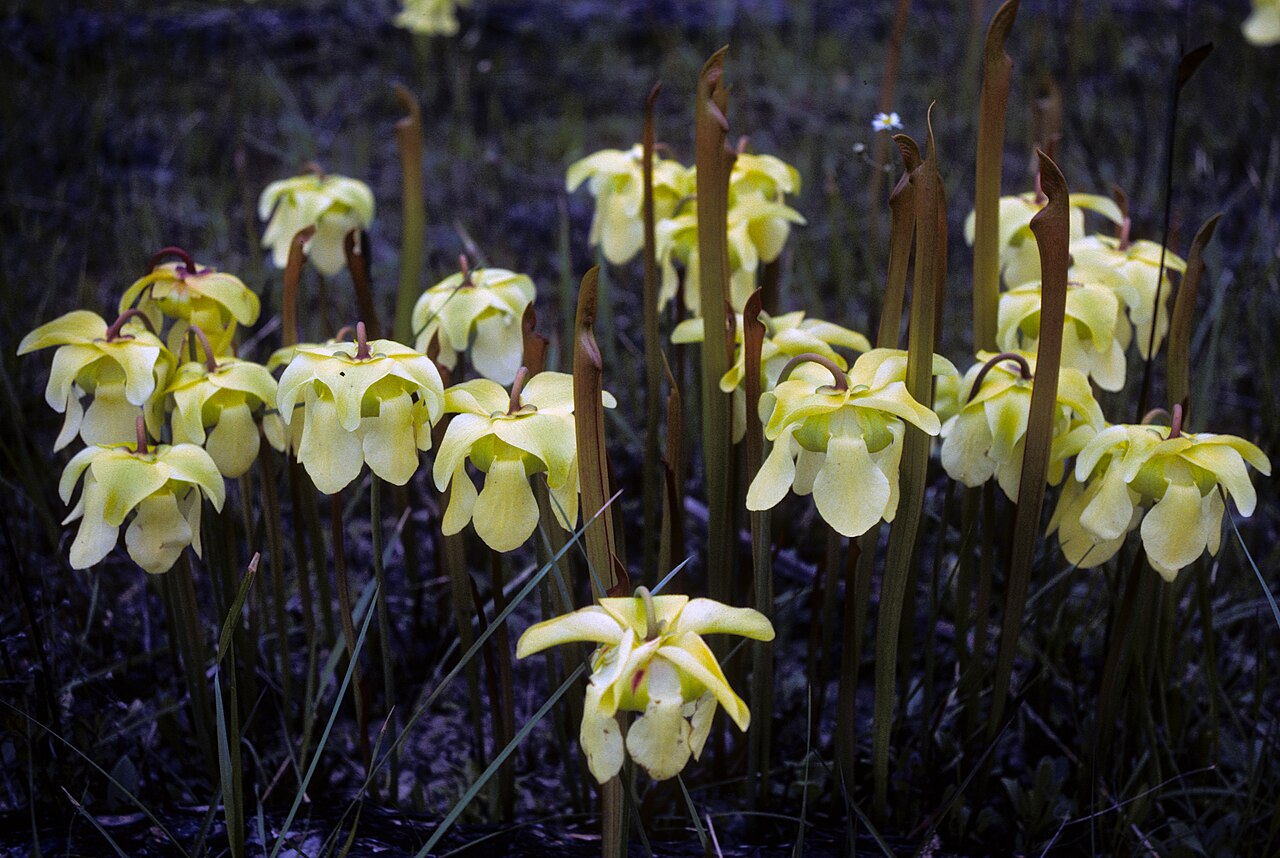
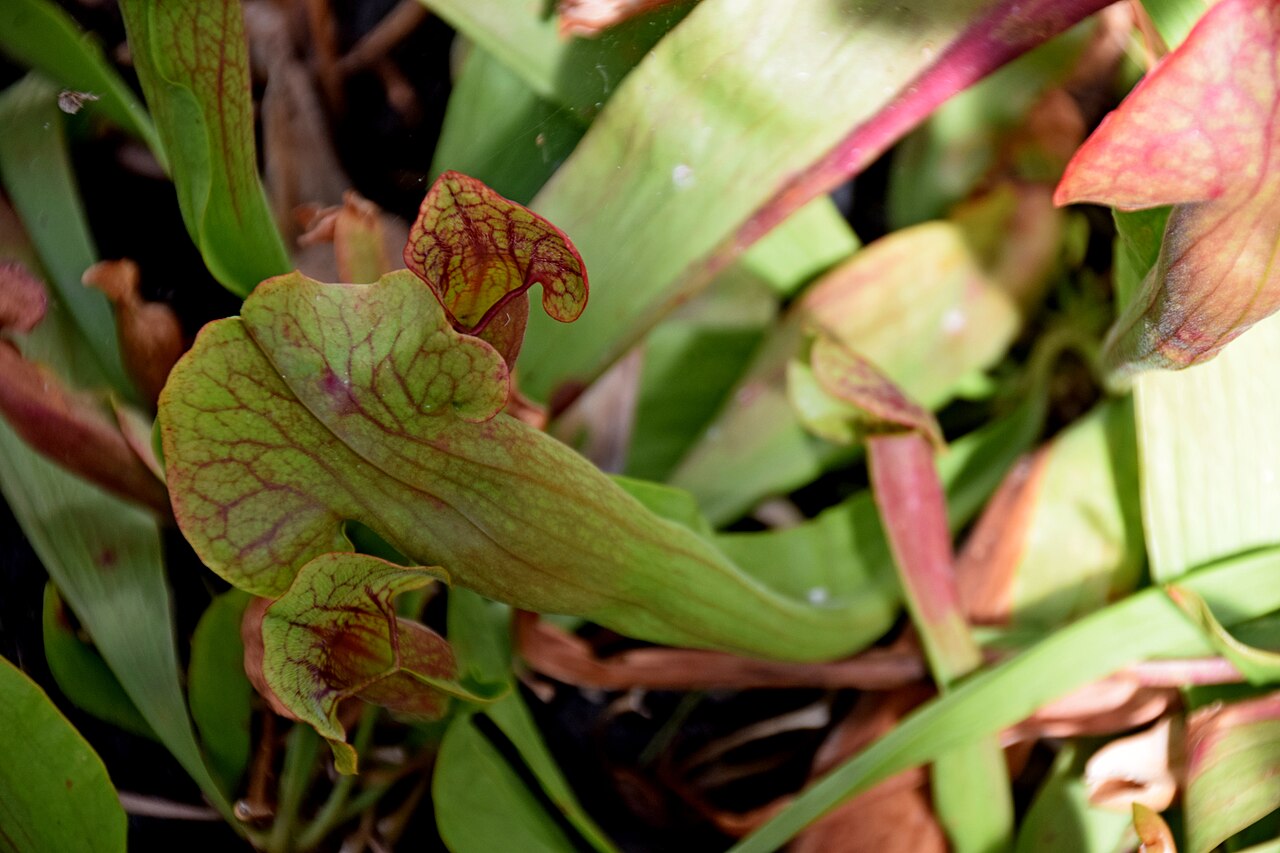
Erect pitchers 15 to 75 cm tall, the upper part usually yellow-green, sometimes purple-lined or purple-veined and in some plants strongly suffused with purple; translucent white areolae are absent. The wing on the front is 1 to 2 cm wide. The orifice is oval, 2 to 5 cm across, with a green, tightly revolute rim. The hood is recurved and held well beyond and over the opening, 3.5 to 6 by 4 to 6 cm and usually wider than long. Sword-shaped pitcherless leaves are usually absent; where present there are one or two, to 40 by 1 to 2 cm. The scape is 15 to 60 cm and stays below the pitchers; the flower has yellowish green sepals 3 to 6 by 2.5 to 4 cm and pale to deep yellow petals. The plant makes two flushes of pitchers a year: a light one in spring and a more robust one in late summer.
Similar species
In the eastern part of the range it stands beside Sarracenia leucophylla, which carries a net of white windows over the upper pitcher, and beside S. flava, whose hood stands upright above the mouth instead of hanging over it like an awning; S. flava also often has a red blotch in the throat. S. rubra is far smaller, with a narrow mouth and dark red flowers. West of the Mississippi the question lapses: there this is the only trumpet pitcher with erect pitchers, and anything lying flat on the ground is S. psittacina or S. purpurea.
The trap and how it works
A pitfall with no moving parts, but with a carefully built route. Nectar glands are densest on the rim of the mouth and on the underside of the hood, so an insect climbing the wing arrives of its own accord at the slipperiest place. The rim is tightly revolute and offers no grip. Inside the tube comes first a waxy zone where feet find no purchase, below it a zone of downward-pointing hairs, and at the bottom the fluid. The hood hangs well over the mouth and keeps the heaviest rain out, but does not seal it: unlike Heliamphora there is no drainage slit, and in a wet week the pitcher does fill with rainwater. The catch is mostly ants, flies, wasps and beetles; the plant digests them with enzymes of its own and with a community of bacteria and larvae living in the fluid.
Habitat and ecology
Wet longleaf pine savanna, wet flatwoods, open bogs and pineland seepage slopes; sometimes also on mineral soils low in organic matter, which is unusual for this group. The ground is permanently saturated and poor. Management decides everything: where fire is used, or where a roadside is mown regularly, the densest stands are found; where nothing happens, the site closes over within a few years.
Distribution and elevation
The Gulf coastal plain from south-western Alabama through southern Mississippi and Louisiana into eastern Texas, from sea level to at most fifty metres. The range falls into two blocks separated by the Mississippi valley: an eastern group from Louisiana to Alabama and a western group from western Louisiana into Texas. Endemic to this area; outside it the species does not occur in the wild.
- Recorded (quarter-degree cells)
Forms and variation
Variation is wide but has not been fixed in names: plants with an all-green pitcher, with purple veins, and with a deeply purple-suffused upper half often grow mixed within one population. The most striking are the heavily purple plants of some populations in Mississippi and Alabama. No varieties are recognised, and the coloured selections circulating in the trade are products of cultivation and fall outside this guide. Natural crosses with S. leucophylla, S. psittacina and S. rubra occur where the species stand together.
Where and when to see it
March and April: the yellow flowers then stand over a savanna still short after the winter burn, and can be seen from the road. The spring pitchers come up shortly after the first flowers; anyone arriving later in the year sees the heavier late-summer flush. Look along the wet side of a sand road through pineland, or in a reserve managed with fire. The field character is the hood hanging like an awning far over the mouth, with no white windows above it.
Conservation status
Near Threatened on the Red List and, like all trumpet pitchers, listed in CITES Appendix II. The species is still numerous and large populations stand on public land in Louisiana and Texas, but the savanna it belongs to has largely been turned into pine plantation, farmland and housing over a century, and what remains is often no longer burned. Drainage, dense pine planting and the closing over of seepage slopes are the main causes; the digging of wild plants plays a smaller but real part.
Scientific name
Sarracenia alata | (Wood) Wood, 1863
Alphonso Wood first published the name in 1861 as a variety, Sarracenia gronovii var. alata, in his Class-Book of Botany; in 1863 he raised it to species rank in Leaves and Flowers. No precise type locality was given; the species occurs naturally along the Gulf Coast, from eastern Texas to western Florida. The species epithet alata is Latin for 'winged', referring to the narrow wing running down the length of the pitcher.
World Checklist of Vascular Plants (WCVP), via Plants of the World Online (POWO), Royal Botanic Gardens, Kew.