All species › Ericales › New World pitcher plant family › Sarracenia oreophila
Sarracenia oreophila | Green pitcher plant
Groene trompetbekerplant
The only trumpet pitcher that chose the uplands instead of the coastal plain, and the rarest of them all. It grows on the Cumberland Plateau and in the southern Appalachians, where thirteen natural populations remain. The most striking thing about it is not its pitcher but what replaces it after summer: a ring of flat, sickle-shaped leaves with no trap at all.

Identification
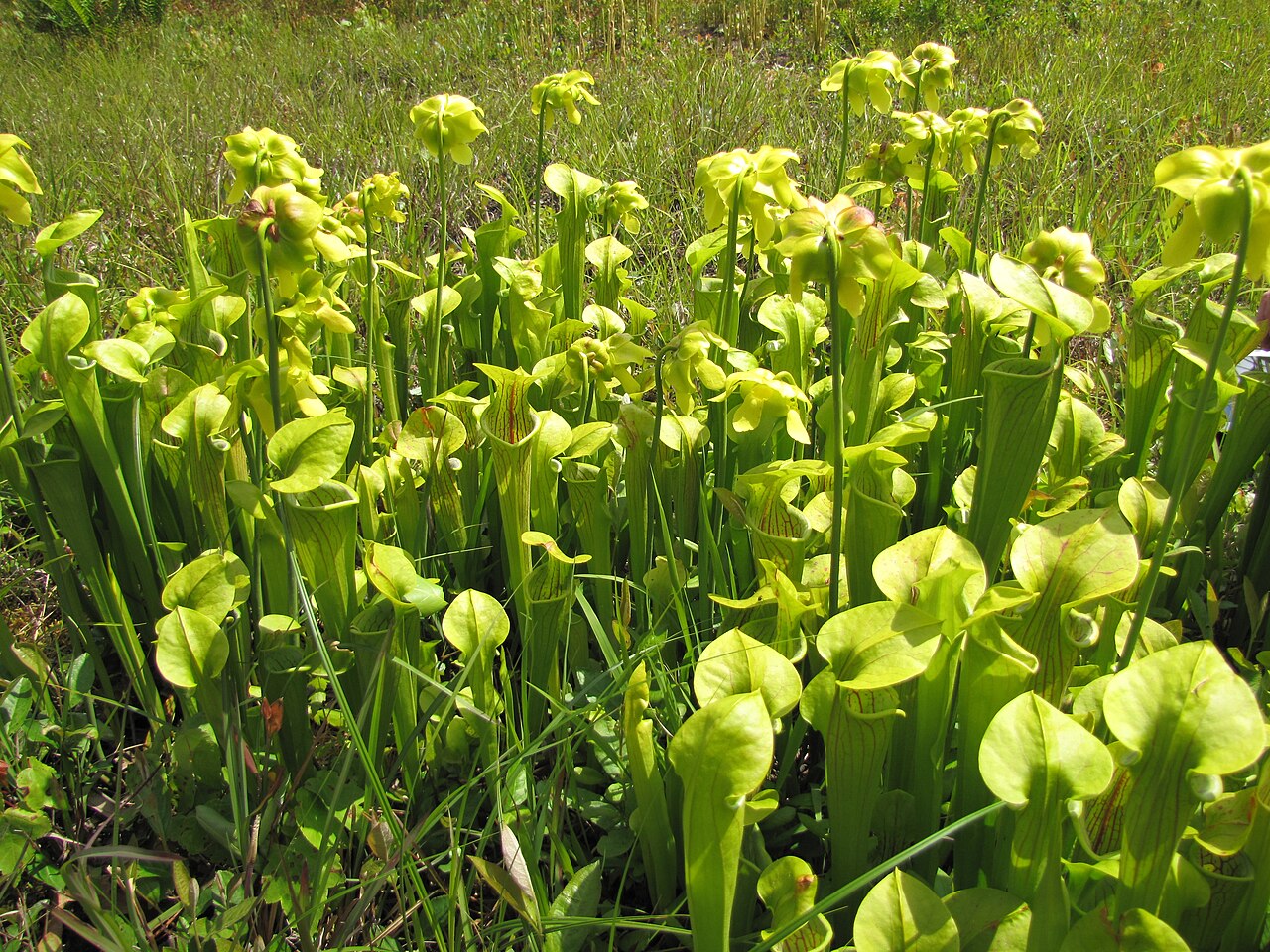
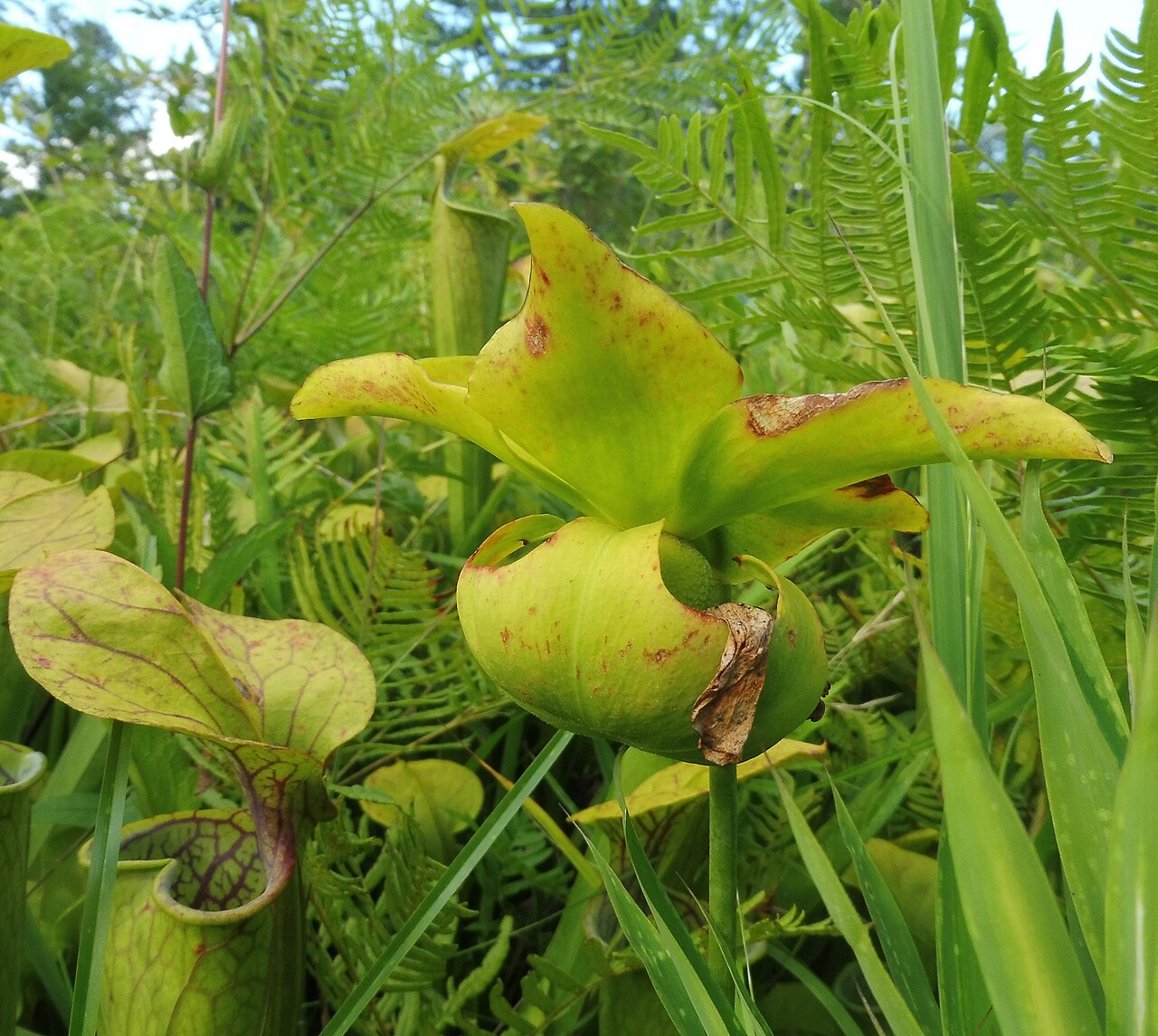
Erect pitchers 18 to 75 cm tall, green to yellowish green, sometimes purple-veined or suffused with purple, without translucent white areolae; the wing on the front is narrow, 0.5 to 1 cm. The hood is yellow-green, broadly ovate to reniform and somewhat undulate, 2 to 8 by 2.5 to 8 cm, held over the opening. The decisive character stands beside it: three to five sword-shaped pitcherless leaves, usually more numerous than the pitchers themselves, decumbent to ascending and weakly to strongly falcate, 5 to 18 by 0.5 to 3.5 cm. In the second half of summer the pitchers wither and the plant is left with little but those sickles. The scape is 45 to 70 cm and stays shorter than the pitchers; the flower is yellow, with sepals 3 to 5 by 2 to 3 cm and petals 4 to 5.5 by 1.4 to 1.7 cm, and is faintly ill-scented.
Similar species
There is confusion with one species only: Sarracenia flava, which is as tall, flowers as yellow and has the same erect pitcher. Two things separate them. First the sword-shaped leaves: in S. oreophila they are numerous, decumbent to ascending and clearly falcate, and after summer they take over the work of the withered pitchers; in S. flava they are few and upright. Second the country: S. oreophila is a plant of the uplands at two to three hundred metres, S. flava a plant of the coastal plain. Where the two do meet, the sickle is the answer.
The trap and how it works
The same pitfall as in the other trumpet pitchers: nectar up along the wing, the densest glands on the revolute rim and under the hood, inside a waxy zone and below it downward-pointing hairs that close the way back. A drainage slit is absent, as throughout the genus: the pitcher catches rainwater and the level shifts with the weather. What sets this species apart is how briefly all this lasts. The pitchers come up in spring and wither already in the second half of summer; for the rest of the growing season the plant does without traps and lives on the photosynthesis of its sickle-shaped leaves. Its trapping season is thus shorter than that of any other species in the genus.
Habitat and ecology
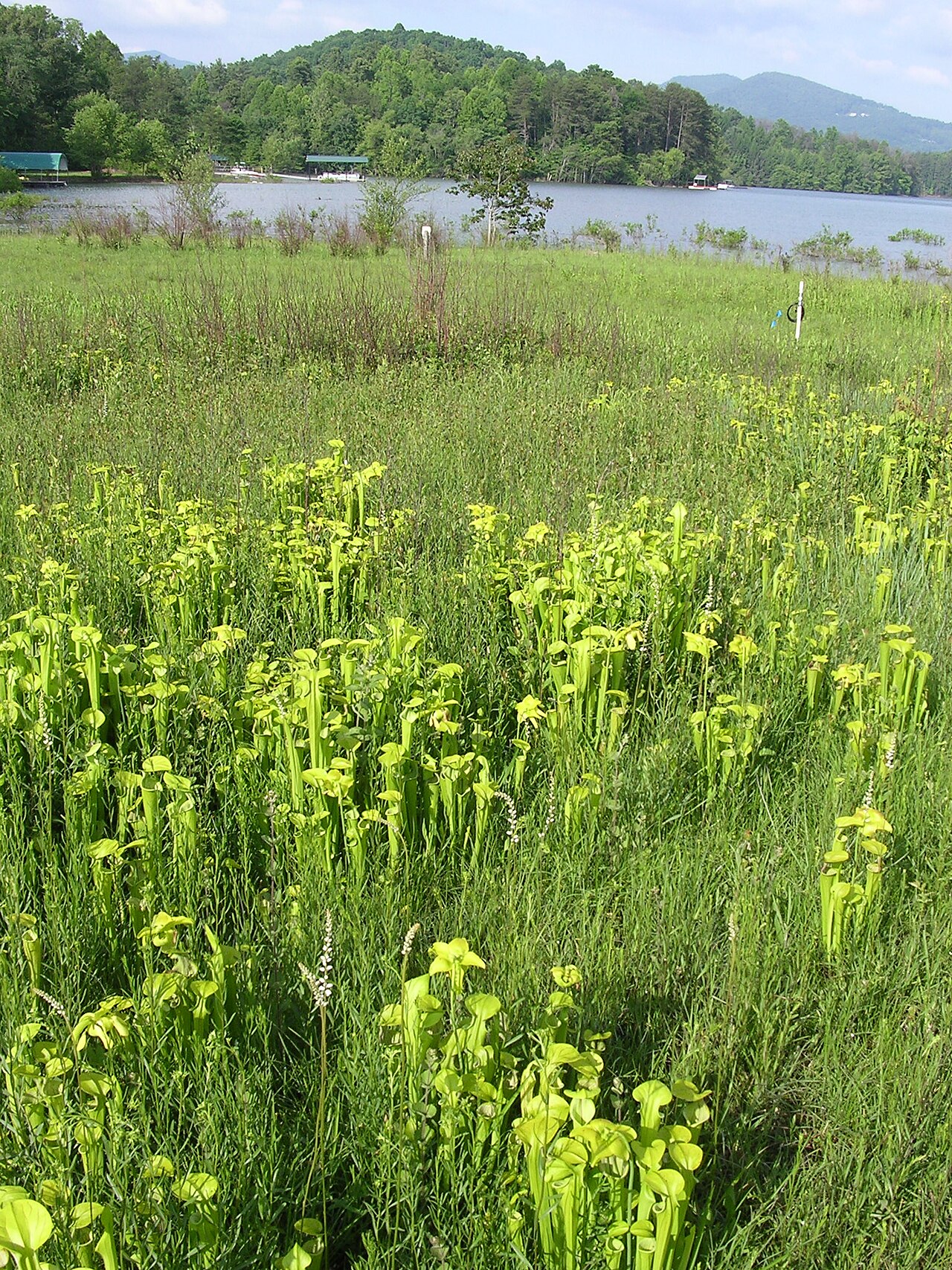
Seepage bogs and wet sands, boggy banks of streams and rivers periodically scoured by floods, wet thickets, and seeps in rich oak woodland. The two main types — bank sites along running water and bogs higher on the plateau — differ sharply in stability: the banks are naturally temporary and one severe flood can remove them in a single season. Everywhere the same rule holds: light has to reach the ground, and where scrub closes over the plant goes.
Distribution and elevation
The uplands of north-eastern Alabama, north-western Georgia and the extreme south-west of North Carolina, at roughly two to three hundred metres above sea level. By far the most sites lie in Alabama. This guide gives no location finer than the state and the upland: for a species with thirteen natural populations left worldwide, a set of directions is a risk that does not repay the convenience.
- Recorded (one-degree cells)
Forms and variation
There is little to report on forms here, and there is a reason: the number of populations is so small and they lie so far apart that the variation there is — in the degree of purple colouring and in pitcher length — owes more to the site than to inherited difference. No varieties or colour forms are recognised. Natural crosses with S. purpurea have been described at the single place where the two meet in the uplands.
Where and when to see it
April to June is when you will recognise it: the yellow flower then stands above the fresh pitchers. Come later and look for the sickles — a rosette of flat, curved leaves without a trap is the signature character in this landscape. A few populations lie on publicly managed or conservation-owned ground with a path along the edge; which ones is not in this guide, and that is deliberate. Ask at the reserve itself, stay on the path and leave the plant alone: every rhizome that leaves the ground is a measurable share of the world population.
Conservation status
Critically Endangered on the Red List and the only trumpet pitcher listed in CITES Appendix I. In the United States it was, in 1979, the first carnivorous plant placed under the Endangered Species Act. At the most recent five-year review thirteen natural populations remained, against fifteen in 2014, spread over three states; eight of them lie on public or conservation-managed land. The causes are the absence of fire and management, which lets woody growth overtop the plant, severe floods that wash away bank populations, the digging of plants for the trade, and the loss of cooperation from private landowners.
Scientific name
Sarracenia oreophila | (Kearney) Wherry, 1933
Thomas H. Kearney first described the species in 1900 as a variety of Sarracenia flava, as Sarracenia flava var. oreophila; Edgar T. Wherry raised it to species rank in 1933. The type locality lies in the mountains of north-eastern Alabama. The species epithet oreophila is Greek for 'mountain-loving', from oros ('mountain') and philos ('loving'), referring to the mountainous habitat in the southern Appalachians.
World Checklist of Vascular Plants (WCVP), via Plants of the World Online (POWO), Royal Botanic Gardens, Kew.
Natural hybrids of this genus
These ten species can cross with one another. See the nineteen named natural hybrids of Sarracenia, with photographs where available.