All species › Passerines › Sylvia warblers › African desert warbler
African desert warbler | Curruca deserti
Afrikaanse woestijngrasmus | Curruca sahariana
The palest bird in this guide. The African desert warbler looks bleached: a small warm-sand warbler with a bright yellow eye that lives out its whole life in the Sahara, from southern Morocco to Libya, and occurs nowhere else on earth. For anyone driving out into the Moroccan desert it is the catch of the morning — a bird that runs away over bare gravel and gives itself away only when it flutters up above the bushes in a song flight.

Voice
A short, clear and surprisingly musical phrase of a few seconds, with more pure whistled notes and less scratchy grating than in Asian desert warbler: a light, cheerful little jingle that carries across the plain as though nothing else existed. It is almost always given in a song flight — the bird flutters a few metres above the bush on quivering, almost butterfly-like wingbeats, sings, and parachutes back down. The call is a dry rattling trrrt and a soft chek. Song mainly from February to May, fiercest in the first hour after sunrise; as soon as the heat starts to shimmer over the plain everything falls silent.
No freely licensed recording is available for this species yet.
Identification
Very small and exceptionally pale: warm sandy above with a faint golden wash, off-white below, with a rufous-orange rump and tail and white outer tail feathers. The closed wing is plain — coverts and tertials have pale sandy fringes with no obvious darker centres — so the upperside looks smooth and unmarked and the rusty tail contrasts only moderately with the back. The iris is bright yellow with a narrow white ring, the small bill yellowish with a dark tip, the legs pale straw. Sexes alike. It spends most of the day on the ground, running under and between the bushes with the tail slightly raised and often spread.
Confusion species
Asian desert warbler is the only real problem, and its own page sets out the same difference from the other side. That bird is colder and greyer above, so its rusty tail contrasts clearly with the back, and it has darker centres to the greater coverts and tertials, which makes the closed wing look patterned. African desert warbler is warmer, golden-sand and uniform throughout. Both have the yellow iris, the yellow bill and the pale legs. Locality decides: African is a Saharan bird, from Morocco to Libya, Asian one of the Caspian steppes and Central Asia, and the two ranges nowhere touch. The two were long carried as a single species, Sylvia nana, and are treated as two by AviList 2025. Sharing the same scrub is Streaked Scrub Warbler Scotocerca inquieta, confusingly similar at range but with a long, often cocked tail with a dark tip, a streaked crown, a dark eye and a clear supercilium. Tristram's Warbler is darker grey-brown with a rufous wing panel and an orange eye-ring; spectacled warbler has a grey head, a rufous wing panel and a dark eye.
Habitat
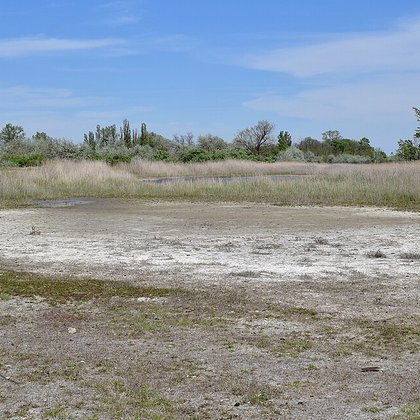
Sandy and gravel desert with scattered low bushes and much bare ground between them: dune edges with tamarisk and Nitraria, salt flats with saltwort, the vegetated margins of wadis and dried lake beds, and the flat hamada plains dotted with dwarf shrubs that every visitor to Morocco knows. The bush is needed for the nest, placed less than a metre above the ground, and for the song post; feeding is done almost entirely on foot across the open ground.
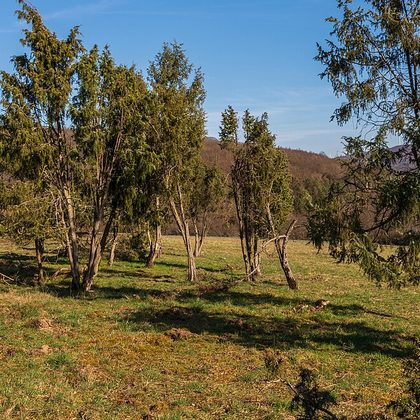
Where the bird is most at home, classified with EUNIS — the European standard for habitats.

Range and movements
The Sahara and nothing else: from southern Morocco, Western Sahara and Mauritania east through Algeria and Tunisia into Libya, and south to northern Mali and northern Niger. It occurs nowhere else in the world and does not migrate; birds shift about locally after rain or drought and that is all. Wanderers have reached the Canary Islands — four Spanish records, on Fuerteventura and Tenerife — and Israel, and once the Netherlands: a bird at Alphen aan den Rijn from 12 November to 11 December 2014, the only record north of the Alps.
- Resident
- Winter
- Passage
- dark = core range, pale = thinly spread
Where and when to look
Morocco, February to April, the first two hours of daylight: the Tagdilt track near Boumalne Dades, or the sandy flats around Merzouga. Walk slowly and watch the ground between the bushes rather than the bushes themselves — what catches the eye is movement at ankle height, not a bird in a twig. Once one sings the job is done, because the fluttering song flight above a low shrub shows from a long way off. After about nine in the morning heat shimmer makes every view worthless, so all of it has to happen in the first light.
Conservation status
Not threatened: the range is enormous, if thinly occupied everywhere, and no decline has been demonstrated. The pressures are local and subtle — prolonged drought, heavy grazing by camels and goats that strips out the low scrub, the cutting of bushes for firewood, and the growing traffic of four-wheel drives and quad bikes across exactly the flat, open terrain where it is commonest. Systematic counts are almost entirely lacking, so the real trend is unknown.