All species › Passerines › Sylvia warblers › Asian desert warbler
Asian desert warbler | Curruca nana
Woestijngrasmus | Curruca del desierto
A warbler the size of a lesser whitethroat, the colour of the sand it lives on, with an eye like a drop of yellow paint. The Asian desert warbler runs on the open ground between the low bushes of the Central Asian semi-desert rather than hopping through them. Only the western fringe of its range — the lower Volga and the steppes north of the Caspian — reaches this guide's map; west of that it is a very rare autumn vagrant.

Voice
The song is a short jingle of two or three seconds in which sweet, clear notes and dry scratchy ones are mixed — nearer to a Whitethroat's chatter than to anything else, but thinner, higher and more silvery. It is usually delivered in an advertisement flight: the bird flutters a few metres up above the bushes on quivering wings, sings, and parachutes back down onto a twig. The call is a dry rattling trrrt, often in short bursts, and a low nasal chair. Song from late April through June, most persistent in the first hours after sunrise, when there is no other sound in the semi-desert at all and the jingle carries a very long way.
No freely licensed recording is available for this species yet.
Identification
Tiny and pale, sandy grey-brown above and whitish below, with almost no pattern except at the back end: the rump and tail are warm rufous-orange and the outer tail feathers are white, and it is that rusty tail set against a colder grey-brown mantle that catches the eye. The iris is a bright, staring yellow with a narrow pale ring around it. The bill is small and straw-yellow with a dark tip; the legs are pale yellowish. The closed wing is faintly patterned: the greater coverts and tertials have darker centres inside pale sandy fringes, so the wing looks a shade busier than the rest of the bird. Sexes alike; autumn birds are warmer and buffer than worn spring adults. On the ground it runs rather than hops, and it constantly flicks and spreads the tail.
Confusion species
African desert warbler is the only real problem, and it is set out from the other side on its own page. That bird is the paler and warmer of the two: a smooth golden-sand warbler whose closed wing shows no darker feather centres at all, so the whole upperside looks uniform and the rufous tail contrasts less with the back. Asian desert warbler is colder and greyer above, which makes the rusty tail stand out more, and it shows those darker centres on coverts and tertials. Both have the yellow iris, the yellow bill and the pale legs, so none of those helps. In practice geography decides: Asian is a bird of the Caspian steppes and Central Asia, African of the Sahara, and the two ranges nowhere touch — the Nile and half the desert lie between the wintering Asian birds on the Red Sea and the African birds of the western Sahara. They were long carried as a single species, Sylvia nana, and are treated as two by AviList 2025. Menetries's Warbler shares the habitat in Iran and Transcaspia but is darker, with a dark tail that it waves constantly and a reddish eye-ring. Desert Whitethroat is greyer and colder still, with dark legs and no rufous whatever in the tail.
Habitat
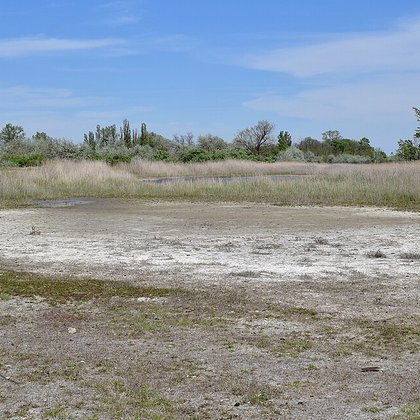
Flat clay and sandy semi-desert and dry steppe with scattered low bushes — saxaul, saltwort, Anabasis, wormwood — and bare, hard ground between them. The bushes are needed only for the nest and the song post; all the feeding is done on the open ground beneath and around them. Salt flats with a fringe of low scrub are especially favoured. In winter it moves to sandy desert, gravel plains and coastal saltbush in Arabia and along the Red Sea, still always where there is bare ground to run on.
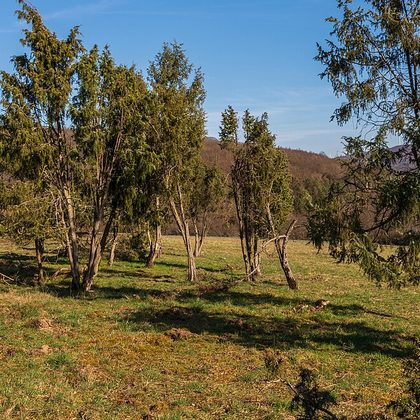
Where the bird is most at home, classified with EUNIS — the European standard for habitats.

Range and movements
Breeds from the Volga delta and the semi-deserts north of the Caspian east through Kazakhstan and Turkmenistan to Mongolia and north-west China. That western tip is the only part of the breeding range that falls inside this guide's map, but the whole winter range does as well: Arabia, Sinai, Egypt and north-east Sudan, together with Iran, Pakistan and north-west India further east. In western Europe it is a very rare vagrant, almost always on the coast in late autumn — three Dutch records, at Zandvoort in 1988, The Hague in 1994 and Terschelling in 2015, with a comparable handful in Britain and Scandinavia.
- Breeding (summer)
- Winter
- Passage
- Migration direction
- dark = core range, pale = thinly spread
Where and when to look
In winter in the Arabian deserts, in Sinai or in Egypt's Eastern Desert, use the wheatears. This warbler regularly attaches itself to a feeding Desert or Mourning Wheatear and works the ground a metre or two behind it, taking what the wheatear puts up. Scan the ground around every wheatear in low scrub and sooner or later a small pale bird with a yellow eye runs out from under a bush. On the breeding grounds go at first light and wait for the song flight: a bird that flutters up out of a saltwort bush and parachutes back down is far easier to find than one running on the ground, where it disappears completely.
Conservation status
Not threatened. The range is enormous and thinly but continuously occupied, and no serious decline is known anywhere in it. Locally the ploughing up of steppe, heavy grazing by sheep and camels and the cutting of saxaul for firewood remove the low bushes it needs for nesting, and the same loss of scrub is at work in the Arabian wintering areas. Because it lives where almost nobody counts birds, trends across most of the range are simply unknown.