All species › Passerines › Sylvia warblers › Eastern Orphean warbler
Eastern Orphean warbler | Curruca crassirostris
Oostelijke orpheusgrasmus | Curruca mirlona oriental
The eastern Orphean warbler is the heavy eastern counterpart of the western species: a large warbler with a coarse bill, a black hood and a pale eye, pouring out a long, rich strophe from the top of an oak. To see one you go to Lesbos or south-west Turkey, where it takes up the old olive groves and the oak-covered slopes from mid-April.

Voice
The song is longer, fuller and more varied than the western species': a continuous stream of clear fluting phrases alternating with grating and rattling passages, which can run on for minutes. Where the western bird gives short whistles with silences between them, the eastern one bubbles straight through and so recalls a Nightingale clearing its throat now and then: tyoo-lee tyoo-lee cher-cher tyoo-wee-leet. It sings from the top of an oak, an olive tree or a tall thorn bush, from mid-April into June, most fiercely in the first two hours after sunrise. The call is a hard, dry tchek, often in series, and an agitated bird gives a low rattling tcherrr that suggests a lesser whitethroat but sounds deeper and slower.
No freely licensed recording is available for this species yet.
Identification
Large and solidly built, with a strikingly long, thick, pointed bill — the scientific name crassirostris means thick-billed for good reason. The male has a black to slate-black hood that runs well below the eye and across the ear-coverts, standing out sharply against a clean white throat and a grey mantle. In old birds the iris is white to pale yellow, ringed by a thin pale eyelid. The underparts are clean white, at most with a light grey cast on the flanks. The long tail is dark with white outer feathers, easily seen as the bird flies off; the legs are lead-grey to black. Females are duller and browner-headed, with less contrast and often a darker eye; young birds have a brownish hood and always a dark iris.
Confusion species
It all turns on western Orphean warbler, treated as a separate species since 2001 — see its own species page, where the same difference is set out from the other side. The eastern bird averages larger and heavier-billed, the hood is blacker and runs deeper, the contrast with the grey mantle is sharper, the underparts are clean white instead of cream- or pink-washed, and there is on average more white in the outer tail feathers. Every one of those characters is a matter of degree and the variation overlaps, so away from the breeding range an Orphean Warbler can rarely be named with certainty; then song and above all locality decide. The ranges do not meet: the eastern species breeds from Greece and Turkey eastwards to Iran and Central Asia, the western one from Iberia and southern France to north-west Africa. Beyond that, Rüppell's warbler is the dangerous neighbour in the same landscape: it is smaller, and the male has a black throat with a white moustachial stripe and a red eye-ring, where the Orphean has a white throat. Blackcap is smaller and finer-billed, with a cap stopping above the eye and a dark eye. Barred warbler is equally bulky but has a yellow iris, two white wing bars with white tertial fringes and barred underparts. Sardinian warbler is much smaller, with a bright red eye-ring and a rattling voice.
Habitat
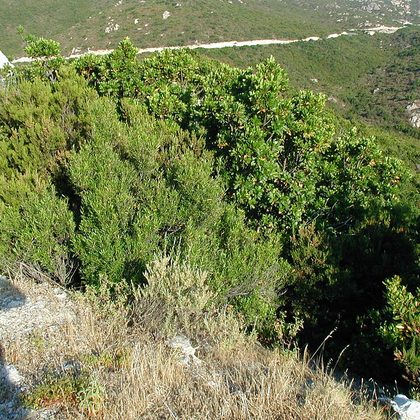
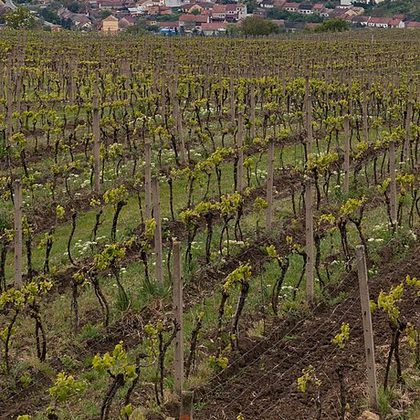
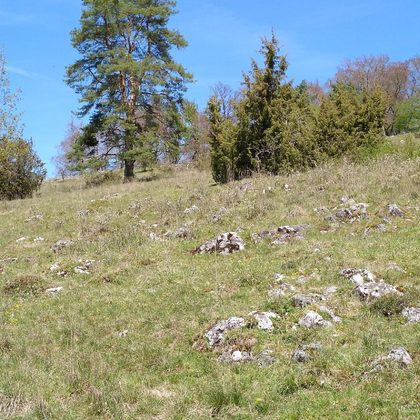
Warm, half-open slopes with height to the vegetation: tall maquis of kermes oak and juniper, open oak woodland and oak coppice, old olive and almond groves with stone walls, abandoned vineyards and montane scrub on the drier hillsides. In Turkey and Iran it climbs far into the mountains, locally above two thousand metres. Like the western species it wants height and song posts, and avoids the low, dense scrub that holds Sardinian warbler.
Where the bird is most at home, classified with EUNIS — the European standard for habitats.

Range and movements
Breeds from Croatia, North Macedonia and Greece eastwards through Turkey, the Caucasus and the Levant to Iran and Central Asia, and winters in north-east Africa, Arabia and India — so part of the range lies outside this map area. In Europe the Aegean coast is the stronghold, with Lesbos the best-known site. In north-west Europe it is an exceptional vagrant, and the few claims are laborious, because a silent Orphean Warbler away from the breeding grounds is barely identifiable.
- Breeding (summer)
- Passage
- dark = core range, pale = thinly spread
Where and when to look
The last week of April and the first half of May, on Lesbos or along the south Turkish coast, in the first two hours after sunrise. Walk an old olive grove or an oak slope and wait for the song; it carries far and is the one character that leaves no doubt. Then find the bird on the topmost twigs and check the heavy bill, the pale iris and the sharp border between black hood and white throat. Rüppell's warbler often uses the same scrub, so always check the throat before writing anything down.
Conservation status
Not threatened globally, with a very large range and a large population. Along the western edge, in the Balkans and Greece, it has declined locally with the loss of extensively managed olive groves, the clearance of scrub and the closing over of abandoned hillsides; in Turkey and Central Asia it still appears widespread. Because it winters in north-east Africa and Arabia, conditions along that long eastern migration route also count.