All species › Passerines › Sylvia warblers › Western Orphean warbler
Western Orphean warbler | Curruca hortensis
Westelijke orpheusgrasmus | Curruca mirlona occidental
The western Orphean warbler is the largest warbler of the Iberian Peninsula and the only one that sounds like a Blackbird: short, clear fluting phrases from the top of a holm oak, with silences in between. Since 2001 the eastern form has been treated as a separate species, so this bird is now the western half of a pair that once carried a single name.

Voice
This is where the name comes from. The song is a run of short, clear, fluting phrases repeated two, three or four times and separated by obvious silences: tyoo-lee tyoo-lee tyoo-lee, unhurried in tempo, warm and round in tone, like a Blackbird or a garden warbler taking its time. A short scratchy passage is sometimes slipped in between the whistles, but the whole remains strikingly melodious and slow for a warbler, and it is that slowness which picks it out from the hurried chatter of the other species. It sings from the top of a holm oak, a juniper or an almond tree, well in the open and with the head raised, usually in the first hours after sunrise, from late April into June. The call is a hard, dry tchek, like two pebbles struck together, often in series, and an agitated bird gives a low rattling tcherrr.
Recording: Philippe_Grange — CC0 · xeno-canto
Identification
A big, long-bodied warbler with a heavy, long, pointed bill and a long tail with white outer edges. The male has a dark grey to blackish head that runs below the eye and stands out sharply against a clean white throat. In old birds the eye is pale: a white to straw-yellow iris set in that dark mask, giving a staring, severe expression. The upperparts are grey to grey-brown, the underparts white with a cream or faintly pink wash across breast and flanks. The legs are dark, lead-grey to almost black. Females and young birds are duller: the head is grey-brown rather than blackish, the contrast with the throat is much softer, and first-years still have a dark iris.
Confusion species
The hardest pair is with eastern Orphean warbler, treated as a separate species since 2001 — see its own species page, where the same difference is set out from the other side. The eastern bird is a shade larger and heavier-billed, with a blacker hood that runs deeper and contrasts more sharply with a greyer mantle, clean white underparts without the cream or pink wash of the western bird, and on average more white in the outer tail feathers. Every one of these differences is a matter of degree and they overlap; away from the breeding grounds an Orphean Warbler often cannot be named with certainty, and then song and above all locality decide. The ranges do not meet: the western species breeds from Iberia and southern France to north-west Africa, the eastern one from Greece and Turkey eastwards. From Blackcap it differs in size, the heavy bill, the pale iris and the hood running below the eye, whereas Blackcap has a cap stopping above the eye and a dark eye. Sardinian warbler is far smaller and more compact, with a bright red eye-ring and a rattling voice. Barred warbler is equally bulky but has a yellow iris, two white wing bars with white tertial fringes and, in adults, barred underparts. Rüppell's warbler, an eastern species, has a black throat with a white moustachial stripe in the male.
Habitat
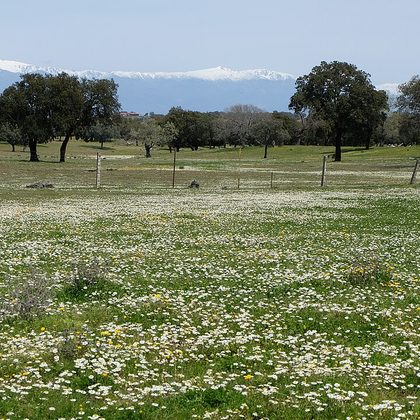
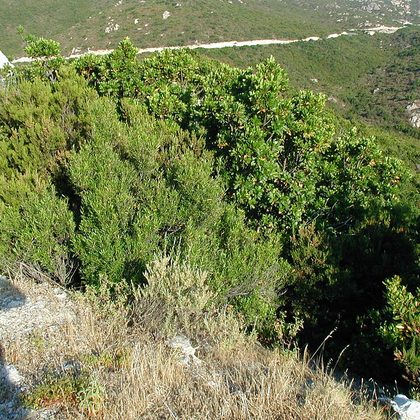
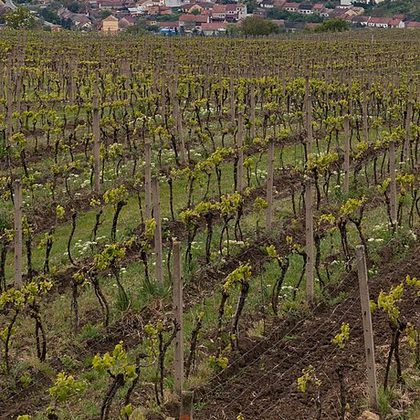
Warm, half-open Mediterranean country with height to it: open holm oak and cork oak woodland with a shrub layer, dehesa with scattered trees, juniper scrub, tall maquis on the lower mountain slopes, and old almond and olive groves with hedges and untidy corners. It sits higher and in taller growth than Sardinian warbler, and avoids both closed forest and bare low scrub: there must be song posts standing above the bushes. Mostly between 300 and 1,500 metres.
Where the bird is most at home, classified with EUNIS — the European standard for habitats.

Range and movements
Breeds in Iberia, southern France, parts of Italy and north-west Africa, and winters in the Sahel, well south of the Sahara. The Iberian Peninsula holds by far the greater part of the world population, concentrated in Extremadura, Castile, Aragon and the mountains of Andalusia. The northern edge of the range is in trouble: numbers in southern France have fallen sharply and in Switzerland the species has all but gone. In north-west Europe it is an exceptional vagrant.
- Breeding (summer)
- Passage
- Migration direction
- dark = core range, pale = thinly spread
Where and when to look
Late April to mid-June, in the first hour after sunrise, in open holm oak woodland, a juniper stand or an old almond grove in Extremadura, Castile or Aragon. Do not look inside the bush but at the topmost twigs: it sings deliberately in the open. Learn the unhurried, Blackbird-like phrase first, among the hurried strophes of Whitethroat, Sardinian warbler and Subalpine Warbler; once the bird is in the scope, check the pale iris, the heavy bill and the black legs. A silent Orphean Warbler is a hard bird; a singing one is immediate.
Conservation status
Not threatened globally, but the trend within Europe pulls two ways. Along the northern edge — southern France, Switzerland, northern Italy — the species has largely gone in half a century, while the Iberian and North African populations remain large. The loss of open woodland with a shrub layer, the conversion of extensive almond and olive groves into intensive plantation, the clearance of hedges and hedgebanks and the closing over of abandoned pasture all play a part. As a migrant wintering in the Sahel it also depends on the rainfall there.