All species › Passerines › Sylvia warblers › Arabian warbler
Arabian warbler | Curruca leucomelaena
Arabische zwartkop | Curruca árabe
The Arabian warbler belongs to a single tree. Wherever an old acacia stands in the desert of the Arava, it can be there: a big, heavily built warbler with a black hood and a long black tail that it does not cock but slaps sharply downwards. The Arava — the rift between the Dead Sea and the Gulf of Aqaba, half Israeli and half Jordanian — is the only place inside this guide's map where it breeds, and there are not many of them.

Voice
The song is surprisingly musical for a warbler: a short, rounded, fluty phrase of two or three seconds with a thrush-like quality, delivered from the top of an acacia or from a dead branch above the canopy. It is full and mellow and lacks the scratching and rattling that most warblers work into their song; if you think you can hear a small thrush in the wadi, this is the bird. The call is a soft, repeated chack, usually in bursts of three or four, and an agitated bird gives a low rolling churr. Song runs mainly from February into May, in the first two hours after sunrise; in the middle of the day an acacia wadi is completely silent.
No freely licensed recording is available for this species yet.
Identification
A warbler the size of an Orphean: bulky, deep-chested, heavy-billed and upright in posture. The male has a brownish-black hood that runs down below the eye and merges without a sharp border into the grey-brown mantle at the nape. The throat is white and the rest of the underparts pale grey, without a trace of pink or buff. The eye is dark, with a narrow white ring round it. The tail is long and black with white outer webs, and the wing is short and round, so that almost no primary projection shows beyond the tertials. The female has a chocolate-brown rather than black hood and a fainter eye-ring; young birds are browner and duller still. The best character is not a colour but a movement: the tail is flicked sharply downwards, again and again, then slowly raised.
Confusion species
Sardinian warbler shares the same wadis and has to be ruled out first. It is far smaller and finer, has a red iris inside a red eye-ring, and it cocks its tail upwards. Arabian warbler is a quarter bigger, has a dark eye inside a white ring, and flicks its tail down — one look at the eye and one at the tail settles it. Eastern Orphean warbler passes through the Arava in April and September and is just as bulky: it has a pale, staring iris, black that goes no further back than the ear-coverts so there is no hood on the nape, creamy rather than grey underparts, and it does not move its tail at all. On a migrant blackcap the cap stops neatly above the eye and the tail is short and plain brown. Ménétriés's warbler, which winters here, is small and pale, has a pink flush across the breast, and waves its tail round and sideways instead of slapping it down.
Habitat
Acacia wadis: broad dry desert watercourses with scattered old acacias, and their side gullies with jujube and tamarisk. It needs standing trees, not scrub — a wadi whose old acacias have died loses the bird even if the low growth beneath them survives. It forages slowly and methodically inside the crown and along the thick limbs, often hanging upside down, and rarely comes to the ground. Outside the map area it occupies exactly the same picture: acacia savanna along the Red Sea and across Arabia.
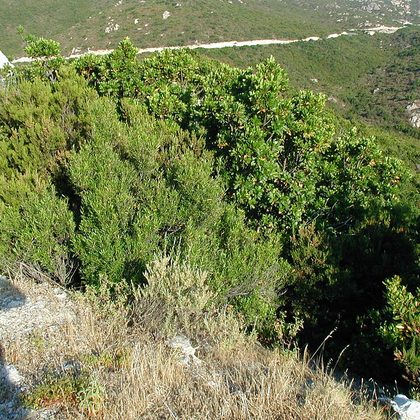
Where the bird is most at home, classified with EUNIS — the European standard for habitats.


Range and movements
From the Arava south along both shores of the Red Sea: Israel and Jordan, Sinai, Arabia to Oman and Yemen, and on the African side south-east Egypt, Eritrea, Djibouti and northern Somalia. Inside this guide's map there is only one population, that of the Arava, on both the Israeli and the Jordanian side of the border. Those birds form their own subspecies, negevensis, and it is a small, thinly spread group: a limited number of wadis holding a handful of territories each. It goes no further north than the southern end of the Dead Sea, and it has never been recorded in Europe.
- Passage
- dark = core range, pale = thinly spread
Where and when to look
Early morning in an acacia wadi in the Arava — around Hatzeva, in the Shezaf reserve, at Nahal Neqarot, or on the Jordanian side in Wadi Araba. Do not walk about looking; sit down and listen. Without song this bird is next to impossible to find inside a large acacia, and with song you have it in two minutes. When you do see a warbler, look at the tail first. One downward slap and you are done; a cocked tail means Sardinian.
Conservation status
Not threatened globally, with a wide range along the Red Sea and in Arabia, but inside the map area it hangs by a thread and it is on the Israeli red list. The bottleneck is the acacia itself. Winter flash floods are now captured in dams and reservoirs and groundwater is pumped out for farming, so the old trees get too little water, die standing, and are not replaced by young ones. A wadi without living acacias is empty for this bird, and that process is at work the length of the Arava. Road building, quarrying and the spread of irrigated agriculture in the valley come on top of it.