All species › Passerines › Sylvia warblers › Tristram's warbler
Tristram's warbler | Curruca deserticola
Atlasgrasmus | Curruca del Atlas
Tristram's warbler lives nowhere but the Maghreb. It is the warbler of the stony mountain slopes of Morocco, Algeria and Tunisia: a small, warm-coloured bird with a rusty wing and a long narrow tail it likes to hold cocked. In winter it drops to the southern flank of the Atlas and to the oueds along the desert edge, where it suddenly sits beside species it never meets on its breeding slopes.

Voice
A fast, high, sweet little phrase of two or three seconds, closest to a subalpine warbler's but fuller and more musical, ending in a small falling flourish. It is sung from the top of a low juniper or thorn bush and regularly in a short song flight, the bird climbing a few metres at an angle and dropping back still singing. The call is the most useful sound: a dry, hard tchett, often doubled, and a purring trrrt when agitated. Song starts early — from February at lower altitudes, only from April high in the mountains — and continues into June.
No freely licensed recording is available for this species yet.
Identification
Small, slim and strikingly long-tailed, the tail graduated towards the tip and edged white on the outer feathers. The male has a blue-grey head with an orange-red eye-ring, a short white submoustachial stripe, and rusty orange-brown underparts running from throat to lower belly without a sharp edge anywhere. The mantle is warm brown and the closed wing carries a broad rufous panel formed by wide fringes to the secondaries and tertials. The legs are orange to flesh-coloured, the bill fine with a pale base. The female is the pale version of the same bird: grey-brown head, an ochre rather than red eye-ring, warm red-brown mantle and wing, and a soft orange-buff breast against a cream belly. Both sexes often hold the tail cocked and spread it briefly at every hop.
Confusion species
Western subalpine warbler is the real trap here, because it winters and migrates through the same bushes and its male also shows a grey head, a red eye-ring and a white submoustachial stripe. Three things settle it. The wing: a broad rufous panel in Tristram's, plain grey-brown with no warm tones in subalpine. The underparts: in Tristram's the rusty orange runs unbroken onto the belly and undertail coverts, in subalpine a coloured breast stands against a white belly. And the tail: longer, narrower, clearly graduated and often cocked in Tristram's. On females, look at the eye-ring — ochre in Tristram's, dirty white in subalpine — and again at that rufous wing. Spectacled warbler lives in the flat low country below and has a shorter, squarer tail, a bright white eye-ring and dark lores; Tristram's has no dark mask at all. Dartford warbler, in the same scrub in northern Morocco, is dark slate above and wine-red below with white flecks on the throat, and its tail is longer still but narrower, with no rufous in the wing. The calendar helps too: in December and January Tristram's is there and the subalpine warblers largely are not.
Habitat
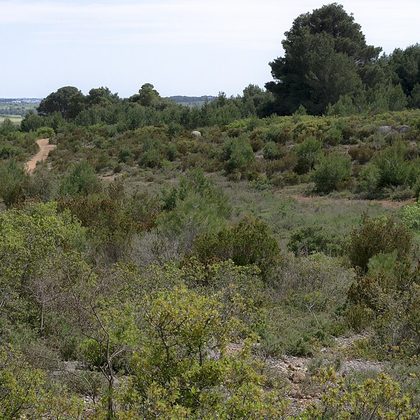
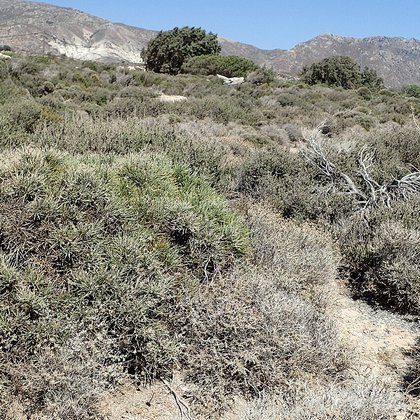
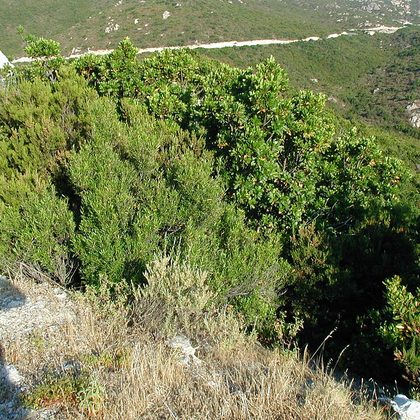
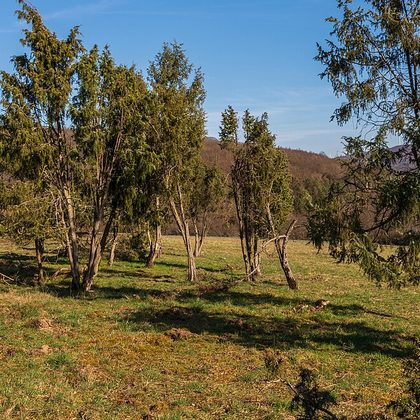
Open, low, spiny mountain scrub on stony slopes: scattered juniper, dwarf oak, rosemary and thyme, spiny cushion bushes, esparto and jujube among bare rock and gravel. In Morocco mainly between about eight hundred and two thousand metres on the southern flanks of the High Atlas and in the Anti-Atlas, in Algeria in the Saharan Atlas and the Aurès, in Tunisia in the central mountains. What matters is structure rather than plant species: bushes to knee height with plenty of open, warm ground between them. In winter the birds move down to lower slopes, to the oueds along the desert edge and to the scrub around the southern oases.
Where the bird is most at home, classified with EUNIS — the European standard for habitats.
Range and movements
North-west Africa and nowhere else: Morocco, northern Algeria, Tunisia and the extreme north-west of Libya, with an outlier in the Western Sahara. The entire world range therefore lies inside this guide's map, which is true of very few species here. Occupation is patchy: numerous in a few valleys and then absent for tens of kilometres. Beyond the Maghreb it is effectively unrecorded; there are at most a couple of doubtful European claims and none accepted in Spain.
- Resident
- Winter
- Passage
- dark = core range, pale = thinly spread
Where and when to look
March and April, on the stony slopes of the southern side of the High Atlas — the Tizi n'Tichka road, the hillsides above Boumalne Dadès, the Anti-Atlas around Tafraoute — in the first hour after sunrise and with little wind. Drive slowly, stop at every slope with scattered low bushes and listen for the dry, doubled tchett. The bird sits low and hidden but sings from a projecting twig and comes fully into the open during its song flight. Once you see it, go straight to the wing: in good light that rufous panel shows at fifty metres and separates it at once from any subalpine warbler in the same bush.
Conservation status
Not threatened, with a range covering the whole Maghreb, but it is thinly and patchily distributed and hardly counted anywhere. The pressure comes from overgrazing by sheep and goats, which strips the low shrub layer from the mountain slopes, from cutting juniper and thorn scrub for firewood and building material, and locally from turning hill scrub into plantations. Where the vegetation has been reduced to bare stone it is gone; where slopes are left alone it returns quickly.