All species › Passerines › Sylvia warblers › Ménétriés's warbler
Ménétriés's warbler | Curruca mystacea
Ménétriés' zwartkop | Curruca de Ménétries
Ménétriés's warbler is the Sardinian warbler of the eastern semi-desert, and it gives itself away with its tail. Where Sardinian warbler flicks the tail briskly up, this bird swings it round: sideways, down, up again, in a restless movement that never quite stops while the bird is awake. Inside the map area it breeds only along the Euphrates in south-east Turkey; in Israel and on Cyprus it is scarce but very nearly annual.

Voice
The song is a hurried, scratchy chatter of two to four seconds, thinner and reedier than a Sardinian warbler's and with less rattle in it, with the odd sweet whistle running through. It is delivered from the top of a tamarisk or in a short fluttering song flight over the scrub. Far more useful is the call: a dry, buzzing, slightly nasal dzheh given at any disturbance, which carries a long way over open ground, together with a hard chek. Song runs from April into June; in the winter quarters the bird is all but silent and that buzzing call is all you get.
No freely licensed recording is available for this species yet.
Identification
A small, slim warbler whose long black tail stands out against a pale, sandy grey-brown back. The male has a dull black crown and a black mask around the eye, but that black is not sharply bounded: on the nape and cheeks it fades into grey, so there is no true hood. The eye-ring is orange-red, the throat white, and a soft pink wash lies across the breast, running from throat to flanks on fresh spring birds. The tertials and greater coverts are plain, without pale fringes, so the closed wing looks unmarked. The legs are pale reddish-brown. The female is sandy grey with dirty white underparts, a pale eye-ring and the same dark tail; young birds look much the same. In every plumage the quickest character is the combination of a dark tail against a pale back plus that circling tail movement.
Confusion species
Sardinian warbler is the standing confusion, and the difference lies in the quality of the black, not in whether there is any. On Sardinian the cap is glossy jet black, covers the whole head to below the eye, and is cut off against the white throat as if with a knife. On Ménétriés's the black is dull and sooty, is confined to crown and eye-stripe, and runs out into grey on the nape. Add to that underparts washed pink rather than clean white, paler and sandier upperparts, and a different way of using the tail: Sardinian jerks and cocks it, this bird swings it round. The subalpine warblers are also pink below, but they have a white submoustachial stripe, which is entirely absent here, and a much shorter, less black tail. A male Rüppell's warbler has a black throat with a broad white moustache, and Cyprus warbler carries black spotting over the whole underside — two species that resemble it only about the head. Females and first-years are the hardest: they are so pale and so unmarked that often all you have is the black tail against the sandy back, and the way it moves.
Habitat
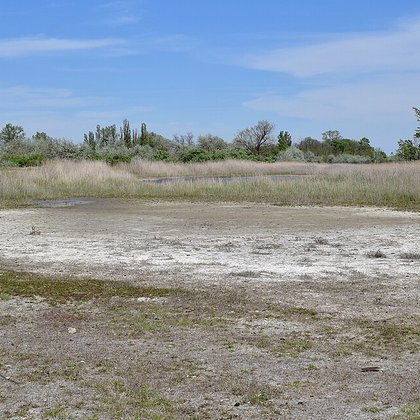
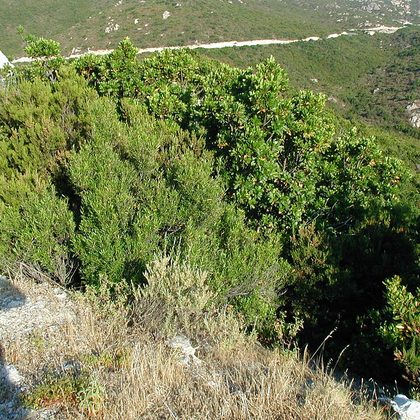
On the breeding grounds, scrub in dry valleys and along rivers: dense tamarisk on the sand and gravel bars of the Euphrates, poplar and willow growth along irrigation channels, and further east saltbush and semi-desert with scattered shrubs. In winter and on passage it uses acacia wadis, saltbush and tamarisk along the Red Sea and in the Arava, and the scrub around Sinai oases. The picture is always the same: bushes half a metre to two metres high with plenty of open bare ground between them, through which it works low down.
Where the bird is most at home, classified with EUNIS — the European standard for habitats.


Range and movements
Breeds from south-east Turkey and Transcaucasia east through Iran and Turkmenistan to Pakistan, in three subspecies. Inside the map area that means only the belt along the Euphrates and its tributaries in south-east Turkey, around Birecik and Halfeti. The winter range lies in Arabia, southern Iran, along the Red Sea and in north-east Africa, and much of that does fall inside the map. In Israel it is therefore a scarce but very nearly annual bird, mostly in winter and on passage in the Arava and around Eilat; on Cyprus a single bird or two turns up most years. In western Europe it is an exceptional vagrant.
- Breeding (summer)
- Winter
- Passage
- Migration direction
- dark = core range, pale = thinly spread
Where and when to look
Mid-May along the Euphrates at Birecik, in the tamarisks on the river bars, in the first hour after sunrise. Walk the edge of the scrub and watch for movement in the tops: the bird sings briefly and then drops back low. In Israel the season is winter — a saltbush wadi in the Arava, or the field edges around Eilat, where it slips through among Sardinian warblers and blackcaps. In both places, do not look at the head but at the tail: Sardinian jerks it upwards, this bird swings it round, and you see that at a distance long before any feather detail.
Conservation status
Not threatened, with a large range from Turkey to Pakistan and no sign of a broad decline. The western edge of that range is vulnerable, though, because it hangs on the tamarisk belt along the Euphrates, and that is under pressure from dams, water abstraction for irrigation, sand extraction and grazing of the river banks. Where the river has been impounded the low scrub on the bars disappears and the bird goes with it. Almost nothing is known about numbers in the winter quarters, because there it sits silent, low and in awkward country.