All species › Cranes, rails and allies › Rails and crakes › Allen's gallinule
Allen's gallinule
Porphyrio alleni | Afrikaans purperhoen | Calamón de Allen
A pocket-sized swamphen, barely bigger than a Water Rail, that now and then makes it from Africa to Europe. Almost every bird that turns up here is an immature — sandy brown, nothing purple about it — which is exactly what makes the record hard work.

Voice
Effectively silent in Europe. On the breeding grounds a sharp, high kik, a fast clicking series kre-kre-kre, and a nasal bleating that recalls Little Crake. Do not expect a vagrant to call; identification here is entirely a matter of getting the bird in view.
No freely licensed recording is available for this species yet.
Identification
Adults have a short, wholly red bill, green mantle and wings, and violet-blue head, neck and underparts, with red legs and absurdly long toes. The frontal shield is turquoise-blue on the male, greenish on the female. The undertail is white with a dark central bar. Immatures are sandy buff with a buff undertail and a dull red bill; only the green gloss on mantle and wing gives the species away.
Confusion species
Against Western Swamphen size settles it: that bird is twice as long and three to four times as heavy, with a deep wedge of a bill and a red shield covering half the forehead, and it is uniform blue-purple with no green mantle. Moorhen is olive-brown with a white flank line, a yellow bill tip and greenish-yellow legs. On immatures work the very long toes, the buff undertail and the green sheen in the closed wing.
Habitat
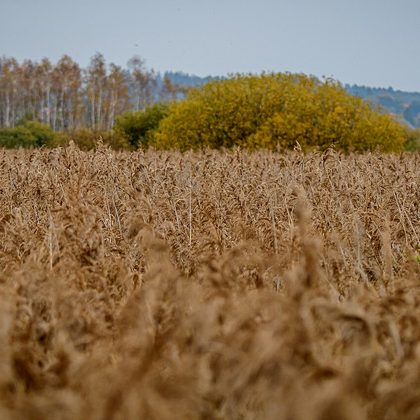
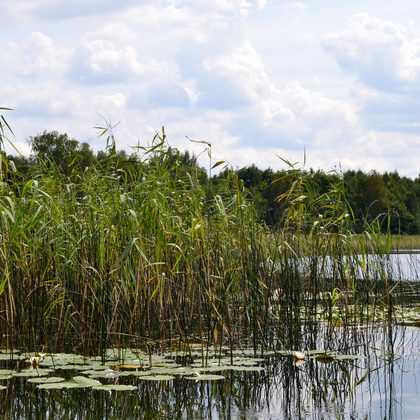
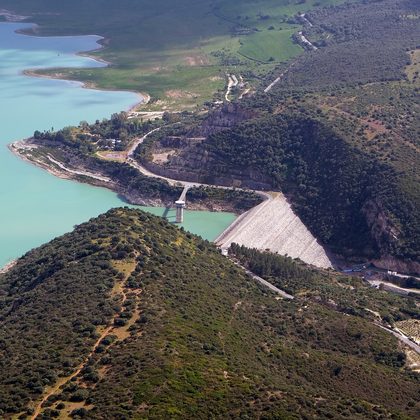
Shallow fresh water with floating leaves: lily-covered pools, choked marshes, rice fields and floating mats among reed and reedmace. It walks over the leaves on those long toes and drops into cover at the first alarm. European vagrants, by contrast, turn up in unlikely places — a ditch, a garden pond, a golf-course reservoir — because they arrive exhausted and take the first water they find.
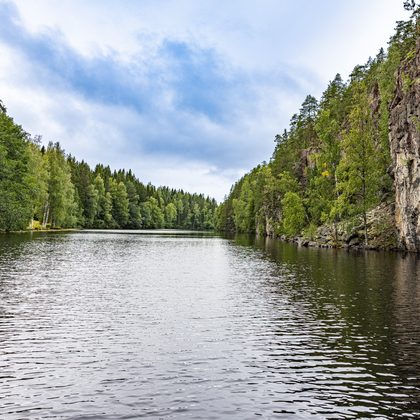
Where the bird is most at home, classified with EUNIS — the European standard for habitats.
Range and movements
Breeds across sub-Saharan Africa from Senegal to South Africa, wandering with the rains. Britain has two records, the only species of purely sub-Saharan range to have reached the country. Elsewhere there are records from the Canaries, Madeira and the Azores and scattered through southern Europe and the Middle East.
Where and when to look
Macaronesia beats the mainland. Work the reed fringes of small reservoirs and golf-course pools in the Canaries or Madeira from late autumn to early spring, in the days after a spell of southerly wind. Be there at first light: an hour or two into the morning the birds slip into cover and stay there.
Conservation status
Numerous and not threatened across its range, with numbers rising and falling on Sahel rainfall. For Europe this amounts to a handful of birds a decade, some of which do not survive their arrival. The real pressures are African: drainage of marshland and the loss of the temporary rain pools the species depends on.