All species › Cranes, rails and allies › Rails and crakes › Western swamphen
Western swamphen
Porphyrio porphyrio | Purperkoet | Calamón común
A rail the size of a chicken: deep blue-purple, with a bill like a red wedge and legs that seem to go on forever. Reduced to a corner of Andalusia by the mid-twentieth century, it now walks the rice fields of Catalonia.

Voice
Loud and hardly bird-like. A harsh, nasal trumpeting that falls away in pitch, koo-aah, mixed with groaning and a tinny chak. It carries hundreds of metres across a reedbed and is usually the first proof the species is present. Most vocal at dusk and through the spring.
Recording: Joost van Bruggen — CC BY-SA 4.0 · Wikimedia Commons
Identification
Big and heavy, uniformly blue-purple, with a deep blue breast and neck and a duskier back. The bill is a scarlet wedge running up into a broad red frontal shield; the legs are flesh-red with huge toes, used to lift food to the bill. A clean white patch under the tail flicks with every step. Juveniles are dull grey with a dark bill and only slowly acquire the purple.
Confusion species
In Europe there is little to confuse it with: Coot is black with a white shield, Moorhen half the size and olive-brown. At range in reeds only the silhouette misleads. Watch instead for birds of other swamphen taxa, such as Grey-headed Swamphen with its grey head and neck; these have generally been treated as separate species since 2015 and appear in Europe as escapes. European birds belong to the taxon porphyrio.
Habitat
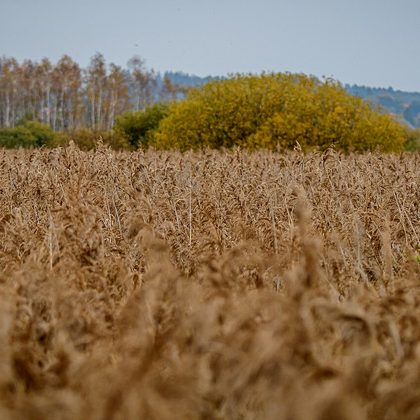
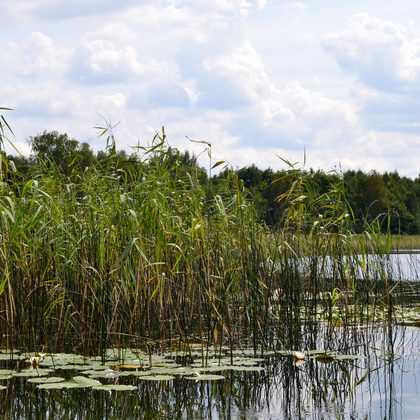
Permanent shallow fresh water with dense marginal growth: reed, reedmace, sedge and papyrus around lagoons and marismas, plus rice paddies, irrigation canals, gravel pits and reservoir margins. Feeds walking over floating vegetation and along the reed edge, often in full view in the first light of the morning.
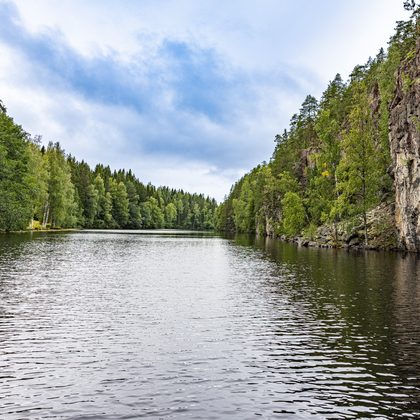
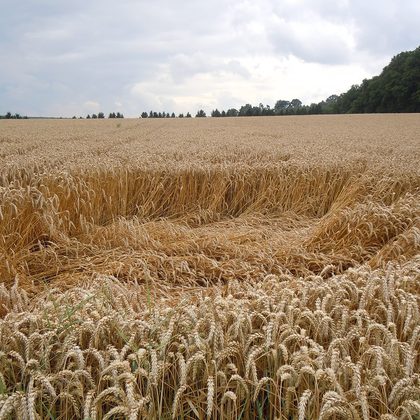
Where the bird is most at home, classified with EUNIS — the European standard for habitats.
Range and movements
Breeds on the Iberian Peninsula, Sardinia, Sicily, north-west Africa and parts of Turkey. Spain holds the bulk: Doñana and the Guadalquivir marismas, El Hondo and the Valencian lagoons, the Albufera, and since the 1990s the Ebro delta and the Empordà. From Catalonia it has moved into Mediterranean France. In north-west Europe it is not admitted as a wild bird; the records there go back to escaped birds.
- Resident
- Breeding (summer)
- Winter
- Passage
- Migration direction
- dark = core range, pale = thinly spread
Where and when to look
March or April in Doñana, El Hondo or the Albufera de València, sitting at a reedbed edge at sunrise. The birds climb the stems to bite off seed heads and stay in view for half an hour or so. Use your ears first — the trumpeting gives them away long before you see anything.
Conservation status
One of southern Europe's clearest recoveries. Hunting bans, protection of the last marshes and a run of reintroductions took the Spanish population from a few hundred pairs in the early 1990s to several thousand by the end of that decade, and the spread up the east coast continues. Drying wetlands, reed cutting and burning during the breeding season, and lead and pesticide loads in rice-growing areas remain the risks.