All species › Passerines › Reed warblers › Basra reed warbler
Basra reed warbler | Acrocephalus griseldis
Basrakarekiet | Carricero de Basora
The rarest songbird in this guide and the only one listed as Endangered. It breeds in one marsh on earth — the reedbeds between the Tigris and the Euphrates — winters on the coast of East Africa, and slips north through the Jordan valley and Eilat in small numbers each spring.

Voice
The song recalls great reed warbler played by someone in a hurry: faster, higher, thinner and with far more true musical notes among the grating, and without the deep frog-croaks and shrill squeals of its big relative. It sings mainly on the Iraqi marshes, April into July, by day and by night from a reed stem. In Israel passage birds are usually silent, though one will occasionally give a short quiet subsong in May. Calls: a hard short tchak and a low churring tcherr.
No freely licensed recording is available for this species yet.
Identification
A slim, elongated reed warbler, smaller and far finer than great reed warbler. The bill is the giveaway: long, thin and evenly narrow along its whole length, pale below with a dark tip. Upperparts cool olive to grey-brown without a trace of rufous, the crown often a shade darker than the mantle so the head looks capped. Throat and breast are clean silky white and cut sharply against buff-brown flanks. The white supercilium is narrow but crisp and runs behind the eye, with a dark loral line below it. The wing is long and pointed with a long primary projection — the stamp of a bird that flies to Malawi — and the tail is proportionately short.
Confusion species
Great reed warbler is the bird it gets called in Israel, and the difference is structure rather than size. Basra: fine, evenly narrow bill, cool grey-brown above, white throat and breast meeting buff flanks at a hard edge, supercilium running behind the eye, long primary projection, short tail. Great reed: heavy bill with a broad base, warmer brown above, dull buff washing right along the underparts, a short supercilium stopping at the eye, and heavy legs and feet. Clamorous reed warbler, resident in the same reed, has a bill as long but a rounded wing with a short primary projection and a long graduated tail, and is duller and more olive above. A silent, worn Acrocephalus in a Jordan valley reedbed in September is best left unnamed.
Habitat
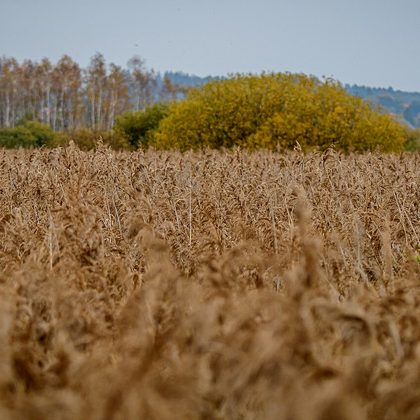
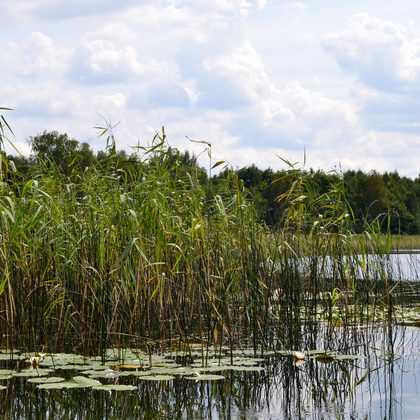
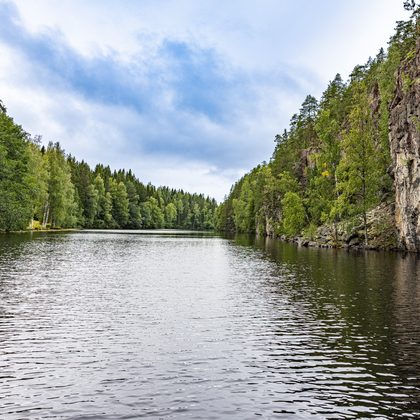
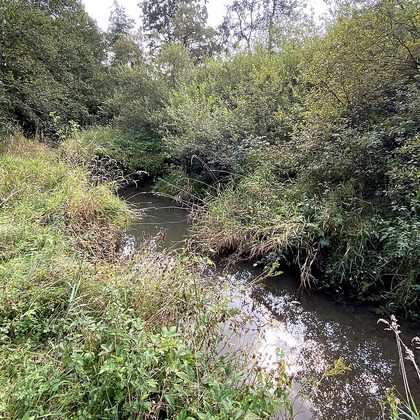
It breeds only in extensive dense reed standing in water, with reedmace among it and open channels through it — the landscape of the Mesopotamian marshes. On migration it is far less particular: reed along fishponds and irrigation canals, tamarisk and acacia in a wadi, even gardens and mango trees. In its Kenyan and Tanzanian winter quarters it uses dense coastal thicket and papyrus, often well away from open water.
Where the bird is most at home, classified with EUNIS — the European standard for habitats.
Range and movements
The breeding range is a single patch: southern Iraq, with the Hawizeh, Hammar and Central Marshes, plus a fringe in adjoining south-west Iran. Until Lake Hula was drained in the 1950s it also bred in northern Israel; since then it has been a migrant there only. The whole world population moves down the Red Sea flyway in autumn to Kenya, Tanzania, Malawi and Mozambique, and back the same way in spring, part of it over Israel and Jordan. Within this guide's map it is therefore purely a Levant passage bird.
- Breeding (summer)
- Passage
- Migration direction
- dark = core range, pale = thinly spread
Where and when to look
Mid-April into early May, in the reed fringes and fishponds of the Bet She'an valley, at the Hula, and in the gardens of Eilat. Work on structure and bill and refuse to be led by size; look for the hard edge between white breast and buff flank, and for the long wing point. This is not a bird you find by searching but by giving every great reed warbler ten seconds longer than seems necessary.
Conservation status
Endangered (EN), and the reason is a map. In the early 1990s the Mesopotamian marshes were drained almost completely by dykes and diversion canals; less than a tenth of one of the largest wetlands of the Old World was left, and the reed that went with it was this bird's entire breeding habitat. After 2003 the dykes were breached and a good share was reflooded — the Ahwar of Southern Iraq were listed as World Heritage in 2016 — but the recovery is fragile. Dams upstream in Turkey, Syria and Iran, prolonged drought and rising salinity dry the marshes out again in bad years, while on the East African coast the thickets it winters in are being cleared. The species hangs by two threads at once, on either side of the Red Sea.