All species › Passerines › Reed warblers › Eurasian reed warbler
Eurasian reed warbler
Acrocephalus scirpaceus | Kleine karekiet | Carricero común
The voice of every Dutch reedbed in June: a slow, halting karra-karra-keet-keet that runs on for hours, while the singer itself is an unremarkable, plain brown bird straddling two vertical reed stems.

Voice
The song is slow, low, monotonous and scratchy, built from short motifs each repeated two to four times: karra-karra-keet-keet, cherk-cherk-cherk, kerra-kerra-keet, at an even, almost sleepy tempo that runs on for minutes or hours, including the middle of the day and at night. It contains little mimicry, does not accelerate and does not build to a climax — the exact opposite of Marsh Warbler. Heard from early May into August. Call: a low short tcherr and, in alarm, a hard repeated tchek. It sings quietly in the winter quarters too.
Recording: Borja — CC BY-SA 4.0 · Wikimedia Commons
Identification
Plain warm brown above without any streaking, with a distinctly warmer, rusty rump contrasting with the mantle — the best feature the moment it flies. The forehead is flat and gently sloping, giving the head a long, pointed look, with a long, fine, sharp bill; the pale supercilium is short, vague and stops just behind the eye. Underparts off-white with buff-brown flanks. Legs grey-brown to lead-coloured, toes included. The primary projection is short to moderate, about two thirds of the exposed secondaries, with some six primary tips visible.
Confusion species
Marsh Warbler is the classic twin and the reason the details matter. Song decides it fastest: Reed Warbler slow, low, scratchy and full of endlessly repeated motifs, Marsh Warbler fast, high, musical and packed with mimicry. Beyond that: legs grey-brown to lead versus pale flesh, primary projection short versus long, rump warm rusty versus dull olive-brown, forehead flat and sloping versus steep, and reed standing in water versus rank herbage and scrub on dry land. Sedge and Aquatic Warblers are streaked on mantle and crown and have a broad pale supercilium. Great Reed Warbler is hulking, with a heavy bill, an obvious supercilium and a far louder, slower song.
Habitat
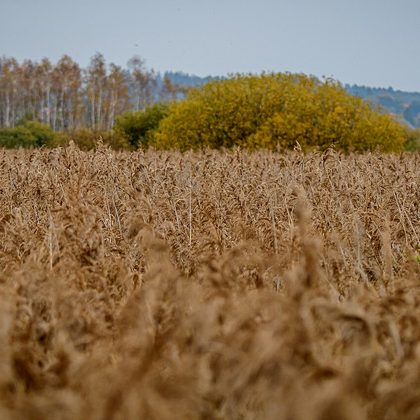
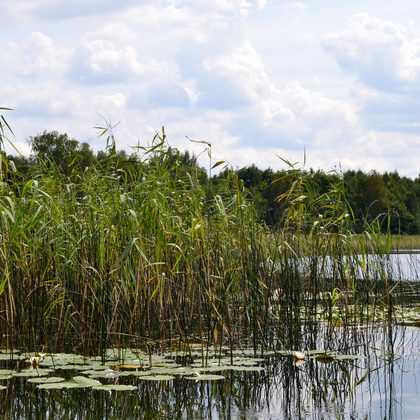
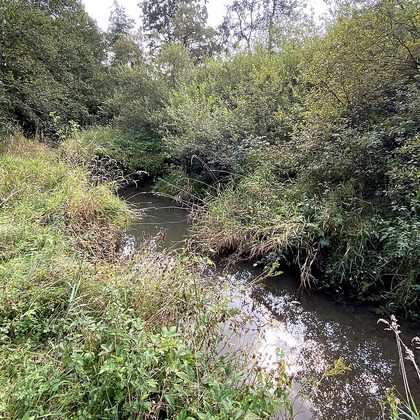
Reed standing in water — that is the rule. Narrow reed fringes along ditches, canals, pools and rivers, broad reedbeds, reed in dunes and on urban water, and in the south also reedmace and rice fields. The nest is a deep basket woven around three or four vertical reed stems above the water, and it is the most used Cuckoo nest in Europe. Outside the breeding season also in scrub, willow carr and gardens.
Where the bird is most at home, classified with EUNIS — the European standard for habitats.
Range and movements
From Iberia and Ireland east into western Siberia. In the Netherlands it is one of the most numerous marshland birds, with well over a hundred thousand pairs, present from late April into September and the main Cuckoo host in reedbeds. In Spain it breeds wherever there is reed, from the Ebro Delta and the Albufera to riverbeds in Andalusia, and in August and September it is joined by large numbers of northern migrants laying down fat for the crossing to the Sahel.
- Breeding (summer)
- Winter
- Passage
- Migration direction
- dark = core range, pale = thinly spread
Where and when to look
June, all day long, along a reed-fringed ditch: it sings almost without a break. Look for the bird straddling two vertical stems and go straight to the legs and rump on your first view, because those are the features that rule out Marsh Warbler. For the distinction, an evening in the first week of June teaches most: both species sing in the same landscape, one in reed over water, the other in the nettles alongside.
Conservation status
Not threatened (LC) and stable to increasing in Europe; in the Netherlands it profits from wetland creation and new marshes, though the loss of old standing reed and over-rigid water levels cost nests locally. As a long-distance migrant it is sensitive to Sahel drought and to the loss of reed marsh along the flyway, and on a larger scale to the draining of southern European wetlands.