All species › Kingfishers, bee-eaters and rollers › Kingfishers › Belted kingfisher
Belted kingfisher | Megaceryle alcyon
Bandijsvogel | Martín gigante norteamericano
The North American kingfisher: blue-grey instead of cobalt and orange, with a heavy head, a ragged punk crest and a broad white collar. In Europe it is among the very rarest of vagrants — a handful of birds, almost all down the Atlantic western edge, and nearly always heard first as a hard rattle over the water.

Voice
A hard, dry rattle, as though someone were swinging a wooden football rattle or running a nail down a comb: krrrek-ek-ek-ek-ek, uneven in tempo, toneless and carrying a long way. Usually given in low flight over the water, and also from a perch when disturbed. It is the sound that gives the bird away; nearly every European finder heard an unplaceable rattle over the water first and only then went looking.
Recording: Jonathon Jongsma — CC BY-SA 3.0 · Wikimedia Commons
Identification
Big and heavily built, with a large head, a long dagger bill and a shaggy crest that splays into two points and is seldom laid flat. Upperparts and a broad breast band blue-grey, collar and underparts white; a white patch flashes in the primaries in flight. Below the grey breast band the female carries a second, rufous band that runs down onto the flanks, so in this species it is the female that is the more colourful bird — an unusual arrangement. Juveniles of both sexes show rusty mottling within the breast band. It hunts from a post or an overhanging branch and hovers heavily and noisily above the water before plunging.
Confusion species
In Europe there is only one comparison to make, and that is the Common Kingfisher. The Belted is more than twice as long and several times as heavy, blue-grey and white rather than cobalt and chestnut, and carries both a crest and a white collar that the Common Kingfisher lacks. With any sort of view the two cannot be confused. The awkward case is a distant bird seen briefly at an Irish river mouth: at range size cannot be judged, and a grey bird hovering over brackish water and then flying off low is readily put down as something else. Look then for the heavy crested head and the white collar, and above all listen for the rattle.
Habitat
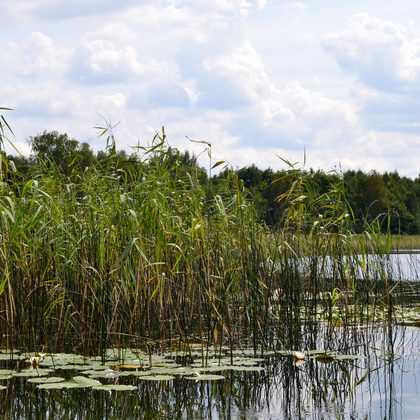
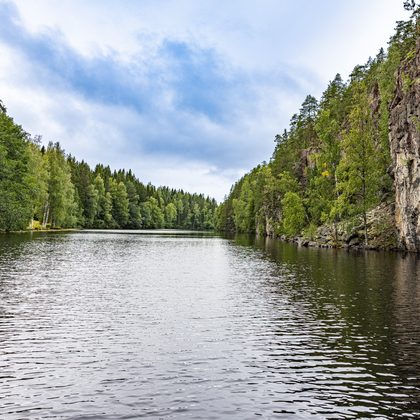
At home along clear water with lookout perches and fish within diving reach: brooks, rivers, canals, lakes, estuaries and rocky coasts. To breed it needs a steep bare earth face in which to dig a nest tunnel one to nearly two metres long; sand and gravel workings serve as well as natural banks. The European birds settled on exactly this kind of water: a small river in Cornwall, a reservoir near Penzance, a sheltered sea inlet on the Beara peninsula in Ireland, and in Lancashire a river and a canal.
Where the bird is most at home, classified with EUNIS — the European standard for habitats.



Range and movements
Breeds across almost all of North America, from Alaska and Canada south into the southern United States, northern birds withdrawing in winter to the southern states, Middle America and the West Indies. In Europe it neither breeds nor passes through: the birds that arrive are individuals carried across on sustained westerlies in autumn. Britain holds five accepted records — a female shot on the River Allen at Sladesbridge, Cornwall, in November 1908, admitted to the British List only seventy-two years afterwards; a male on that same Cornish river from October 1979 into June 1980 that reappeared at Boscathnoe Reservoir near Penzance in August 1980; a first-summer male tracked from Tixall, Staffordshire, on 1 April 2005 by way of Eastrington Ponds in Yorkshire to Peterculter in North-east Scotland on 4–8 April; a male at Porth Hellick, St Mary's, Scilly, on 18 April 2018; and a first-winter male that wintered on the Ribble, the Darwen and the Leeds–Liverpool Canal in Lancashire from November 2021 into April 2022. Ireland holds five, the most recent a first-winter male at Dunboy near Castletownbere, Co Cork, from 9 November 2020, preceded by one in Co Galway on 5–6 October 2012 and by two early birds, in 1979 and 1980, that were shot; Northern Ireland adds one, shot in Co Down on 12 October 1980. Elsewhere the species is barely known: a single Dutch bird shot at Rheden on 17 December 1899, and a scatter of Azorean records.
Where and when to look
This is not a bird you go out to look for; it is one you happen upon. Walking a western estuary or creek in October and November, work by ear — that rattle belongs nowhere in Europe, and it is why most of the records were noticed at all. Beyond that it is a matter of following the news. A bird that has settled on a stretch of river may hold it for months, as the Lancashire bird did from November 2021 into April 2022, so a long-stayer is worth the journey in a way an autumn island bird never is.
Conservation status
Not globally threatened (IUCN: Least Concern), with the North American breeding population put at roughly 1.8 million birds. American breeding bird surveys nevertheless show a steady loss of rather more than a third between 1966 and 2019, attributed to the armouring and stabilising of river banks, which removes the steep faces the species needs to nest, and to disturbance of occupied stretches. In a European context there is nothing to manage: the species amounts to a few individuals. It says something, though, that the earliest of them — in the Netherlands, in Ireland and in Cornwall — are known to us only because they were shot.