All species › Passerines › Larks › Bimaculated lark
Bimaculated lark | Melanocorypha bimaculata
Bergkalanderleeuwerik | Calandria bimaculada
The Calandra Lark of the Asian mountain steppe: just as heavily built, with the same black neck patch, but without the white trailing edge that gives its western counterpart away. It breeds from central Anatolia to Kyrgyzstan and leaves the region entirely in winter; in north-west Europe it is about as rare as a passerine gets.

Voice
The song closely resembles Calandra Lark's but is drier and thinner, with shorter phrases, more pauses and a good deal of mimicry of steppe birds. It sings in a wide circling song flight over the hillside, on the same slow flapping wingbeats, and also from a stone or an earth clod. The call is a short dry chirrup and a hard rattling trrp-trrp, a shade sharper and less rolling than in Calandra Lark. It sings from March into June, including in the full heat of midday.
No freely licensed recording is available for this species yet.
Identification
A bulky lark with a big head, a thick pale bill and a short tail, marginally smaller and more compact than Calandra Lark. The head pattern is more contrasted: a long creamy supercilium that flares broadly behind the eye, a dark eyestripe and a pale-rimmed ear-covert patch. A black patch sits on each side of the lower neck, often crescent-shaped and sometimes almost joined across the breast. Upperparts sandy brown with dark scaling, breast buff with fine streaks, belly creamy white. In flight the wing is plain: the secondaries show no white trailing edge at all and the underwing is greyish, not sooty black. The tail is dark with narrow white tips to the outer feathers — tips, not white sides.
Confusion species
It all turns on Calandra Lark — see its own species page, where the same difference is set out from the other side. That bird is larger and heavier, with a broad white trailing edge to the wing, a sooty-black underwing and white sides to the tail; its head is more uniform, the supercilium less sharply drawn. On a perched bird, look at the tail end: white tips on an otherwise dark tail mean Bimaculated, white tail sides mean Calandra. Skylark is slimmer and finer-billed, has a small crest and white outer tail feathers, and lacks the black neck patches altogether. Anyone finding a big neck-patched lark in western Europe should have seen the open wing before writing it down.
Habitat
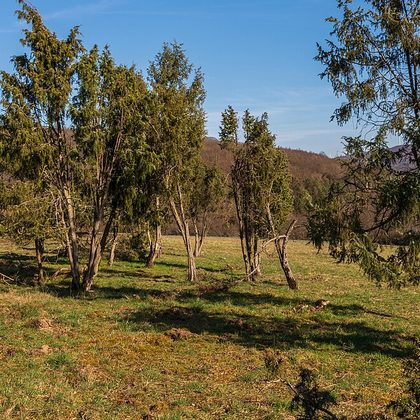
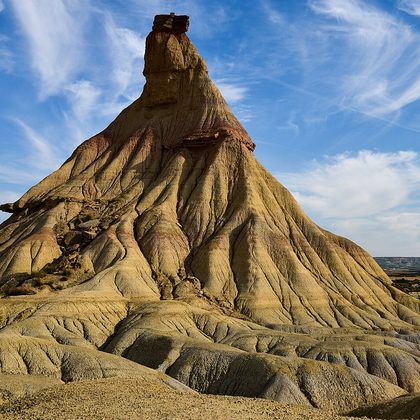
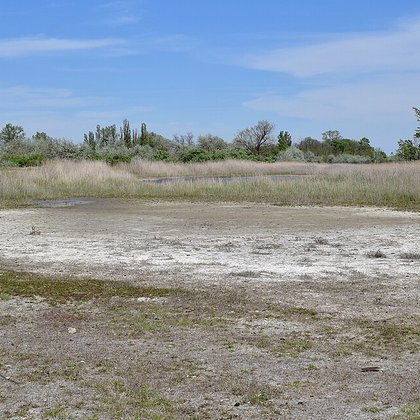
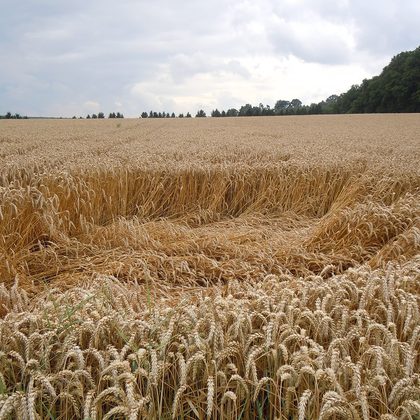
Dry stony montane and plateau steppe with short, sparse cover, from roughly 800 to over 2,700 metres: wormwood steppe, cushion vegetation on gravel, bare loam and salt flats around the Anatolian salt lakes, and the cereal fields and fallows at the foot of the slopes. It prefers ground that is more bare than vegetated, and feeds by walking between the stones. The nest is a scrape under a tussock or the lee of a rock.
Where the bird is most at home, classified with EUNIS — the European standard for habitats.
Range and movements
Breeds in central and eastern Turkey, Armenia, the Caucasus, Lebanon, Israel, Syria and northern Iraq, and eastwards through Iran and Turkmenistan to Afghanistan, southern Kazakhstan and Kyrgyzstan. The western part of that range falls inside the map area, the greater part outside it. Almost the whole population leaves the breeding grounds in September and winters in north-east Africa, Arabia and north-west India. In northern and western Europe it is a vagrant: a few dozen records for the whole continent, a handful of them in Britain and the Netherlands, nearly all in spring.
- Breeding (summer)
- Winter
- Passage
- dark = core range, pale = thinly spread
Where and when to look
The best address is central Anatolia in May: the steppe around the salt lake Tuz Gölü, the slopes above Sultansazlığı, or the plateaux near Erzurum. Look on bare stony slopes for singing birds in a wide circling flight, and check the plain wing with no white trailing edge. If you find one at home, only one thing matters: photograph the bird in flight, from above and below, because without the wing and the tail tip the record will not stand.
Conservation status
Not threatened (LC), with a very large range and a population that looks stable at world scale. Locally it is under pressure: overgrazing of the mountain steppe, ploughing of plateaux for cereal, irrigation schemes on the Anatolian and Iranian lowlands and the fast spread of orchards onto old steppe soil. In Turkey, which holds the European stronghold, it is precisely the saline steppes around the inland lakes that have suffered most in recent years from water abstraction.