All species › Passerines › Larks › Greater short-toed lark
Greater short-toed lark | Calandrella brachydactyla
Kortteenleeuwerik | Terrera común
The lark of the southern cereal plains and steppes: pale, short-tailed and heavy-billed, with a clean white breast and a small dark smudge at the side of the neck. Millions of pairs breed between Spain and Turkey, yet north of the Mediterranean it is a bird of a handful of days a year.

Voice
The song comes mostly from an undulating song flight at twenty to fifty metres and consists of short, endlessly repeated phrases: tip-ze-tee-zer-li-loo, dry and rather monotonous, but laced with surprisingly good mimicry of other birds — Kestrel, Crested Lark, Corn Bunting. A song flight normally lasts three to eight minutes, exceptionally half an hour. The flight call is a short, hard, dry chirrp or drrp, usually from small parties passing over. It sings from April into June, often from first light.
No freely licensed recording is available for this species yet.
Identification
A small pale lark, slightly smaller and shorter-tailed than a Skylark. Sandy to greyish-brown above with fine streaking, and in western birds often a rufous crown. The decisive picture is underneath: a clean, unstreaked creamy-white breast with a small dark patch on each side of the neck. The bill is short, thick and conical, pinkish with a grey culmen. The tertials are strikingly long and cover almost the whole wing point, so that only one or two primary tips show on the closed wing. Outer tail feathers are dirty white rather than pure white, and two faint pale bars cross the wing. It runs fast and low over bare ground; outside the breeding season it flies in tight flocks that wheel as one body.
Confusion species
Mediterranean Short-toed Lark is the real trap — see its own page, where the same difference is set out from the other side. It has a finely but clearly streaked breast instead of a clean one, lacks the dark neck patch, has a shorter and blunter bill and shorter tertials, so three or more primary tips show; its call is a dry rolling prrrit rather than a short hard tick. Skylark is larger and much longer-tailed, with a crest, a white trailing edge to the wing and pure white outer tail feathers. Tawny Pipit is slimmer and longer-legged, with a fine pipit bill, a wagtail-like gait and no neck patch.
Habitat
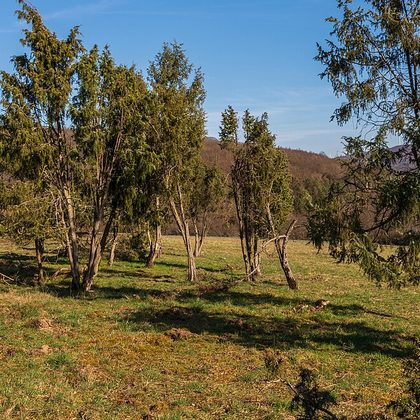
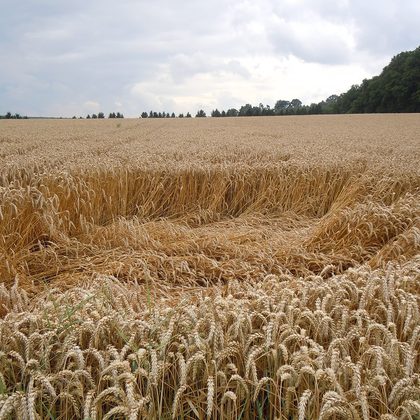
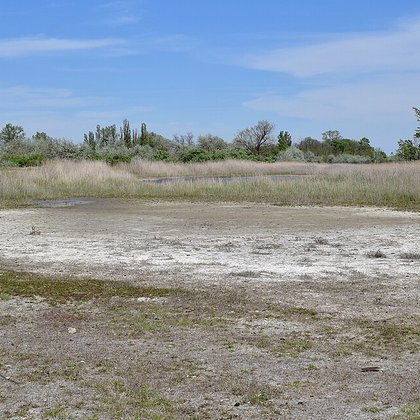
Flat, dry, treeless and bushless ground: cereal stubble and fallow on the Spanish and Turkish plateaux, dry steppe grassland, salt steppe, bare waste ground and semi-desert. What it wants is low, thin vegetation with plenty of open soil between — too bare and it is absent, too rank and it is gone. The nest is a scrape, usually tucked against a tussock, a stone or a low ridge and facing north so that it lies in shade; on hard ground the rim is built up with soil crumbs and pebbles.
Where the bird is most at home, classified with EUNIS — the European standard for habitats.

Range and movements
From Iberia and north-west Africa east to China, with the European strongholds in Spain, southern France, Italy, the Balkans and above all Turkey. The northernmost, isolated colonies are in central France and on the salt steppe of eastern Hungary. Virtually all European birds winter along the southern rim of the Sahara, in the transition from Sahel to desert; Asian birds go to north-west India. In Britain, the Low Countries and Scandinavia it is a scarce but near-annual migrant, in April and May and again in October and November, with spring birds thought to be overshooting southerners and autumn birds mostly Asian.
- Breeding (summer)
- Passage
- dark = core range, pale = thinly spread
Where and when to look
The best chance is in the south. In May, drive a farm track out onto a Spanish or Turkish cereal plain, switch the engine off and listen: the dry rattling song flight is overhead before you see the bird. Further north it is a coastal bird — dunes, machair, headlands and short turf in May or October, usually walking among Meadow Pipits. Then check three things: the clean white breast, the dark mark on the side of the neck, and the short thick bill.
Conservation status
Not threatened (LC): the world population runs into the hundreds of millions and the range is vast. The European picture is less comfortable. Between 1970 and 2000 numbers fell steeply in Spain and in European Russia, while Turkey — with by far the largest population — held steady. The decline tracks the loss of fallow and stubble, the conversion of dry plateaux to irrigated crops, and the sowing or afforestation of steppe. In France and Hungary the species has been pushed back to a few relict populations on very particular ground.