All species › Passerines › Larks › Horned lark
Horned lark
Eremophila alpestris | Strandleeuwerik | Alondra cornuda
The Horned Lark breeds on bare tundra and above the treeline and only turns up on our coast when winter really bites: small parties along the strandline of a saltmarsh, running low over the sand, wearing a yellow-and-black face pattern that no other European lark can match.

Voice
You will hardly ever hear the song here, since it is delivered on the breeding grounds from May to July: a thin, high, lightly tinkling phrase, tsee-tsee-tseedle-di-tseeh, accelerating and jingling upwards at the end, given from a stone or in a short dancing song flight. What you do hear on the saltmarsh is the call: a thin, reedy, two-syllable tsee-deep or a short high tseeh, usually from a party flushing at your feet, and so high and soft that the wind swallows it. Learn that call: nine out of ten Horned Larks are heard before they are seen.
Recording: Mary Krieger — CC BY 4.0 · Wikimedia Commons
Identification
Sandy brown above, off-white below, slim and long-bodied, with a small black bill. The head decides it: yellow throat and supercilium, a black lore and cheek stripe hanging down like a broad moustache, and a black breast band. Summer males carry two small black feather horns above the crown; in winter these usually lie flat and the black is veiled by brown feather fringes, so the pattern looks softer. Legs black. In flight it shows white outer tail feathers but no white trailing edge to the wing.
Confusion species
On the saltmarsh it walks with Snow Buntings and Twite. Snow Bunting is bulkier and far whiter, with big white wing panels that flash the moment it flies. Twite is smaller, streaked throughout, with a yellow bill in winter and a pink rump on males. Skylark and Crested Lark lack the yellow and black face mask entirely and have a streaked breast instead of a clean black band; Skylark also shows a white trailing edge to the wing.
Habitat
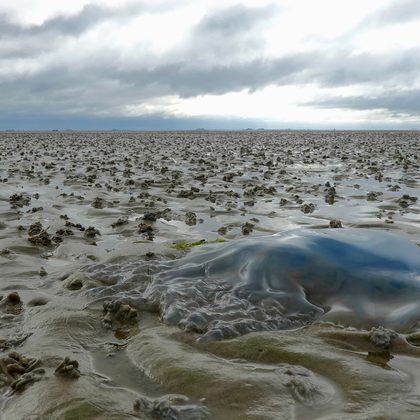
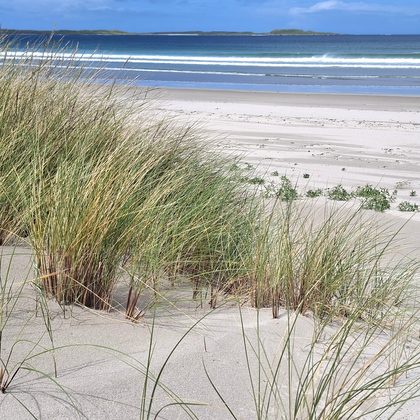
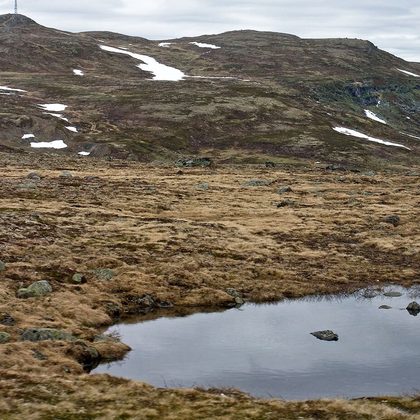
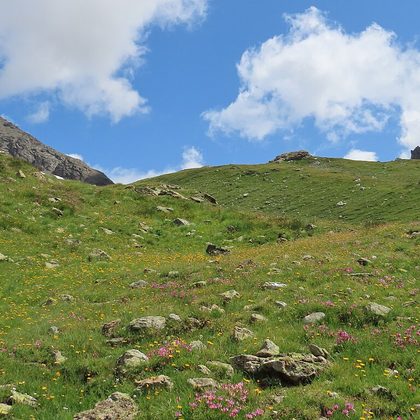
Breeds on open, bare ground: arctic tundra, wind-scoured slopes above the treeline, and stony semi-desert in the Balkans and Turkey. In winter strictly coastal: saltmarsh with glasswort and sea aster, the tideline, sea walls, bare sand flats behind the dunes, high-tide roosts and occasionally stubble fields just inland of the sea defence. Always walking on the ground, never in a bush.
Where the bird is most at home, classified with EUNIS — the European standard for habitats.
Range and movements
Circumpolar across North America, northern Europe and Asia. In Europe the yellow-faced form flava breeds on the tundra of Scandinavia and northern Russia, and penicillata in the mountains of the Balkans, Greece and Turkey. In the Netherlands it is a winter visitor only, October to March, best looked for along the Wadden coast, the Groningen and Friesland saltmarshes and in the Delta. In Spain it is a rare vagrant on the north coast.
- Breeding (summer)
- Winter
- Passage
- Migration direction
- dark = core range, pale = thinly spread
Where and when to look
November to February, in the two hours either side of high tide, on a saltmarsh such as the Dollard, Noord-Friesland Buitendijks or the Boschplaat. Walk slowly along the tideline and use your ears first. The birds sit motionless among the wrack and give themselves away only when they burst up at your feet. Check every flock of Snow Buntings and Twite, since the three species often travel together.
Conservation status
Not globally threatened (LC), but the northern European breeders are declining fast and wintering numbers on the North Sea coast have fallen by well over ninety per cent in thirty years: where flocks of hundreds once fed on a saltmarsh, a few dozen is now a good count. The likely causes are warming and scrub encroachment on the Scandinavian tundra, the loss of pioneer saltmarsh vegetation through tidy coastal management, and the clearing of tideline wrack. It is one of the most sharply declining winter visitors on our coast.