All species › Passerines › Larks › Wood lark
Wood lark
Lullula arborea | Boomleeuwerik | Totovía
Europe's smallest lark, with a strikingly short tail and the finest song in the family: a falling, wistful run of flute notes that hangs over a heath at dusk and carries for kilometres.

Voice
The hallmark is a descending series of clear, melancholy flute notes: lu-lu-lu-lu-lu, slow at first, then accelerating and dropping in pitch, alternating with a rolling tloo-ee-tloo-ee-tloo-ee and soft plaintive didloo motifs that die away like a sigh. It sings in a wide circling song flight up to a hundred metres up, or from a treetop or post, often at dusk and on clear moonlit nights. The season runs from late January into June, peaking in March. The call, usually from birds passing over in October, is a soft, nasal, undulating tit-loo-eet.
Recording: British Library — CC BY-SA 4.0 · Wikimedia Commons
Identification
Small and compact, with a tail so short that the bird looks almost cut off behind in flight, and broad rounded wings. The long creamy supercilium runs right back to the nape, where it very nearly meets its counterpart from the other side, forming a pale V on the hindneck. On the bend of the wing sits a small but decisive black-and-white block on the primary coverts. Upperparts warm brown and finely streaked, breast cream with crisp dark streaks; the little crest is raised only in excitement. In flight it shows no white outer tail feathers — only small white corners at the tail tip — and no white trailing edge to the wing.
Confusion species
Skylark is larger and much longer-tailed, with obvious white outer tail feathers and a white trailing edge to the wing, and sings a sustained jangle during a song flight lasting minutes, high overhead, rather than a descending whistle. Crested Lark is coarser and sandier, with a genuine spiky crest, buff tail sides and a longer bill. Meadow and Tawny Pipits are slimmer, have a fine pipit bill and lack the black-and-white block on the wing bend.
Habitat
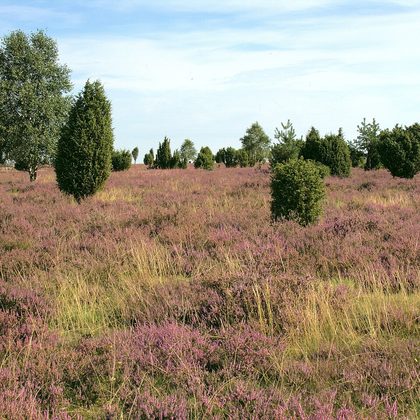
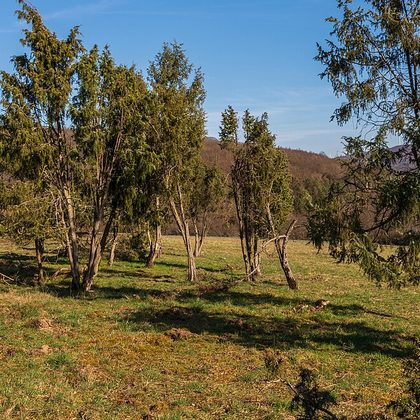
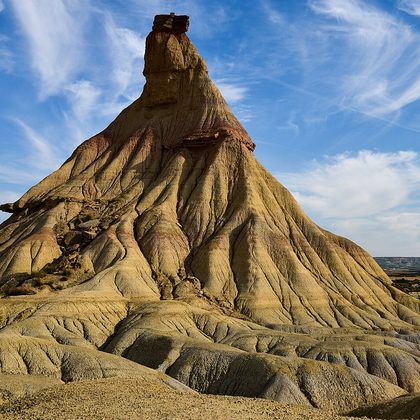
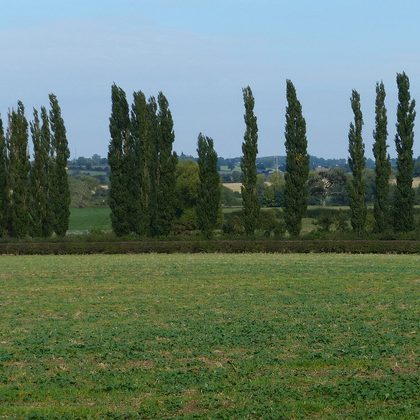
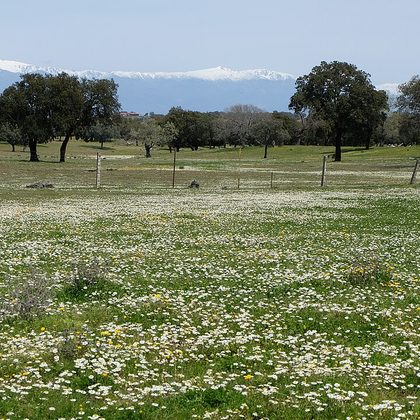
Warm, dry, nutrient-poor ground with a mosaic of bare sand, short turf and scattered trees: heaths, inland dune edges, young conifer plantations, clear-fells, firebreaks, military training areas and woodbanks. In southern Europe also cork oak dehesa, vineyard margins, olive groves and hillsides with low scrub. The nest is on the ground, and the bird needs both bare feeding patches and a raised song post.
Where the bird is most at home, classified with EUNIS — the European standard for habitats.
Range and movements
From Iberia and North Africa east to the Urals and Turkey. In the Netherlands it breeds on the sandy soils — the Veluwe, Drenthe, the Brabant and Limburg heaths and the dunes — with numbers well up since the 1980s. Most birds leave for France and Iberia in October and are back by February; a handful winter. In Spain it is resident almost countrywide, from dehesa to mountain edge, joined in winter by birds from northern Europe.
- Resident
- Breeding (summer)
- Winter
- Passage
- Migration direction
- dark = core range, pale = thinly spread
Where and when to look
Late February or early March, half an hour before sunrise, on a heath or inland dune on the Veluwe or in Drenthe, in calm, lightly frosty weather: the song carries for kilometres and the bird often starts singing in the dark. Dusk in April is the second chance. By day look for it on bare patches along firebreaks, where it walks away quietly rather than flying; then note the short tail and the black-and-white block on the wing bend.
Conservation status
Not threatened (LC) and clearly increasing in western and central Europe since the 1990s, helped by heathland restoration, clear-felling, forest rejuvenation and milder winters, after a deep trough caused by agricultural intensification and heaths growing over. A severe winter can halve the population overnight. The pressures are open sand closing up under nitrogen deposition, ground nests disturbed by loose dogs and recreation, and the loss of the fine-grained mosaic of woodland and bare ground.