All species › Passerines › Bushshrikes › Black-crowned tchagra
Black-crowned tchagra | Tchagra senegalus
Zwartkruintsjagra | Chagra del Senegal
The black-crowned tchagra brings a whole family into this guide that is otherwise entirely African: the bush-shrikes. It is a bird of dense low scrub that you almost never simply see. You hear it — a run of clear, wistful whistles out of an impenetrable bramble tangle — and only after patient waiting does it edge into the open for a few seconds. The hills behind Tarifa, on the Spanish side of the Strait of Gibraltar, hold the only European population.

Voice
The song is a series of four to eight clear, wistful whistles running down the scale: tuu-tuu-tuu-tuu, slow, pure and far-carrying, with the tone of a tin whistle. It is delivered from a bush, but also in a short display flight in which the bird flutters up at an angle, rattles a dry rrrrt with its wings and parachutes back down — the one moment it shows itself properly. In alarm a harsh grating chairr and a clattering rattle. Loudest from February to May, chiefly in the first hour after sunrise and again towards dusk.
No freely licensed recording is available for this species yet.
Identification
Shrike-sized and shrike-shaped, but longer-tailed and heavier-billed: 21 to 23 cm, a good part of it graduated tail. The crown is glossy black, bordered by a broad cream supercilium with a black eyestripe below, so the head is marked in three crisp bands — the best mark at any distance. Upperparts grey-brown, the closed wing carrying a warm rufous panel, underparts dingy white with grey-buff flanks. The black tail is strongly graduated and broadly white-tipped, flashing as the bird dives back into cover. The bill is black, deep and clearly hooked at the tip; the legs are blue-grey. Sexes alike; juveniles have a dull brown-black crown and a blurred head pattern.
Confusion species
Nothing in this region really looks like it, but rufous-tailed scrub-robin shares the same thickets and the same skulking habits, and also cocks a long white-tipped tail. That bird is slimmer, with a thin insect-eater's bill, a rusty rump and tail and an upright, hopping carriage; the tchagra moves heavily and horizontally and carries that thick hooked bill. Shrikes are the other trap, but mostly in the observer's head: Iberian grey shrike and woodchat shrike perch conspicuously on wires and bush tops, whereas a tchagra drops into the tangle the moment it knows it is being watched. A run of pure descending whistles from dense scrub in southern Spain or Morocco can be nothing else.
Habitat
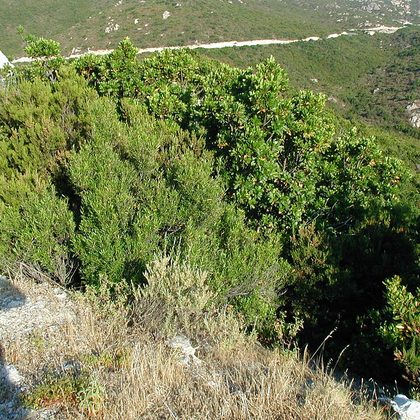
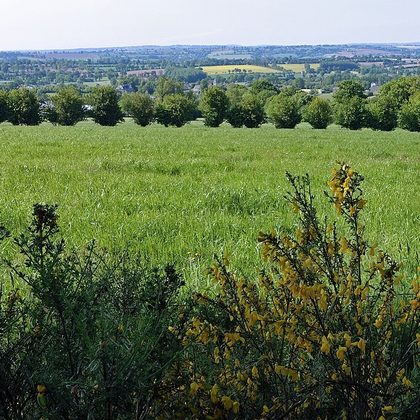
Dense, low, preferably thorny scrub with bare ground beneath it: bramble and dwarf fan palm on sunny slopes, lentisc and wild olive, neglected field margins, prickly-pear hedges around cultivation, and the bushy edges of streams and wadis with tamarisk and oleander. It is emphatically a scrub bird rather than a woodland bird: it avoids closed woodland just as firmly as it avoids bare plains. Most foraging is done on foot on the ground under the bushes, taking large insects, small lizards and snails; the nest sits low and deep inside a thorn bush.
Where the bird is most at home, classified with EUNIS — the European standard for habitats.


Range and movements
Within the area of this guide the species falls into two separate blocks. The larger is north-west Africa: Morocco from the Atlantic plains and the Souss up into the lower slopes of the Atlas, and eastwards through northern Algeria into Tunisia. The second is a small stronghold in the Spanish province of Cádiz, in the hills around Tarifa, Bolonia and Facinas, where it has been known as a breeding bird since the middle of the last century and where a few tens of pairs hold on — the only place in Europe. Beyond the region it is a widespread African bird, from the Sahel to South Africa. It does not migrate and holds its territory all year.
- Resident
- Breeding (summer)
- Winter
- Passage
- Migration direction
- dark = core range, pale = thinly spread
Where and when to look
Southern Spain, March to May, the first hour of light: take the road from Tarifa to Bolonia or the slopes near Facinas, switch off the engine and listen. Do not push into the scrub, which is counter-productive; wait for the song, walk it down to the right bush, and with luck the bird will lift above the tangle in its display flight. In Morocco it is far easier: almost any overgrown wadi edge in the Souss will produce one. Do not use recordings to draw it out — the Spanish population is tiny and the birds respond strongly.
Conservation status
Not globally threatened (IUCN: Least Concern), with a vast African range and no demonstrable decline. The European fringe of that range is another matter: the few tens of pairs in Cádiz are legally protected and vulnerable to scrub clearance and burning, to wind farms built on exactly those hills, and to disturbance from birders crowding the song posts. In Morocco and Algeria the species is common and appears to do well in half-open farmland with hedges and thickets.