All species › Passerines › Penduline tits › Black-headed penduline tit
Black-headed penduline tit | Remiz macronyx
Zwartkopbuidelmees | Pájaro moscón cabecinegro
The Black-headed Penduline Tit is the penduline tit of the Caspian reedbeds: the same tiny felting weaver, but with an entirely black head instead of a black mask. It is one of the least studied birds in Central Asia, and the edge of its range just reaches this guide's map area in the delta of the Ural.

Voice
Poorly documented, which for a bird this close to the Eurasian Penduline Tit is a real gap. What has been described and recorded comes to much the same thing: a high, thin, slightly descending whistle of the tseeeoo type, carrying over the reeds but easily lost among Reed Warblers, plus short tsee-tsee contact notes within a party. The male sings a soft, hissing little song at the nest. Anyone listening over reedbeds in this region does well to look hard at every penduline tit call.
No freely licensed recording is available for this species yet.
Identification
As small and finely built as the Eurasian Penduline Tit, with a short awl-shaped bill, sturdy legs and a proportionally long tail. In the adult male the whole head is jet black: forehead, crown, cheek, ear-coverts and nape, and in most birds the black continues over the throat. Below it lies a warm chestnut band across the upper breast and mantle, fading to sandy towards the rump; the underparts are pale sandy brown. The female has the same pattern in duller tones, with a brown forehead and a less sharply outlined hood. In fresh autumn plumage pale feather fringes make the whole bird paler and vaguer. Juveniles lack the black altogether and are plain sandy brown.
Confusion species
Really only the Eurasian Penduline Tit, which in the northern Caspian is genuinely next door. The difference is in the head: a black mask through the eye on a pale grey head in the Eurasian, a solid black hood with no grey around it in this species. Note that the Caspian form of the Eurasian Penduline Tit already carries a great deal of black in the face, so one glance at a half-black head is not enough — you want to see how far the black runs over crown and nape. Further east it shares the reedbeds with White-crowned Penduline Tit, told by the pale crown patch set in the black. For the record, AviList and the IOC list run it as a separate species, while HBW and BirdLife have placed it back within the Eurasian Penduline Tit since December 2020.
Habitat
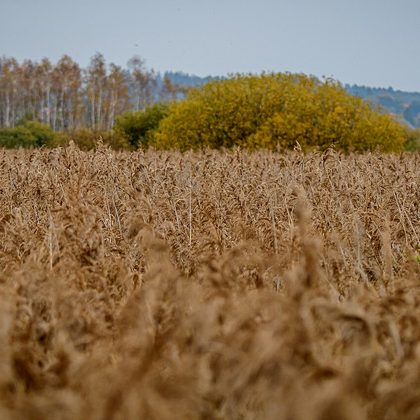
Reed, reedmace and clubrush stands in shallow water along lakes, rivers and oxbows, with tamarisk and willow scrub on the edge towards dry ground. The nest is not slung from a twig but woven between several reed stems, forty centimetres to a metre and a half above the water, from strips of reed leaf and plant down; the male does nearly all the building. Five to seven eggs from early May to early July, probably two broods, with fledged young in July and August. Outside the breeding season it wanders through scrub and small reed patches, away from open water as well.
Where the bird is most at home, classified with EUNIS — the European standard for habitats.


Range and movements
From the Caspian Sea eastwards to Lake Zaysan in Kazakhstan and south into Iran, in scattered and disconnected reed country; breeding in China was confirmed for the first time in 2023. Within the map area of this guide one corner of that is left: the reedbeds of the Ural delta at Atyrau, where it is seen regularly from April to July, together with old records from the Lankaran lowland in Azerbaijan. A first record for Turkey, a bird trapped on the Aras, was published in 2022. By far the greater part of its range therefore lies east of the edge of the map.
Where and when to look
To see one you need the reed fringes of the Ural at Atyrau in May, where the delta is less than a day out from the city. Search low: the nest sits between the stems at eye level above the water, grey and felted like that of the Eurasian Penduline Tit but without the free-hanging spout on a willow twig. And check the head of every penduline tit you meet in this region, because this is exactly where the two species touch.
Conservation status
Not evaluated (IUCN: Not Evaluated). That is a matter of bookkeeping rather than concern: BirdLife, which prepares the bird assessments for the Red List, has kept it within the Eurasian Penduline Tit since 2020, and that species as a whole is listed as Least Concern. Little is known about its numbers; the reed country of the Caspian and Aral basins is shrinking through water abstraction, salinisation and reed burning, and the western subpopulations are precisely the ones least studied.