All species › Birds of prey › Hawks, eagles and kites › Black-winged kite
Black-winged kite | Elanus caeruleus
Grijze wouw | Elanio común
The Black-winged Kite is the small, pale, red-eyed raptor of dry Iberian farmland: white below, pearl grey above and with a black shoulder patch visible a kilometre away. It hovers like a Kestrel but on kite's wings, and since the first European breeding record in Portugal in 1963 it has spread across half a continent.

Voice
A fairly silent bird, especially outside the breeding season. On territory it gives a thin, slightly nasal whistle, wheee-ah, repeated calmly from a perch or in flight, and a harsh, broken kree-kree-kree at intruders. In display and at food passes a higher, faster series is heard, and young beg with an insistent piping that betrays the nest at close range.
Recording: JMK — CC BY-SA 4.0 · Wikimedia Commons
Identification
A small raptor, Kestrel-sized but far broader and paler in appearance, with a large rounded head and a short, square-ended tail. The adult is pearl grey above and pure white on head, neck and all the underparts, with a large black shoulder patch that covers the coverts when perched and forms a black triangle along the leading edge of the wing in flight. The eye is deep coral red rimmed with black, and a short black line crosses the lore; the bill is black with a yellow cere and the legs are short and yellow. In flight the wings are long and fairly blunt-tipped and are held in a high V when hovering; from below the bird is white with dark primary tips. The juvenile is recognisable at once: greyish brown above with pale feather fringes giving a scaled look, a diffuse orange-brown bib across the breast, a duller shoulder patch and a dark brown to amber iris that only turns deep red after the first year.
Confusion species
With Black Kite and Red Kite the resemblance is one of family, not of appearance: both are far larger, with a loose, rocking flight and a long forked tail — shallow in the Black, deep and rusty in the Red — and brown or rufous plumage with none of the Black-winged Kite's clean white. A Black-winged Kite weighs a quarter of a Red Kite and has a short, square tail; if the bird you are watching keeps correcting its course with the tail, it is a kite in the classic sense. The Kestrel is the real pitfall, because it hovers at length over the same dry farmland and at the same height: but it is rufous brown with a long narrow tail, pointed wings and a quick, nervous beat, while the Black-winged Kite is white and grey, with broad blunt wings, a compact body and a short tail, and when hovering holds the wings higher with a slower, deeper beat before dropping in stages with legs dangling and wings raised steeply. At distance and against the light a male Hen Harrier is also grey and white, but it is far longer in wing and tail, has a white rump and a black wingtip instead of a shoulder patch, and quarters the ground low rather than hanging over one spot. A distant gull deceives more often than people admit; the moment the bird hovers, the matter is settled. On juveniles the brown scaling and orange bib can suggest a Kestrel, but the broad silhouette, short tail and dark shoulder are still there.
Habitat
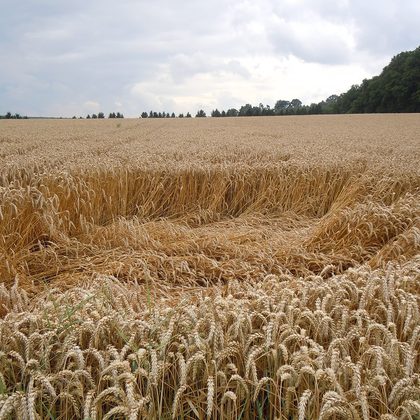
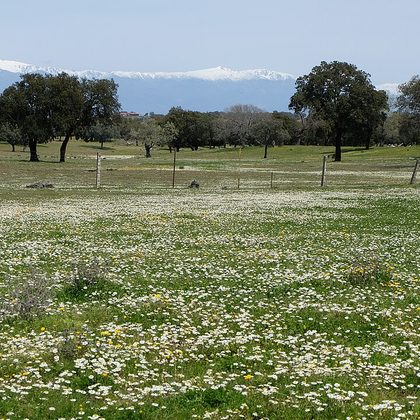
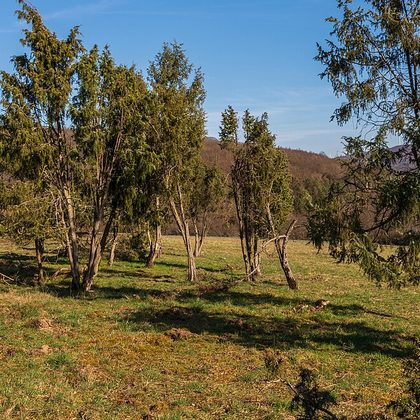
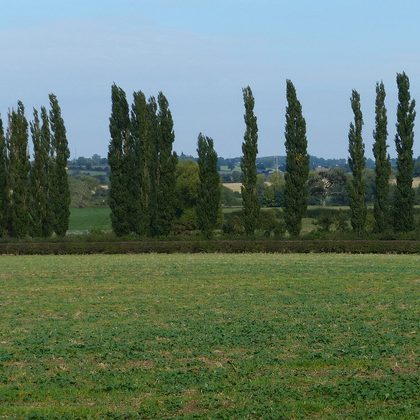
Open, dry farmland with scattered trees: dryland cereal, fallow and rough ground, holm oak and cork oak dehesa, low-intensity olive groves, grassland and field edges with isolated oaks or eucalyptus. It needs two things at once: tall grass holding voles and mice, and a tree or a wire to watch from. It hunts by hovering at ten to thirty metres and dropping in stages, and also by still-hunting from a post or a power line. It nests in a small stick nest in the crown of an isolated tree and can raise two or even three broods in a good rodent year.
Where the bird is most at home, classified with EUNIS — the European standard for habitats.
Range and movements
An African and Asian species that also breeds in south-west Europe. The first European breeding was recorded in Portugal in 1963, and the species now occupies much of the western half of the Iberian peninsula, with its core in Extremadura and the Alentejo and further birds in Andalusia, Castile-La Mancha, Madrid, Castile and León, Aragon, Catalonia and the Basque Country; the Iberian population is put at more than a thousand pairs. Since the 1990s it has colonised France and now breeds as far as the north of that country, with occasional nesting in Germany, Hungary and Denmark. In the Netherlands it was once an outright rarity — one record up to 1979 and one between 1980 and 1999 — while several tens of birds are now seen each year, enough for the species to have been dropped from the rarities list in 2022.
- Resident
- Breeding (summer)
- Winter
- Passage
- Migration direction
- dark = core range, pale = thinly spread
Where and when to look
In Extremadura or the Alentejo, drive a minor road through cereal country and dehesa at sunrise or in the last hour of the day and scan the wires, the posts and the isolated crowns: the kite perches high and in full view, and its white shows up at long range. If you see a small raptor hovering over a fallow field, stop and watch calmly: within a few seconds you will see whether the tail is long and brown, for a Kestrel, or short and white, for a Black-winged Kite. Further north, in France or the Netherlands, it pays to work the same open farmland between May and November.
Conservation status
Not globally threatened (IUCN: Least Concern) and clearly increasing in western Europe in both range and numbers. In Spain it is listed as Near Threatened in the national red data book and is treated as a species of special interest, because the population, though growing, remains small and tied to one particular farmed landscape. The main threats are agricultural intensification and the loss of field margins and scattered trees, electrocution and collision on power lines, road casualties — it hunts a great deal along roads — and poison laid for other animals.