All species › Birds of prey › Hawks, eagles and kites › Bearded vulture
Bearded vulture
Gypaetus barbatus | Lammergier | Quebrantahuesos
Of all Europe's vultures the Bearded Vulture is the one you can name on silhouette alone from kilometres away: a huge dark sickle with a long wedge-shaped tail, sliding along a rock face without a single wingbeat. It feeds almost entirely on bone, and that explains both its build and its behaviour.

Voice
Almost always silent; most observers never hear it. At the nest and in display a thin, high, falcon-like tsee-ook or a shrill whistle, and occasionally a soft chattering chek-chek. Communication is largely visual: tandem flights by the pair, raising the crown feathers and fluffing out the beard.
No freely licensed recording is available for this species yet.
Identification
Very large raptor with strikingly long, narrow, backswept wings and a long, wedge-shaped tail that is longer than the wing is broad — the only European vulture with those proportions, and the feature everything turns on. Adult: slate-grey to blackish above with pale feather shafts, cream to deep rusty-orange head, neck and underparts (that orange comes from bathing in iron-rich mud, not from the plumage itself), a black eye mask running into a black bristle beard below the bill, and a blood-red orbital ring around a straw-yellow eye. Unlike the true vultures the head is fully feathered, since the bird never puts it inside a carcass. Immatures are uniformly dark sooty brown with a blackish head and neck, with broader, blunter wings and a shorter tail, and take five to seven years to reach adult plumage.
Confusion species
Griffon Vulture is shorter and far broader-winged, with a short, square-cut tail barely projecting behind the wing, heavily fingered primaries, a bulging white ruff and a withdrawn, bare head; it soars in a pronounced V. Cinereous Vulture is bulkier still and uniformly dark, with very broad, plank-like wings, a straight trailing edge and a short tail that is at most slightly wedged. The Bearded Vulture, by contrast, soars on flat or slightly drooped wings, projects head and neck well forward and shows that long diamond tail; at range the shape recalls a falcon blown up to giant size rather than a vulture. A juvenile Bearded Vulture is darker and broader-winged than an adult and is the plumage most often confused with Cinereous — look at the tail again.
Habitat
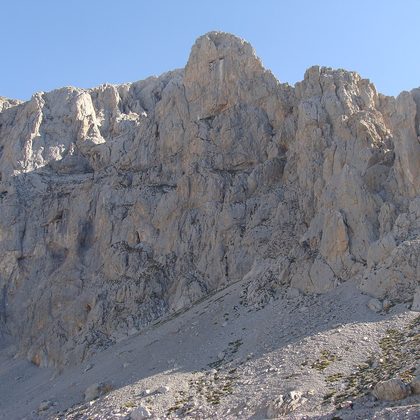
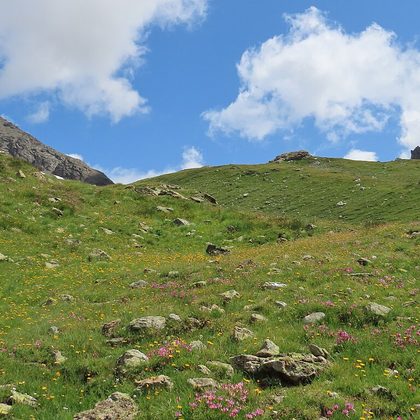
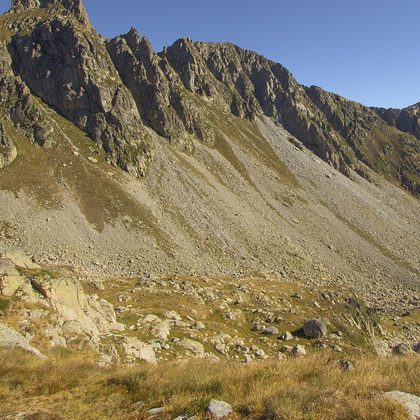
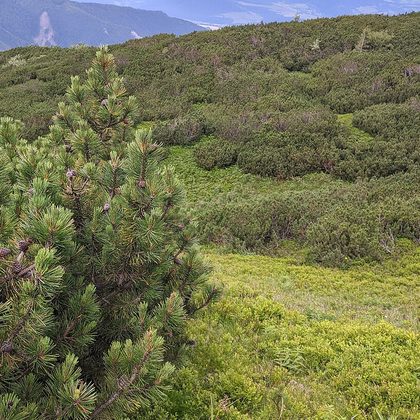
High mountains with deep valleys, vertical rock faces and reliable updraughts. The nest sits in a cave or under an overhang on an inaccessible wall, usually between 500 and 2,500 metres, and is reused for many years. Forages over alpine pasture, scree, snowfields and scrub at and above the treeline, and in the southern ranges over dry, stony mountain grassland as well, where the carcasses of chamois, ibex, marmot and free-ranging sheep lie. Characteristic are the traditional bone-breaking sites: smooth rock slabs and stony slopes where the bird has been shattering bones for generations.
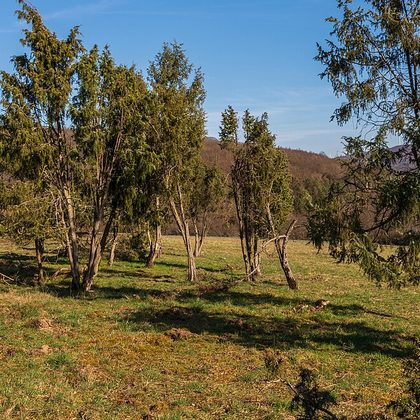
Where the bird is most at home, classified with EUNIS — the European standard for habitats.
Range and movements
The western European stronghold is the Pyrenees, with well over a hundred pairs on the Spanish and French sides and spread into the Cantabrian range and the Iberian System. Beyond that Crete (nine or ten pairs), Corsica (a handful of pairs and in serious trouble), the Turkish ranges and the Caucasus; in the Balkans it has all but vanished as a breeding bird. In the Alps it was wiped out around 1900. From 1986 young birds were released in the Hohe Tauern, Haute-Savoie, the Vercors and the Swiss Valais; the first wild-hatched chick fledged in 1997 and there are now more than a hundred pairs, Europe's second largest population. In Andalusia a second reintroduction has run since 2006 in the Sierras de Cazorla, Segura y Las Villas, with the first wild chick in 2015 and some fifteen territories today; birds have also been released in the Picos de Europa, the Maestrazgo, the Sierra Nevada and the French Grands Causses.
- Resident
- Breeding (summer)
- Winter
- Passage
- dark = core range, pale = thinly spread
Where and when to look
In the Pyrenees or the Alps pick a clear morning in late winter or early spring and take a viewpoint overlooking a large rock face and the valley in front of it; between nine and twelve the thermals get going and birds patrol the wall, often at eye level or below you. In Spain the hides at the supplementary feeding stations in the Sierra de Guara and around Ordesa are the most reliable; in the Alps the valleys around Leukerbad, the Vanoise and the Hohe Tauern. With every vulture that passes: check the tail shape first, the colour second.
Conservation status
IUCN: Near Threatened. The species is declining globally, but in Europe it is recovering from a historic low: reintroductions, permanent feeding stations and protection of breeding cliffs have brought the European population to roughly six hundred to a thousand pairs. The main causes of death are illegal poisoning through baits set for predators, lead poisoning from hunting ammunition left in carcasses, collisions with cable cars, power lines and wind turbines, and disturbance of nesting cliffs by climbers, paragliders and drones. Because a pair raises at most one chick a year and does not start breeding until about its eighth year, the loss of every adult reverberates through the population for years.