All species › Owls › Typical owls › Boreal owl
Boreal owl
Aegolius funereus | Ruigpootuil | Mochuelo boreal
An owl the size of a Little Owl but with a strikingly large, round head and a surprised expression. It is strictly nocturnal and spends the day pressed against a trunk, so most encounters happen in the dark: a fast, hollow whistled series that carries for kilometres on a still night.

Voice
The male's song is a rapid, hollow series of five to eight whistled notes, sometimes more than ten, poo-poo-poo-poo-poo, rising slightly in pitch and volume towards the end and starting again after a few seconds. On a windless night it carries two to three kilometres. There is also a short, shrill kyak of alarm and soft chuckling at the nest. Song peaks from late February to April, mainly around midnight and in the last hours before light; birds sing briefly again in September and October.
Recording: Klaus-Jürgen Papke — CC BY-SA 4.0 · Wikimedia Commons
Identification
Large, round head with a broad pale grey facial disc framed by a dark rim; within it, yellow eyes under raised white eyebrows that give the bird a surprised, wide-eyed expression. Crown dark brown with small, close-set white spots, upperparts brown with large white spots, underparts whitish with diffuse, blurred brown blotches rather than crisp streaks. Legs and toes are densely feathered white right to the claws. The tail is short; flight is straight and even on broad, rounded wings, without the undulation of Pygmy or Little Owl. Females weigh 130 to 215 grams and males 90 to 140, a difference not apparent in the field.
Confusion species
Pygmy Owl often shares the same wood but is far smaller, with a small round head and no obvious facial disc, a stern, low-set eyebrow line, a proportionally long tail that is frequently cocked, and a deeply undulating woodpecker-like flight; it is also active at dusk and by day, while Tengmalm's appears only after dark. The false eyes on the Pygmy Owl's nape are absent here. Little Owl has a flat crown, broad white eyebrows and fierce yellow eyes in a frowning face, and sits on posts and roof ridges in open farmland, not in closed mountain forest. Tawny Owl is much larger, with a round plain face and wholly black eyes.
Habitat
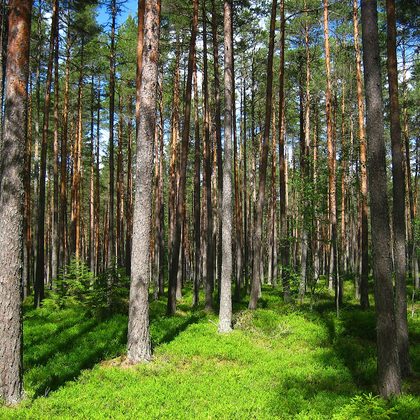
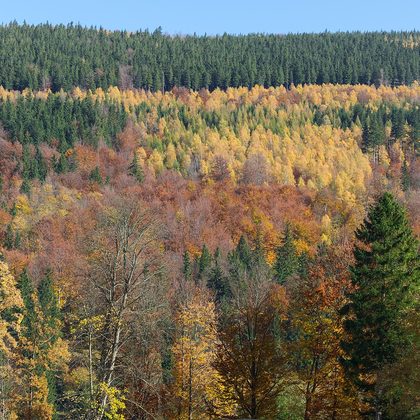
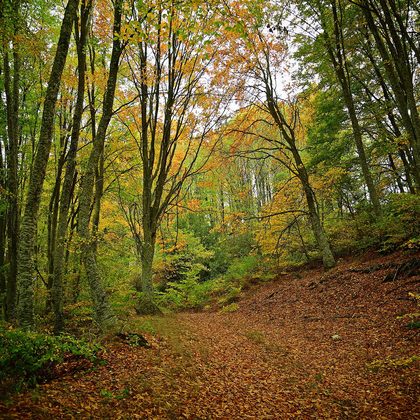
Old, dense coniferous forest of spruce, pine and silver fir, in the north also mixed with birch, with clearings, felled patches and plenty of dead wood alongside. It breeds almost exclusively in disused Black Woodpecker holes and takes readily to nest boxes. It hunts voles and shrews from a low branch and locates prey in the dark almost entirely by ear, even beneath a layer of snow.
Where the bird is most at home, classified with EUNIS — the European standard for habitats.
Range and movements
The taiga of Scandinavia, the Baltic states and Russia far into Siberia, and southwards as scattered islands in the mountain forests: Harz, Eifel, Sauerland, Black Forest, Bavarian Forest, Alps, Carpathians, the Balkans and the Pyrenees. In Belgium it breeds in the Ardennes and the Hautes Fagnes, in Germany in the uplands. It has never been recorded in Britain, and in the Netherlands it is a very rare visitor, with calling males on the Veluwe and in Drenthe in late autumn and winter but no confirmed breeding. In northern years with few voles, young birds in particular wander far south and west, and that is when they turn up.
- Resident
- Breeding (summer)
- Winter
- Passage
- dark = core range, pale = thinly spread
Where and when to look
The only practical method is listening. In March, on a clear, windless night around midnight, stand at the edge of old spruce forest in the Ardennes, the Eifel or the Harz and wait; the whistled series carries for kilometres and gives the direction at once. Dress warmly, because standing still is part of it. Leave playback alone: the species reacts strongly to it and will abandon its territory over it.
Conservation status
Not globally threatened (IUCN: Least Concern), with a large taiga population and smaller, fragmented populations in the southern mountains. Those southern outposts are vulnerable: loss of old trees with Black Woodpecker holes, the clearing of dead wood and the conversion of mixed mountain forest into even-aged plantation all make woods unsuitable, and Pine Marten is the main nest predator. In Spain the species is Near Threatened on the national list; nest boxes and the retention of hollow trees have locally raised numbers in the Pyrenees.