All species › Passerines › Shrikes › Brown shrike
Brown shrike | Lanius cristatus
Bruine klauwier | Alcaudón pardo
The Brown Shrike breeds in the southern taiga of Siberia and East Asia and winters in South and South-East Asia, so its migration route leads away from Europe. Even so, one turns up on the North Sea coast every few years, almost always in autumn. It is a compact, warm brown shrike with a heavy bill that hunts from a low perch and impales its prey on thorns and barbed wire, like the rest of its family.

Voice
Almost always silent in Europe. On the breeding grounds the commonest call is a hard, rattling chek-chek-chek, drier and more chattering than the alarm call of Red-backed Shrike. The song is a soft, sustained warble laced with imitations, delivered with the bill closed while the tail swings up and down; it can be heard on sunny days in the winter quarters too.
Recording: Jayakrishnan U — CC BY-SA 4.0 · Wikimedia Commons
Identification
A compact shrike, about the size of a Red-backed Shrike but more thickset and longer-tailed. The upperparts are uniform warm brown, reddest on crown and nape; a broad black mask runs through the eye across the ear-coverts and is bordered above by a wide, clean white supercilium. The underparts are creamy white with warm buff flanks. The tail is long, distinctly rounded and dull brown with a warm cast — without white, and without the rusty red of the other two eastern shrikes. Two structural features give it away when the colours are unhelpful: the bill is thick and deep, nineteen to twenty-one millimetres long and strongly hooked, and the primary projection is strikingly short — usually only four primary tips show beyond the tertials on the closed wing, against seven or eight in Red-backed Shrike. Females have a dull brown rather than black mask, a duller supercilium and fine crescent-shaped barring on breast and flanks. First-year birds are finely barred above and keep their pale-fringed juvenile tertials into the spring.
Confusion species
All three eastern shrikes that reach us recall a young Red-backed Shrike at first glance, and a proportion of birds simply cannot be named with certainty in the field. Start with the tail. Red-backed Shrike has a black-and-white tail; Daurian and Red-tailed Shrike have a bright rusty red tail that flares against a pale back as the bird flies; Brown Shrike has a dull brown tail, warm in tone but never rusty. Then look at the wing: of the four, Brown Shrike has by far the shortest hand, usually with four primary tips visible, which gives it a squat, long-tailed outline, and its bill is clearly deeper and longer. It differs from Daurian Shrike in its warm brown against that bird's pale sandy tones, and from Red-tailed Shrike in lacking the rufous crown that contrasts with a greyer mantle and the broader black mask that runs across the base of the bill. On females and young birds the flank pattern helps: fine, even vermiculation on a white ground, much finer than the coarse crescents of a female Red-backed. Two cautions belong here. Daurian and Red-tailed Shrike were treated as one species, Isabelline Shrike, until this century, and have been treated as separate species on the British List since 2018; for many older records it can no longer be established which of the two was involved. Hybrids also occur within this group, particularly between Red-tailed and Red-backed Shrike, betrayed by a tail in which rufous and dark markings run together. A bird that does not fit every criterion is better left unnamed.
Habitat
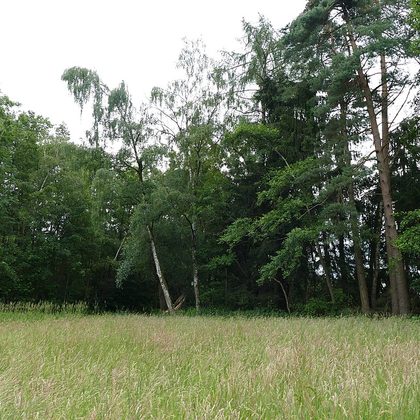
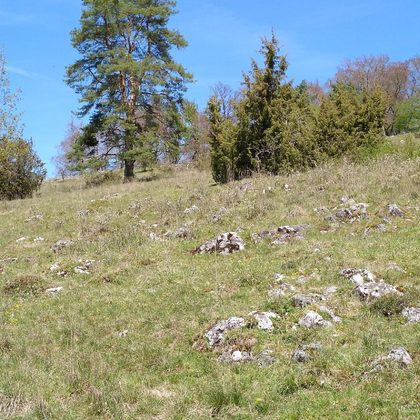
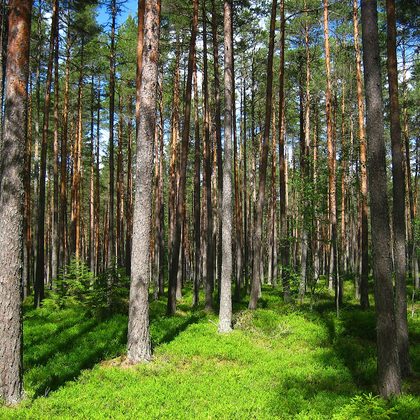
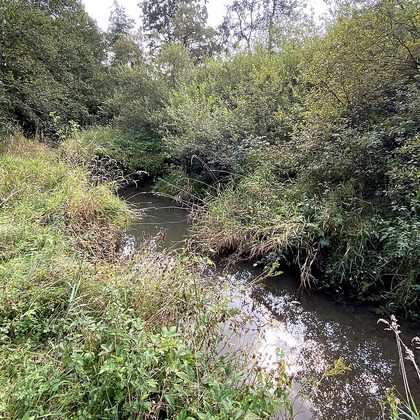
Breeds in half-open woodland along the southern edge of the taiga and in the forest-steppe beyond it: clear-fells, burnt ground and glades in larch and birch forest, woodland edges with a dense shrub layer, and belts of willow and scrub along rivers. The picture is always the same — a low bush or dead branch to hunt from, with bare or short-cropped ground beneath. In the winter quarters it takes to gardens, woodland edges and field margins, where the same bird returns to the same spot year after year.
Where the bird is most at home, classified with EUNIS — the European standard for habitats.
Range and movements
The breeding range runs from the Altai and southern Siberia east to Sakhalin, Korea, north-east China and Japan; it winters from India and Sri Lanka to Indochina, the Philippines and the Greater Sunda Islands. Within the area of these maps it is a genuine vagrant: only a few dozen records are known from the Middle East, nearly all from Kuwait. Britain has more than forty accepted records since the first on Shetland in 1985, clearly concentrated between late September and early November. The Netherlands has five: a bird that wintered in the Achterhoek from January to May 2014, a second at Den Helder in February and March 2017, two in October 2019 on Vlieland and near Oss, and one at Bergen in October 2024. Spain's two birds also stayed put: one wintered in the Ebro delta from 2014 into April 2015, another in Galicia from November 2019 into February 2020.
Where and when to look
Mid-September to late November, on the coast and the Wadden islands, ideally after a run of days with easterly winds. Look for a bird sitting low and upright on a bush top, fence or wire and dropping repeatedly to the ground; shrikes often hold the same patch of rough ground for days. Photograph it in profile and from behind: tail colour, the number of visible primary tips and the fineness of the flank barring are easier to judge on an image than through binoculars, and that is exactly where the identification is settled. Two of the five Dutch birds stayed for months, so it is worth reporting one.
Conservation status
Not globally threatened (IUCN: Least Concern) and still numerous across its range, but with a declining trend; in parts of Japan numbers have fallen by more than eighty per cent. For Europe this is not a species with a conservation status but a rare visitor. It was hardly ever seen here before the mid-1980s; since then the number of records has risen steadily, partly because observers now look harder at the differences within this group and old images have been reassessed.