All species › Passerines › Crows and jays › Alpine chough
Alpine chough | Pyrrhocorax graculus
Alpenkauw | Chova piquigualda
The Alpine Chough is the bird of the mountain station. Wherever a cable car docks in the Alps or a mountain hut opens its terrace, a party of black birds with short yellow bills is on the railing within a quarter of an hour. It is the highest-nesting songbird on record, with a nest known from above 6,500 m, and in the Himalaya flocks follow climbers into thin air. Watching one drop along a rock face and ride the air back up changes how you look at crows.

Voice
Not a caw but a clear, almost musical set of notes, and the quickest way to separate it from the other mountain crows. The usual contact call is a rippling, slightly rolling preep; alongside it comes a drawn-out, whistled, falling sweeee-oo that carries right across a corrie. Alarm is a rolling churr. A feeding flock keeps up a low continuous chatter, and above a mountain hut this swells into a high, cheerful babble that few people expect from a crow.
Recording: Marie-Lan Taÿ Pamart — CC BY-SA 4.0 · Wikimedia Commons
Identification
Larger than a Jackdaw and clearly smaller than a Carrion Crow, wholly black with a faint gloss and two colour marks that carry a long way: a short, slightly curved, bright yellow bill and coral-red legs. The silhouette is notably long. At rest the tail projects well beyond the folded wingtips, so that a walking bird looks almost too long for itself. In flight the wings are fairly narrow and only shallowly fingered at the tip, and the tail is long with a slightly rounded end. Young birds have a duller, dirty-yellow bill and dark legs that turn red during their first year. Everything about the flight is play: a flock spills down a cliff, climbs back on rising air and tumbles around itself on the way.
Confusion species
Red-billed Chough shares the same mountains and often the same flock, and at range the identification rests on the bill and on the shape of the wing. Alpine Chough has a short yellow bill, Red-billed a long, slender, clearly decurved red one. Juvenile Red-billed Choughs have a dull orange bill, but it stays long and curved, and their legs are pink rather than coral. In flight Alpine Chough is the slimmer bird: narrow wings with shallow fingering and a long tail that projects beyond the wingtips. Red-billed Chough has broad wings with deeply spread primaries and a short, square-cut tail, which makes it look stocky and wide. On voice they separate at once: a rippling preep and a whistled, falling sweeee-oo against a loud, far-carrying chee-ow. Jackdaw is smaller and more compact, with a grey nape, a pale grey eye and a dark bill, and lives lower down among villages and church towers. Carrion Crow is much larger and heavier, with a thick black bill, a dark eye and slow, even wingbeats.
Habitat
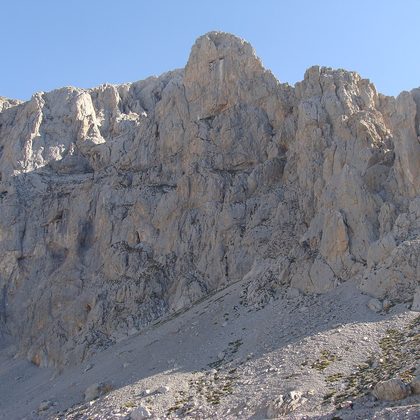
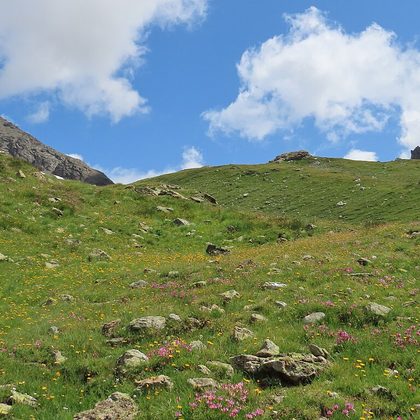
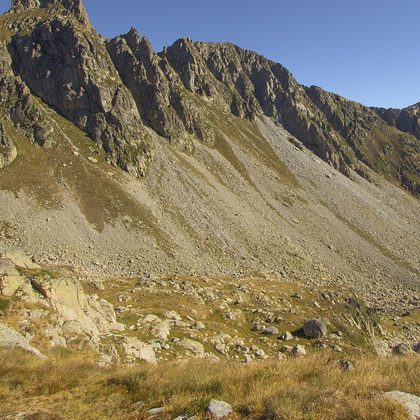
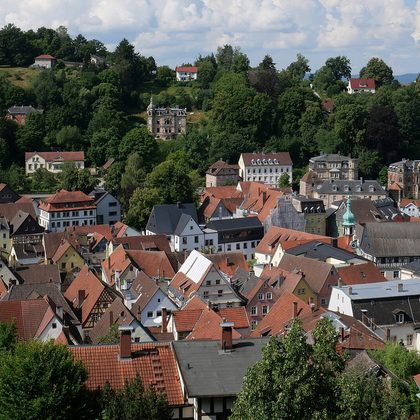
Rock faces, gorges and rock plateaux between roughly 1,300 and 2,900 m in Europe, the nest set deep in a crevice or cave. It feeds on alpine grassland and on scree, working insects, larvae and snails out of the short turf and from between the stones, and takes berries in late summer. In winter it drops into the valleys and hangs around ski stations, mountain restaurants, car parks and villages, living partly on scraps; this is not an oddity at the edge of its life but a regular annual part of it.
Where the bird is most at home, classified with EUNIS — the European standard for habitats.
Range and movements
A broken chain of mountain ranges: the Cantabrians and Pyrenees, the Alps, the Apennines, Corsica, the Carpathians, the Balkan ranges and Greece, Crete, Turkey, the Caucasus and Lebanon, plus the Atlas in Morocco. From there the range continues across Central Asia and the Himalaya into western China, so well beyond Europe. The species is resident and moves mainly up and down rather than across the map. It does not occur in the Low Countries; the nearest birds are in the Alps. In Spain it is confined to the north, from the Cantabrian mountains to the Pyrenees.
- Resident
- Breeding (summer)
- Winter
- Passage
- Migration direction
- dark = core range, pale = thinly spread
Where and when to look
Easiest at the top of a cable car or at a mountain hut from about 2,000 m: sit down, wait, and the flock comes to the terrace. Better still is an hour at a steep face on a windy day, when dozens of birds dive along the rock and climb back. In winter, ski stations and the car parks below them are the surest bet. In any mixed flock, look at the bills first: short and yellow, or long, red and curved.
Conservation status
Not threatened (IUCN: Least Concern) and stable across its range. For food it depends on short-grazed alpine pasture, and where summer grazing is abandoned and the sward closes over with scrub it loses feeding ground. Against that, mountain tourism supplies it with food and locally improves winter survival. The long-term question is warming: its habitat can only shift upward, and above the ridge the mountain runs out.