All species › Passerines › Crows and jays › Red-billed chough
Red-billed chough | Pyrrhocorax pyrrhocorax
Alpenkraai | Chova piquirroja
The Chough is the crow of the western sea cliffs: black, glossed with blue and green, with a long, slender, decurved bill of improbable red and legs to match. In Wales, Cornwall, the Isle of Man and western Ireland it is the bird of the cliff-top path, and its return to Cornwall in 2001, after nearly thirty years without one, is among the happier stories in British birding. Elsewhere in Europe it is a mountain bird, but the requirement is the same everywhere: short, grazed turf full of ants and beetles, and a crevice in rock to nest in.

Voice
One call dominates: a loud, ringing and surprisingly far-carrying chee-ow, sharp at the start and falling away. It is built like a Jackdaw's call but is fuller, louder and much clearer in tone, and it travels the length of a cliff front. There is also a shorter, higher kweek and, in alarm, a run of hard rattling notes. In practice you hear the bird first and then watch it lift over the cliff edge.
Recording: Victor C. Lewis / British Library — CC BY 4.0 · Wikimedia Commons
Identification
Between Jackdaw and Carrion Crow in size, slimmer than the crow and with a silhouette all its own. The plumage is deep black with a green-blue gloss; everything eye-catching is at the extremities — a long, slender, clearly decurved blood-red bill and bright red legs. In flight the wings are strikingly broad with a straight trailing edge and deeply spread primaries standing out like fingers, and the tail is short and square-cut, so the whole bird reads as wide and stocky. Juveniles are duller black, with a shorter, dull orange bill and pink legs, and are the awkward birds of their first summer. Along a windy cliff face, pairs put on a display of stoops, sideslips and rolls onto the back.
Confusion species
In the mountains it shares its crags with Alpine Chough, often in the same flock, and then bill and wing shape settle it. Chough has a long, slender, decurved red bill; Alpine Chough a short, straight, yellow one. In flight Chough shows broad wings with deep fingering and a short, square-cut tail, while Alpine Chough has narrower, barely fingered wings and a longer tail that projects beyond the wingtips at rest. Even at range that holds: one broad and angular, the other slim and long-tailed. The voices are far apart — a loud, ringing, far-carrying chee-ow against a rippling preep and a whistled, falling sweeee-oo. Young Choughs with their dull orange bill are the pitfall, but that bill stays long and curved. Jackdaw is smaller and shorter-billed, with a grey nape and a pale grey eye, and calls a clear kyak. Carrion Crow is heavier, with a thick black bill, a dark eye, plain black plumage without red anywhere and slow, even wingbeats.
Habitat
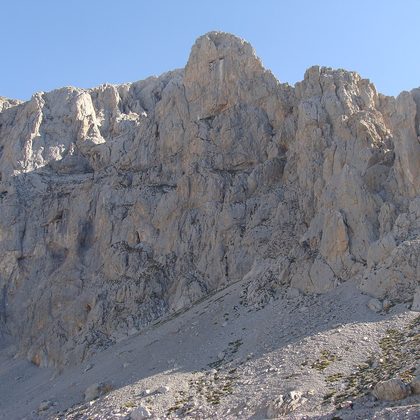
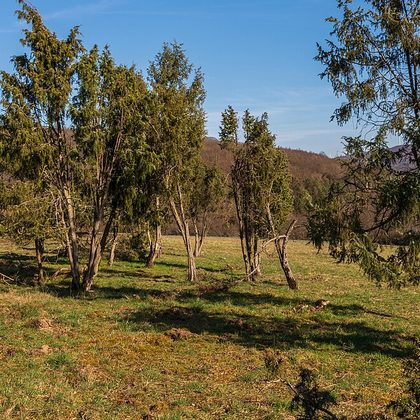
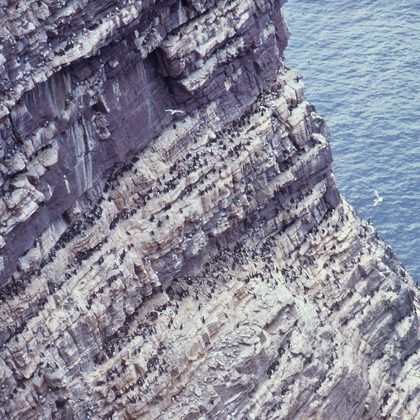
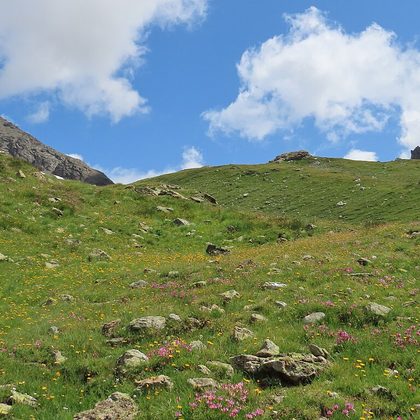
The same life in two settings. Inland it uses rock faces, gorges, caves, old buildings and quarries to nest in, with short-grazed dry grassland and mountain slopes alongside for feeding. On the coast it nests in crevices and caves in sea cliffs and feeds on the short-grazed maritime grassland and dune pasture above them. The feeding ground is what decides everything: it needs turf a couple of centimetres high, kept down by cattle or sheep, in which it can probe for ants, beetles, larvae and leatherjackets. Where the sward grows up, the bird goes.
Where the bird is most at home, classified with EUNIS — the European standard for habitats.
Range and movements
A broken chain along coast and mountain: western Ireland, the Isle of Man, Wales, south-west Scotland and Cornwall, Brittany, Iberia, the Alps, Italy, the Balkans, Greece and Crete, Turkey and the Caucasus, and north-west Africa. From there the range runs on across Central Asia and the Himalaya into China, far beyond the area of this guide. It is absent from the Low Countries; the nearest birds are in Brittany and the Alps. The last full survey of Britain, Ireland and the Isle of Man put the population at some 430 pairs, and the Cornish birds, which arrived from Ireland under their own power in 2001, reached a record 55 breeding attempts in 2024. Spain holds the largest European population.
- Resident
- Breeding (summer)
- Winter
- Passage
- Migration direction
- dark = core range, pale = thinly spread
Where and when to look
On a cliff-top path in Wales, Cornwall or western Ireland, walk until you hear the call, then watch the edge: the birds usually rise from below and slide low over the turf. Ramsey Island and the Lizard are as reliable as anywhere, and the Great Orme puts them within sight of a car park. In the mountains the same recipe works at a pass or a steep face above a grazed valley. In any flock, check bill colour and, on perched birds, whether the tail clears the wingtips.
Conservation status
Not threatened (IUCN: Least Concern), but the European picture is uneven. Through the twentieth century the range contracted and broke up in many countries as small-scale, low-intensity livestock farming was given up, and through persecution and disturbance; in France, Britain and Ireland numbers now appear to have steadied. Grazing is the key: where cattle or sheep keep cliff tops and hill pasture short the birds hold on, and where grazing stops they are gone within a few years. Keeping coastal pasture grazed at the right level is accordingly the single most effective measure, and it is what the recent Cornish and Welsh gains are credited to.