All species › Passerines › Crows and jays › Iberian magpie
Iberian magpie | Cyanopica cooki
Blauwe ekster | Rabilargo ibérico
The Iberian Magpie is the bird every traveller in the Spanish dehesa notices first: a black cap, a cream-white throat, azure wings and a long pale blue tail, all of it in noisy parties drifting from tree to tree. It lives nowhere else in Europe than on the Iberian Peninsula.

Voice
You hear a party of Iberian Magpies before you see one. The ordinary contact note is a shrill, upward-curling zhreee, repeated by several birds at once as soon as the group moves on. There is also a shorter, metallic kwink-kwink-kwink, often introduced by a single harsh krarrah, and at any disturbance a rattling alarm that brings the whole party over the intruder. There is no true song; the calls are heard all year and loudest in the early morning at drinking places.
Recording: Joost van Bruggen — CC BY-SA 4.0 · Wikimedia Commons
Identification
A slim corvid of thirty-five centimetres, nearly half of it tail. The cap is matt black and runs down below the eye and onto the nape, set off sharply by a cream-white throat. Back, breast and belly are soft dove grey with a pink cast, the wings sky blue with white outer edges to the primaries, and the long graduated tail is pale blue with a lighter tip. Sexes are alike. Juveniles have a duller brown-black cap with pale feather fringes and a distinctly shorter tail, which makes them look stockier in summer than they really are.
Confusion species
None. No other European bird carries a black cap above a cream throat with azure wings and a long blue tail, and the parties of ten to seventy birds moving through the dehesa only make it easier. For scale: a Magpie is black and white with a green-glossed tail and far bulkier, a Jay is pinkish brown with a white rump and a small blue wing panel. The Iberian birds have been treated as a separate species since 2008, first by the IOC list and later by the other world checklists, apart from the East Asian Cyanopica cyanus, from which they are separated by nine thousand kilometres; older guides still run both under one name.
Habitat
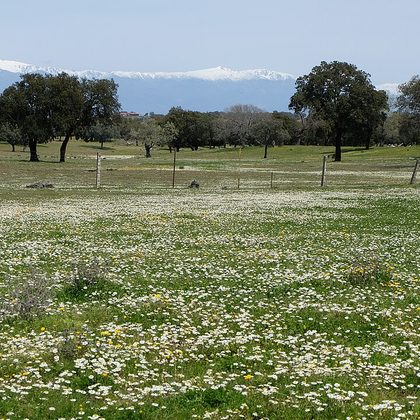
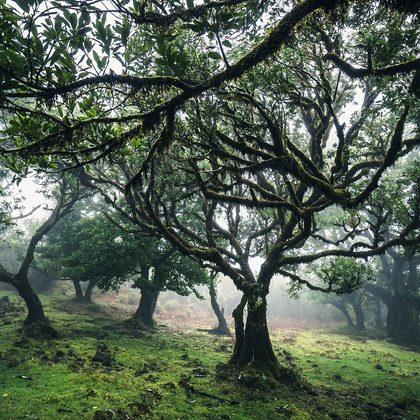
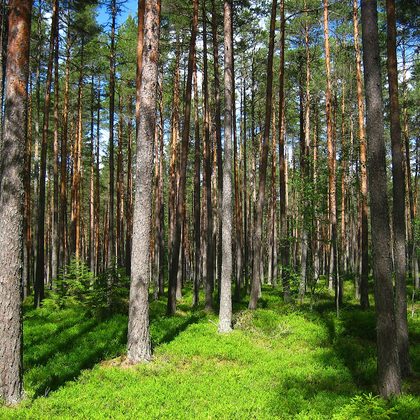
Semi-open wooded country: dehesa with holm and cork oak over short grass, and beyond that stone pine woods, olive groves, riverside trees, gardens and town parks. It flies low from tree to tree and forages both in the canopy and on the ground, taking acorns, pine seed, insects, berries, carrion and scraps from picnic sites. It breeds in loose colonies with one nest per tree, and young birds from an earlier year regularly help to raise the brood.
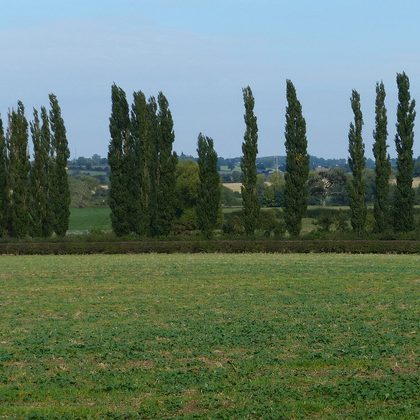
Where the bird is most at home, classified with EUNIS — the European standard for habitats.
Range and movements
The south-west and centre of the Iberian Peninsula: Extremadura, Andalusia, Castile, and in Portugal chiefly the Alentejo and the Algarve. It is absent from northern and eastern Spain and from the islands. At the northern edge of the range odd birds have turned up in recent years in Navarre and even in south-western France. It does not occur in the Netherlands; anything reported there is almost always an escaped Asian bird or a misread Jay.
- Resident
- Winter
- Passage
- dark = core range, pale = thinly spread
Where and when to look
In Monfragüe or the Sierra de Andújar, settle by a drinking trough or a small stream in the first hour after sunrise. The party comes in single file, each bird waiting in the bush until the one before it has finished, and you have them at ten metres for twenty minutes. The roadside picnic areas of Extremadura are almost a guarantee as well: where crumbs are left, an Iberian Magpie appears within a quarter of an hour.
Conservation status
Not globally threatened (IUCN: Least Concern), though globally means something small here: the entire world population sits in Spain and Portugal, and what happens to the dehesa decides its future. The species is numerous and is spreading slightly at its northern edge, while the ageing of the holm oak pastures without replanting is the longer-term worry. Birds are still lost locally to illegal control aimed at other corvids.