All species › Passerines › Crows and jays › Siberian jay
Siberian jay | Perisoreus infaustus
Taigagaai | Arrendajo funesto
The Siberian Jay is an unobtrusive grey-brown bird that nearly always finds you before you find it. It drifts in through the spruce without a sound, settles on a branch above your head and stays there watching — and only when it turns do you see where its colour is kept: rusty red on the sides of the tail, at the bend of the wing and on the rump.

Voice
Mostly it says nothing, which is what makes the encounter so quiet. Those who do hear it usually hear a high, plaintive, far-carrying kaaaay, startlingly like a calling Buzzard, and beside that a soft throaty krroo that keeps a family group together as it moves. Close to, it sings under its breath: a long strung-together mixture of squeaks, creaks, whistles and trills with imitations of other forest birds worked in. Heard all year, but always softly.
No freely licensed recording is available for this species yet.
Identification
A small, soft, round-shouldered corvid, smaller than a Jay, with a short black bill. The body is plain grey-brown, with a dark brown cap running back behind the eye, a paler forehead and a dirty-white to buff throat; the loose, downy plumage makes it look rounder still in the cold. The rust is the feature: outer tail feathers, rump, undertail coverts and a patch at the bend of the wing are warm rusty orange, and all of those flare at once as the bird lifts off and turns. The flight is light and silent, with short glides between the trunks, and the outline is that of a long-tailed, short-winged bird built for moving through dense forest.
Confusion species
In the forest it occupies it shares ground with two other corvids that nobody confuses with it once it has been seen properly. Jay is clearly larger and far more strongly marked: pink body, blue wing panel, white rump against a black tail. Nutcracker is Jay-sized and chocolate-brown with white drops and a white tail edge. The Siberian Jay carries no pattern at all: it is plain grey-brown, and all its colour sits in the rust of tail sides, wing bend and rump. Carrion Crow and Rook serve only as a yardstick — half again as long and wholly dark. On a poor view it most resembles a large long-tailed thrush or a very large tit, and then the rust in the tail settles it.
Habitat
Old, dense coniferous taiga, preferring spruce forest with a closed canopy and plenty of beard lichen on the branches, and mixed stands of spruce, pine and birch. It stays there all year; a Siberian Jay rarely moves more than a few kilometres from its territory. It eats berries, seeds, insects, fungi and carrion, and sometimes eggs and nestlings. It lays in small winter stores, gluing them behind flakes of bark and into tufts of beard lichen with sticky saliva. It lives in family parties in which the previous year's young help at the next nest.
Where the bird is most at home, classified with EUNIS — the European standard for habitats.
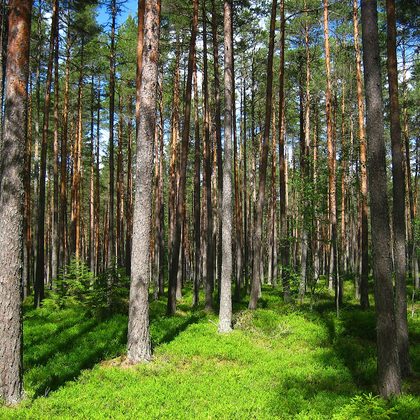
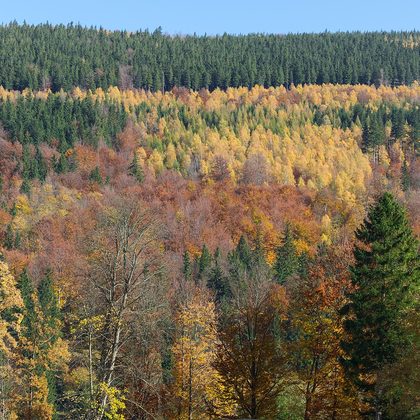
Range and movements
Breeds in the conifer belt from Norway, Sweden and Finland eastwards across the whole of Russia to eastern Siberia, with outliers into northern Mongolia and north-east China. It is therefore not a European bird in the narrow sense: the Scandinavian part is only the western rim of a range that runs almost the full width of northern Asia. In Sweden and Finland the southern edge lies further north today than it did fifty years ago; in Norway it reaches into the inland valleys. South and west of that it does not occur, not even as a vagrant of any consequence.
- Resident
- Breeding (summer)
- Winter
- Passage
- dark = core range, pale = thinly spread
Where and when to look
Look for it in Swedish or Finnish Lapland, and preferably at a shelter, a fire pit or a small car park at the head of a trail in old spruce forest: it is not shy and will come of its own accord to see what you are holding. That does not make it a tame bird — these are wild Siberian Jays that have learned people leave crumbs. The best view comes from sitting on afterwards until the party moves along, and watching the birds take turns to tuck a piece of bread behind a flake of bark.
Conservation status
Not threatened globally (IUCN: Least Concern) on the strength of an enormous range, but the European part is doing less well. Finland still holds forty to eighty thousand pairs and lists the species as of national concern; across southern Finland and central Sweden it has gone from many of its old sites. The reason is always the same: it needs old, closed spruce forest to hide in, and modern forestry with clear-felling and even-aged planting does not leave that standing. Where old stands remain, so does the bird.