All species › Passerines › Crows and jays › Eurasian jay
Eurasian jay
Garrulus glandarius | Gaai | Arrendajo euroasiático
The Jay is the loudest forester there is: it has warned the whole wood before you have even seen it. It is also Europe's oak planter — a single bird buries thousands of acorns in one autumn and never recovers hundreds of them.

Voice
The best-known sound is a harsh, tearing shraaak shraaak, like linen being ripped, that carries through the wood the moment a human, marten or owl appears. There is also a surprisingly pure mewing pyeew. The Jay is a practised mimic besides: it copies Buzzard above all, and further Goshawk, Tawny Owl, Sparrowhawk and occasionally a cat or a creaking gate. Anyone who suddenly hears a Buzzard calling in a silent wood with no raptor in sight is almost always listening to a Jay. Heard all year, loudest in autumn while hoarding acorns.
Recording: Marie-Lan Taÿ Pamart — CC BY-SA 4.0 · Wikimedia Commons
Identification
A pinkish-brown corvid of just over thirty centimetres, with a black-and-white streaked crown that rises into a shaggy crest when excited, a broad black moustache and a pale blue iris. The bend of the wing carries the unmistakable panel of sky-blue feathers finely barred with black. In flight the picture is as simple as it is reliable: a startling white rump against a black tail and a large white wing patch, carried on a flapping, uneven action. Iberian birds are greyer above with a more heavily streaked crown.
Confusion species
Few, and it is fair to say so: no other European bird combines a pink body with a blue wing panel, a white rump and a black tail. At long range or against the light the flapping flight with white rump can suggest Great Spotted Woodpecker or Magpie, but the woodpecker bounds and the Magpie has a long green-glossed tail. In southern Spain and Portugal it shares the woods with Iberian Magpie, which is far slimmer, with a black cap and long blue tail.
Habitat
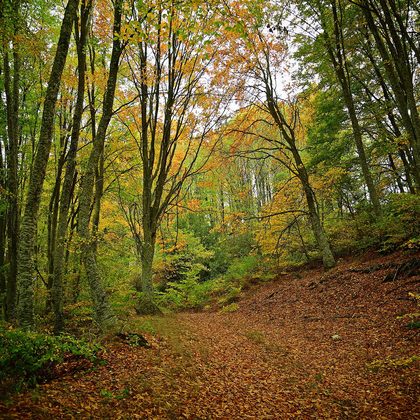
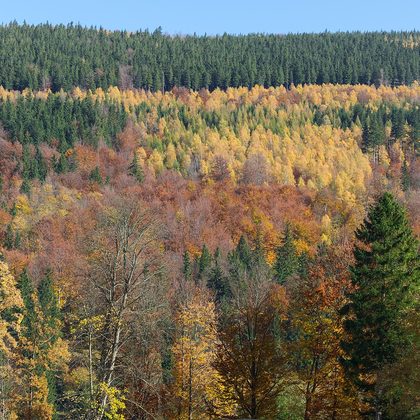
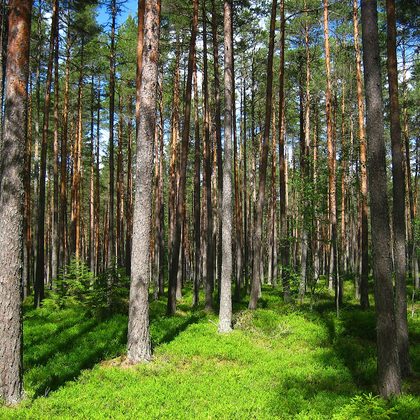
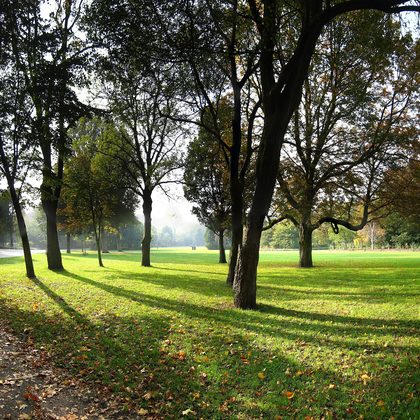
Woodland of every kind, favouring broadleaved and mixed stands with oak and beech, but also conifer plantation, hedge banks, parks, cemeteries and old gardens right into city centres. Nests low and hidden in dense scrub or ivy. Takes caterpillars, beetles and nestlings in summer; in winter mainly acorns, beech mast and hazelnuts, carried in the throat and buried singly in the ground.
Where the bird is most at home, classified with EUNIS — the European standard for habitats.
Range and movements
Almost all of Europe apart from the far north. In the Netherlands a common resident found equally in the Veluwe woods and a city park, with striking autumn irruptions of north-eastern birds in years when the acorn crop fails. In Spain widespread in oak, cork oak, beech and montane pine forest, up into the Pyrenees and the Sierra Nevada; the Iberian races look greyer and more heavily streaked than northern birds.
- Resident
- Breeding (summer)
- Winter
- Passage
- dark = core range, pale = thinly spread
Where and when to look
Walk an oak wood in late September or October and follow the birds crossing the clearings low with a bulging throat: those are Jays ferrying acorns to their caches, and you will see more in an hour than in the rest of the year together. To hear the mimicry, sit still at sunrise in March and question every Buzzard call that does not come from the sky.
Conservation status
Not threatened, and stable to slightly increasing in Europe; in the Netherlands it has grown in numbers over recent decades and increasingly breeds in villages and towns. It profits from ageing woodland and from oak planting — most of which, in fairness, it does itself.