All species › Passerines › Crows and jays › Rook
Rook
Corvus frugilegus | Roek | Graja
The Rook is the sociable crow: it breeds in colonies, feeds in flocks and roosts in hundreds in a single copse. The bare, greyish-white face of the adult is its signature — and it is exactly that feature its own young do not have.

Voice
The voice of the Rook is the voice of its rookery: a persistent, hoarse and nasal kaah kaah, higher and flatter than a crow's and without the grating finish, hanging over the trees from dozens of birds at once. There is also a short keh in flight and soft chattering at the nest. Colonies are loudest from February into May, from first light; in winter the same chorus rises over the roosts.
Recording: Vladimir Yu. Arkhipov, Arkhivov — CC BY-SA 3.0 · Wikimedia Commons
Identification
Slightly slimmer than Carrion Crow, with a purple-blue gloss on head and mantle. The bill is long, straight and pointed, with bare grey-white skin around the base reaching back below the eye. The rear crown is distinctly peaked, the forehead rises steeply, and loose thigh feathering gives the look of baggy trousers. In flight the wings appear narrower and more pointed than a Carrion Crow's, the tail slightly wedge-shaped to rounded, the action deeper and looser.
Confusion species
Carrion Crow is more compact, with a heavier, more curved bill, a fully feathered bill base, a flat crown and tight thigh feathering. The great pitfall is the juvenile Rook: through its first year the bill base is still fully feathered and the bird looks much like a Carrion Crow. Go instead by the pointed, straight bill, the steep peaked forehead, the baggy thighs, and the fact that it is nearly always in adult Rook company. Jackdaw is far smaller with a grey nape; Raven far larger with a wedge tail.
Habitat
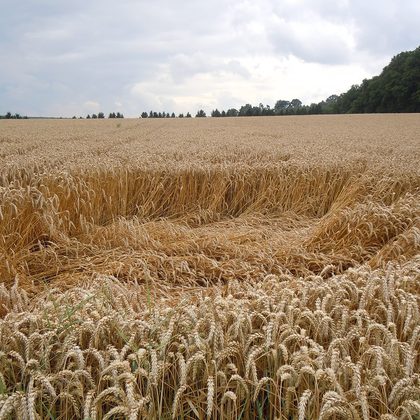
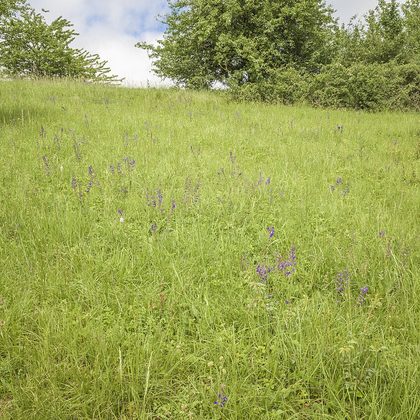
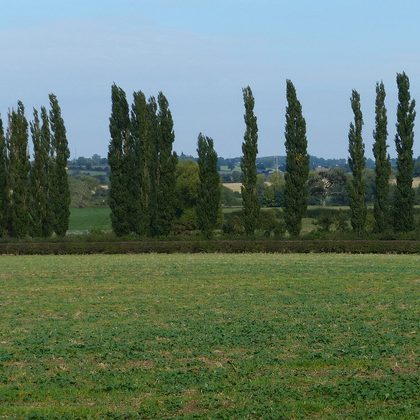
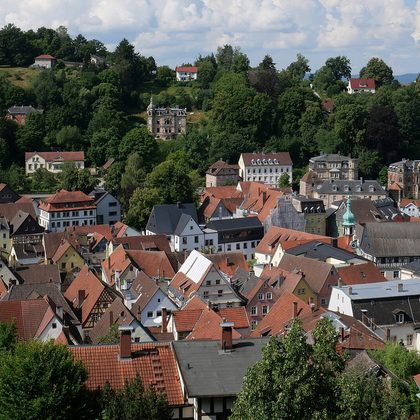
Open farmland with scattered tall trees: arable fields, pasture, rough verges and village edges. Breeds in colonies of ten to several hundred nests in the crowns of poplars, elms, oaks and limes, often in the middle of a village or along a road. Feeds walking on short swards and freshly worked fields, probing deep with the pointed bill for leatherjackets and wireworms.
Where the bird is most at home, classified with EUNIS — the European standard for habitats.
Range and movements
Breeds across most of central and north-western Europe. In the Netherlands a common resident with colonies in almost every municipality, joined in winter by large numbers from further east. In Spain it breeds only in a small area of León province, in the Torío, Bernesga, Esla and Órbigo valleys, plus a recent foothold near Figueres; elsewhere it is a scarce winter visitor.
- Resident
- Breeding (summer)
- Winter
- Passage
- dark = core range, pale = thinly spread
Where and when to look
Visit a village rookery at sunrise in late February or March and simply stand for ten minutes: the noise, the dragging of sticks and the squabbles over nest material tell the whole story. In June and July look in the same flocks for the young birds with no bare face; learn them there and they will not catch you out in autumn.
Conservation status
Not threatened, but clearly reduced in western Europe since the 1970s through loss of grassland, more intensive arable management and the felling of colonies regarded as a nuisance. Dutch numbers recovered once control was banned, but have slipped again in recent decades. The species hangs on two things: old tall trees to nest in and short grassland to feed on.