All species › Waterfowl › Ducks, geese and swans › Canvasback
Canvasback
Aythya valisineria | Grote tafeleend | Porrón coacoxtle
The largest of the North American diving ducks and the one you can name on shape alone. Head and bill run together into a single long sloping wedge, and the body is so pale that the bird stands out in a Pochard flock like a white block. Britain has around a dozen records, several of them the same returning birds.

Voice
Silent away from the breeding grounds. Displaying drakes give a soft hollow cooing with a squeaky ending and females a low krrek; neither carries far. A bird on this side of the Atlantic will not be heard at all.
No freely licensed recording is available for this species yet.
Identification
Big, long-bodied and long-necked, clearly larger than a Pochard. The profile decides it: the forehead runs from the crown in one unbroken sloping line into a long, wholly black bill with a slightly concave culmen, with no step and no band. The drake has a deep chestnut head darkening to blackish on forecrown and chin, a red iris, black breast and stern, and a back and flanks so finely vermiculated that they read as white at any distance. The female repeats the same profile in brown and pale grey: warm brown head and neck, dark eye, and a body paler than that of any other diving duck. In flight the long neck and the pale upperwing with a grey bar are the marks.
Confusion species
Common Pochard is the only real confusion species and the head profile settles it at once. Pochard has a steep, concave forehead peaking above the eye, with a shorter bill set on at an obvious angle; on Canvasback the long sloping forehead continues into the bill without a break. Beyond that, Pochard's bill is black with a broad grey band while Canvasback's is entirely black, and Pochard's back is plainly grey where Canvasback's is near-white. Females need the same approach: colour helps little, profile helps completely. Watch for Pochard × Canvasback hybrids, which turn up in collections and show an intermediate head shape with a partly grey bill.
Habitat
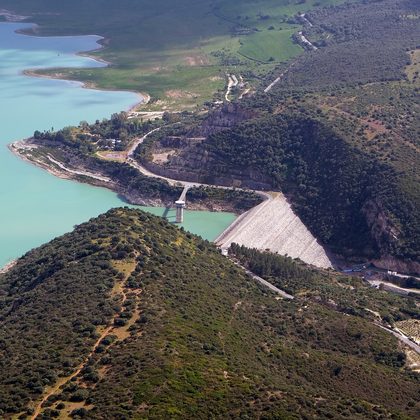
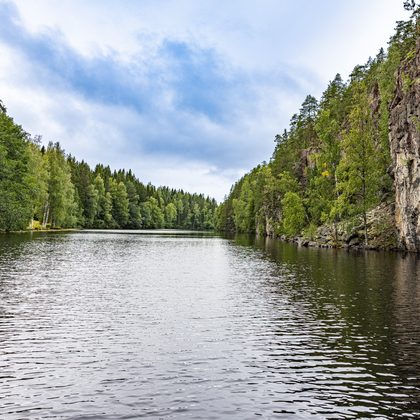
In Britain on large, deep open water: reservoirs, big pits and flooded washes, always among Pochard and Tufted Duck. In North America it breeds in dense emergent vegetation on prairie marshes and winters on estuaries and bays, diving for the rootstocks of pondweeds.
Where the bird is most at home, classified with EUNIS — the European standard for habitats.
Range and movements
Breeds on the prairies and across north-western North America and winters from Chesapeake Bay to California and Mexico. In Europe it is among the rarest of ducks. The British list opens with a first-winter drake at Cliffe, Kent, on 7 December 1996, followed by birds in Norfolk, Kent, Cornwall and Orkney and by a long run of winters at Abberton Reservoir, Essex, where an adult drake was again present from 2023 to 2025. Many of those records involve returning individuals, so the number of birds is smaller than the number of reports. The Netherlands has a single accepted record, an unringed second-calendar-year drake at Zoetermeer from 31 May to 2 June 2024 keeping company with Pochard; earlier claims at Castricum fell when one of the birds proved to be wing-clipped. That clipped wing sums the problem up, because this species too is kept in collections.
Where and when to look
From November to March work reservoirs holding hundreds of Pochard, and scan on shape rather than colour: a long, low-carried head with a sloping forehead picks out at three hundred metres even on a sleeping bird. Backlight kills the value of the pale body, so trust the profile. Because birds return, a site with a past record is worth checking winter after winter.
Conservation status
Least Concern, but with a history of sharp troughs: the North American population fell heavily in the early 1980s through prairie drought and the collapse of submerged vegetation in Chesapeake Bay. Recovery since then has been good, helped by restrictions on shooting. The continuing pressures are the drying of prairie marshes and water quality in the wintering bays. In Europe it is a vagrant only and carries no conservation status.