All species › Waders, gulls and terns › Plovers and lapwings › Caspian plover
Caspian plover
Anarhynchus asiaticus | Kaspische plevier | Chorlito asiático
A slim, long-winged plover of the dry steppe around the Caspian Sea, which in western Europe turns up perhaps once every few years among Golden Plovers on a saltmarsh or a bare field. The breeding male carries a broad chestnut breast band with a thin black lower border.

Voice
A short, sharp chip, usually given in flight, and sometimes a more drawn-out chu-eet. On the breeding grounds it gives a soft rattling display note that barely carries. Vagrants in north-west Europe are silent in practice, so voice rarely helps with identification.
No freely licensed recording is available for this species yet.
Identification
A little larger than Ringed Plover but clearly slimmer, longer-legged and longer-winged, with a long primary projection beyond the tail. The bill is short, thin and black, the head rounded with a steep forehead. Breeding male: white face and throat, broad white supercilium, dark eye-stripe and grey-brown crown, and a wide chestnut breast band cut off from the white belly by a narrow black lower border. Females and winter birds show a grey-brown breast band with no chestnut. Legs yellowish-brown to dull ochre.
Confusion species
The real problem is Oriental Plover. That bird is bigger and longer-legged, stands more upright, has a longer neck and an almost wholly white, gull-like head without a dark eye-stripe, and its black lower breast border is broad rather than thin. Caspian has a shorter, finer bill and yellowish-brown legs; Oriental has longer, paler ochre to fleshy legs. In flight the underwing settles it: pale with white axillaries on Caspian, uniformly dark brown on Oriental. The wingbar is narrow but visible on Caspian, mostly across the primaries, and effectively absent on Oriental; neither shows white tail sides. Against Greater Sand-Plover, note the fine short bill, the yellowish rather than greenish-grey legs and the far narrower wingbar. Bill shape and leg colour can only be judged on a resting bird at close range in good light; axillaries and wingbar need the bird to fly, and a vagrant in a Golden Plover flock may only do that once.
Habitat
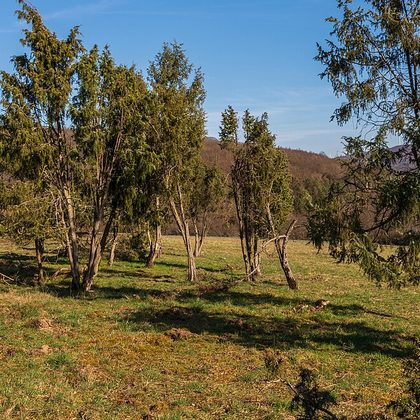
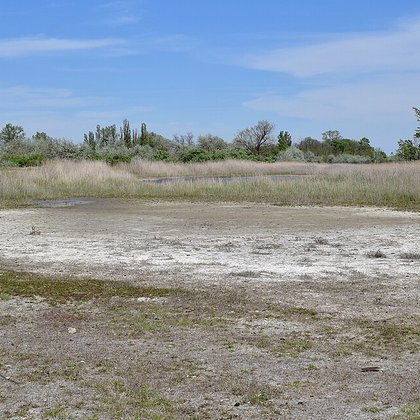
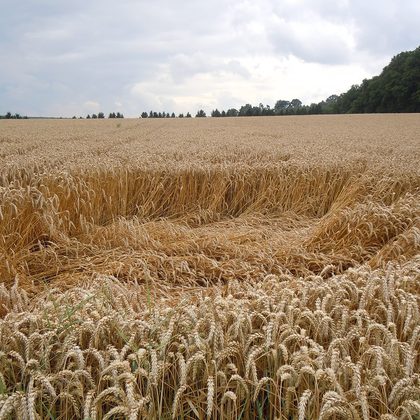
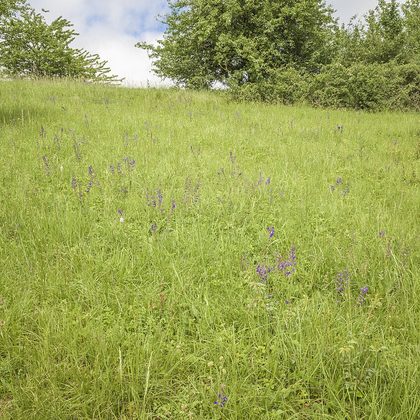
Breeds on dry, bare steppe and clay semi-desert with wormwood around the Caspian Sea, usually several kilometres from the nearest drinking water. Winters on dry grassland, dried-out floodplains, coastal dunes and cultivated land in eastern and southern Africa. In Europe vagrants seek the same kind of ground: saltmarsh, closely grazed pasture, ploughed fields and drying saline flats, hardly ever the waterline itself.
Where the bird is most at home, classified with EUNIS — the European standard for habitats.

Range and movements
Breeds in southern Russia, Kazakhstan, Uzbekistan, Turkmenistan and parts of Iran and Afghanistan, with a flyway that crosses Arabia and the Red Sea to eastern Africa and reaches south to the Zambezi. To western Europe it is a very rare vagrant. The Netherlands has four accepted records, two on Texel and one each in Zeeland and Groningen, two of them remarkably in midwinter. Britain and Spain have similarly short lists, with records scattered thinly over more than a century.
- Breeding (summer)
- Winter
- Passage
- Migration direction
- dark = core range, pale = thinly spread
Where and when to look
The chance comes in autumn and early winter from working systematically through big flocks of Golden Plover and Lapwing on bare fields and saltmarsh, especially in Zeeland, on the Wadden islands and in northern Groningen. Look for a slim, tall-legged plover that keeps to the edge of the flock and feeds in short runs. To see the species reliably, go to the Taukum steppe in south-east Kazakhstan in May, where pairs stand beside the sand tracks.
Conservation status
Not globally threatened, but the breeding grounds are under pressure from the conversion of steppe to arable land, from heavy grazing around water points and from the drying of Central Asian salt lakes. The species migrates on a narrow front and concentrates at few sites on the way, which makes it sensitive to changes in land use along the Red Sea. All the plovers involved here, from Caspian to Greater Sand-Plover and Oriental, have since 2023 been placed in the genus Anarhynchus rather than Charadrius; older guides still list this bird as Charadrius asiaticus.