All species › Waders, gulls and terns › Buttonquails › Common buttonquail
Common buttonquail | Turnix sylvaticus
Gestreepte vechtkwartel | Torillo andaluz
A tiny bird that looks like a quail and is not one: buttonquails form a family of their own within the waders, the order that also holds plovers, sandpipers and gulls. The roles are reversed here too — the female is larger, more strongly marked and the only one that calls, while the male incubates and rears the brood alone. Inside the map area one population is left, on a strip of coastal farmland in Morocco, and it is in serious trouble.
No freely licensed photograph of a living wild bird of this species exists.
Voice
The female does the calling. In spring and after rain she gives a deep, hollow, lowing hoom-hoom-hoom, slowly repeated and sometimes sustained for minutes, like a distant cow or someone blowing across a bottle. It carries several hundred metres, is almost impossible to place and seems to come out of the ground itself. The male answers with a soft, rapid kek-kek-kek. Otherwise the species is silent, and in practice the female's lowing is the only way anyone establishes that birds are still there.
No freely licensed recording is available for this species yet.
Identification
Barely fifteen centimetres, round-bodied and short-tailed, with a fine grey bill and pinkish legs. Upperparts sandy brown scaled with rufous and black; the breast warm orange-buff, the sides of the breast and the flanks marked with black crescents that show best in profile. The iris is creamy white to pale yellow, a small but reliable feature. Unlike any true gamebird a buttonquail has no hind toe and stands on three. In flight a pale buff panel across the wing coverts contrasts with dark flight feathers. The female is larger, warmer rufous and more heavily marked on the flanks than the male.
Confusion species
Common quail is the only real confusion and shares the same Moroccan fields. Quail is bigger and longer in shape, plainer sandy with sharp cream streaks along the back, dark-eyed, streaked rather than crescent-marked on the flanks, and shows no pale covert panel in flight. Behaviour helps as much as plumage: a flushed quail goes off hard and far, while a buttonquail whirs twenty metres low and drops straight back in. At close range the missing hind toe settles it.
Habitat
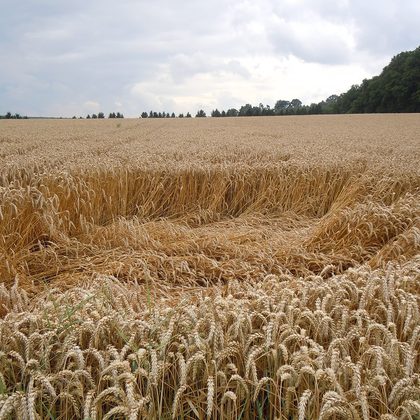
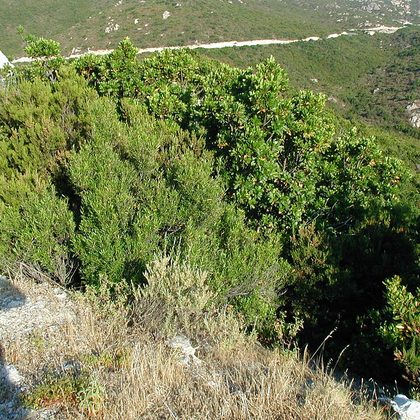
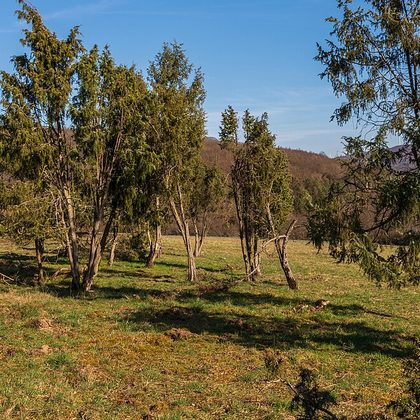
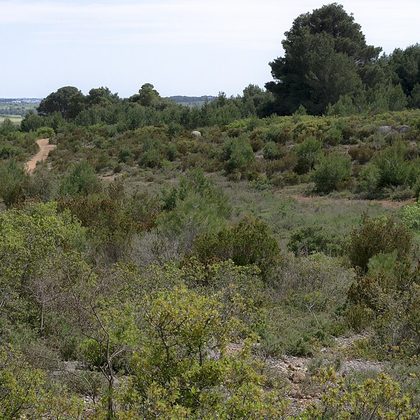
Warm, dry, sandy soils under low but dense cover. Originally the dwarf palm scrub and open coastal maquis of the Moroccan coastal plain, but since the 1990s that has been almost wholly turned over to farmland, and the last birds live in cereal, lucerne, fallow and stubble, in the field margins and unploughed patches between them. The bird walks away rather than flies, so it needs continuous cover at ground level.
Where the bird is most at home, classified with EUNIS — the European standard for habitats.
Range and movements
As a species it is widespread from sub-Saharan Africa to India, South-East Asia and southern China. Inside the map area only the nominate form counts, once found from Portugal and southern Spain through Sicily to Libya, Tunisia, Algeria and Morocco. One site is left: a strip of intensively farmed coastal land in the Doukkala between Sidi Abed and Oualidia, north of El Jadida, under fifty square kilometres all told. Every recent record comes from there.
- Breeding (summer)
- Migration direction
- dark = core range, pale = thinly spread
Where and when to look
Honestly, do not count on it. This is among the hardest birds in the map area, and what remains sits on private farmland where wandering about is not a given. If you try, take a field track in the Doukkala at first light in April or May and listen for an hour without entering the crops; the female's lowing is the only realistic clue. Report anything you hear to a Moroccan bird group, because for this bird every record counts.
Conservation status
Two stories part company here. As a species the common buttonquail is widespread across Africa and Asia and is not globally threatened, and that is the category in the panel alongside. The North African and European nominate form, by contrast, is close to collapse. It has gone from Portugal, Sicily and Spain, and Spain formally declared it extinct in the wild in 2018. In Morocco it went unrecorded for twelve years after 1988 and was refound only in 2000. Counts in the one remaining area gave 1,890 birds in 2011, 492 in 2014 and 596 in 2017, including about 117 breeding females; over those same years the share of suitable farmland fell from 63 to 38 per cent, mainly through deeper and more frequent ploughing. It is among the most threatened birds in this guide, and whether it is still there is asked afresh every year.