All species › Passerines › Tits › Crested tit
Crested tit
Lophophanes cristatus | Kuifmees | Herrerillo capuchino
The Crested Tit is the only European tit with a true crest, and so the only one you never have to identify. It is also as sedentary as songbirds get: find one in March and you know where to look for it in December.

Voice
The characteristic sound is a low, rolling purr, gurrrl-gurrrl, heard far more often than the bird is seen and easy to home in on through a spruce plantation. Alongside it come thin high contact notes, see-see-see, that run straight into the trill. There is virtually no true song; the trill serves as the territorial call. Heard all year, most from February to April and again as flocks form in late summer.
Recording: Alexander Kurthy — CC BY-SA 4.0 · Wikimedia Commons
Identification
A small, short-tailed tit with a pointed crest speckled black and white, held erect even at rest. The head pattern is the real calling card: a white cheek crossed by a black sickle that curves down behind the eye and joins a black collar, plus a small black bib under the chin. Mantle and wings are plain grey-brown with no wing bar, the underparts off-white with a buff wash on the flanks. The sexes look alike; juveniles have a shorter, duller crest.
Confusion species
No other European tit has a crest, so confusion is really about silhouettes against the light, or about voice. Coal Tit shares the same conifer wood and is just as small, but has a black head with a white nape patch and two white wing bars. Blue Tit and Bearded Reedling come into it on size alone, but lack the crest and collar entirely. On a bird half-hidden high in a pine, the speckled crest against the sky is all you need.
Habitat
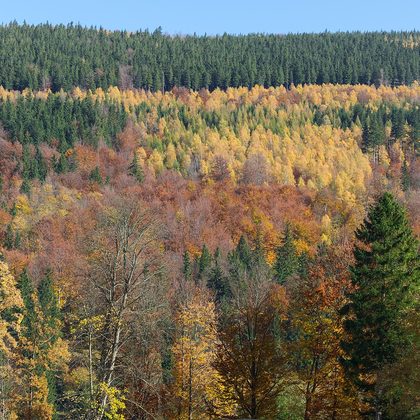
Conifer forest, above all old Scots pine and spruce with standing dead wood, plus mixed woodland with a strong conifer element. In southern Europe also montane pine, and even cork oak and beech. Excavates its own nest hole in soft, rotting wood in dead trunks and stumps, usually low down; it seldom uses nest boxes. Stores seeds and insects in autumn, tucked among bark and needles.
Where the bird is most at home, classified with EUNIS — the European standard for habitats.

Range and movements
From central Scandinavia to the Mediterranean, with a western limit in Britain where it occurs only in the Scottish pine forests. In the Netherlands a scarce to fairly common resident of the Veluwe, Drenthe, North Brabant and the dunes; away from those woods it is rarely seen, since it hardly moves at all. In Spain, by contrast, it is widespread and common in pine forest from the lowlands to high in the Pyrenees, the Sierra de Guadarrama and the Sierra Nevada.
- Resident
- Breeding (summer)
- Winter
- Passage
- dark = core range, pale = thinly spread
Where and when to look
Look for it in old Scots pine, because that is where it is and nowhere else. Walk slowly in February or March and listen for the rolling gurrrl; stop the moment you hear it and search the upper half of the pines. In winter it travels in mixed flocks with Coal Tit, Goldcrest and Treecreeper: meet such a flock and every conifer specialist is on your list within five minutes.
Conservation status
Not threatened and broadly stable in Europe. In the Netherlands it has increased slightly as conifer stands have aged and timber extraction eased, but it remains strictly tied to woods with enough standing dead wood. Large-scale conversion of pine plantation to broadleaved woodland works against it locally.